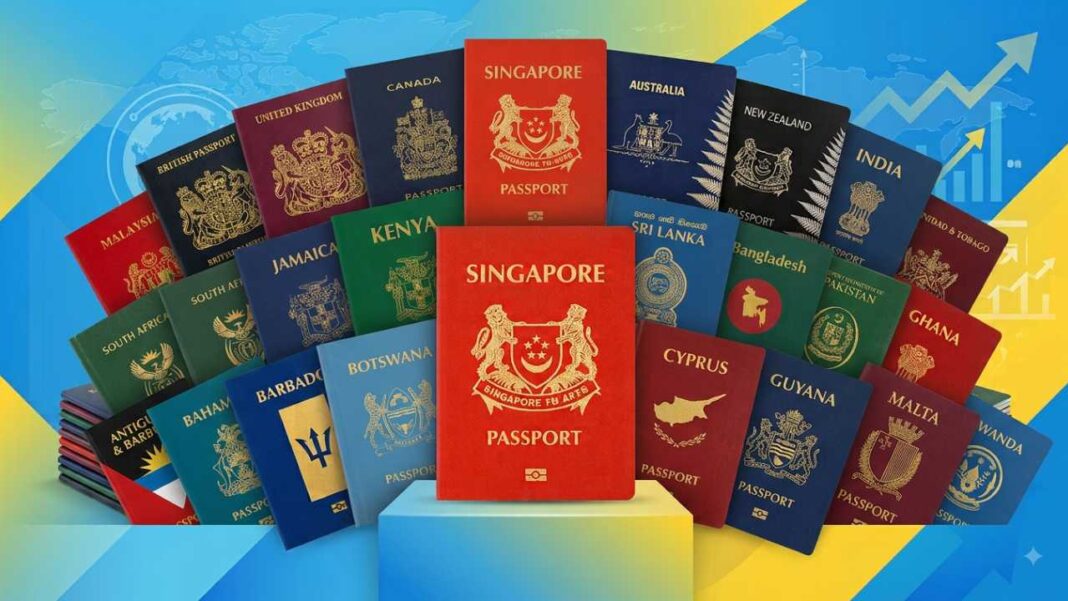

UK (Commonwealth Union)_ The 2026 Henley Passport Index provides a fresh picture of global travel freedom, with Singapore continuing to hold the world’s strongest passport. Accordingly, its citizens can enter 192 destinations without securing a visa before departure. Japan, South Korea and the United Arab Emirates follow closely, while European countries continue to occupy many of the highest positions. The ranking measures passports by the number of destinations their holders can visit without obtaining a visa in advance. It also shows a sharp difference in global mobility.
Afghanistan remains at the bottom, with access to only 22 destinations. That leaves a 170-destination gap between the strongest and weakest passports. For Commonwealth countries, the results are mixed. Singapore leads the group by a wide margin, followed by Malta, the United Kingdom, Australia, Canada and Malaysia. At the other end, Pakistan, Bangladesh and Sri Lanka have the weakest Commonwealth passports. Diplomatic relations, economic strength, political stability, regional cooperation and visa agreements all play a role in determining passport performance.
Top 20 strongest passports
The United Arab Emirates recorded one of the biggest gains in the latest ranking, moving three places to join second with Japan and South Korea, with access to 188 destinations. Sweden follows in third with 187 destinations. A large group of European countries share fourth place with access to 186 destinations. Austria, Greece, Malta, Portugal and Switzerland are jointly fifth with 185 destinations. Hungary, Poland and the United Kingdom follow in sixth. Australia, Canada, Malaysia and New Zealand are among the countries sharing seventh place. The United States remains 10th with access to 180 destinations. The UAE’s long-term rise remains one of the most notable developments in passport rankings. Over two decades, it has climbed 60 places and gained access to 153 additional destinations. Its progress reflects stronger international relationships and growing diplomatic and economic influence.
- Singapore – Rank 1 – 192 visa-free destinations
- Japan – Rank 2 – 188 destinations
- South Korea – Rank 2 – 188 destinations
- United Arab Emirates – Rank 2 – 188 destinations
- Sweden – Rank 3 – 187 destinations
- Belgium – Rank 4 – 186 destinations
- Denmark – Rank 4 – 186 destinations
- Finland – Rank 4 – 186 destinations
- France – Rank 4 – 186 destinations
- Germany – Rank 4 – 186 destinations
- Ireland – Rank 4 – 186 destinations
- Italy – Rank 4 – 186 destinations
- Luxembourg-Rank 4 – 186 destinations
- Netherlands – Rank 4 – 186 destinations
- Norway – Rank 4 – 186 destinations
- Spain – Rank 4 – 186 destinations
- Austria – Rank 5 – 185 destinations
- Greece – Rank 5 – 185 destinations
- Malta – Rank 5 – 185 destinations
- Portugal – Rank 5 – 185 destinations
Top 20 weakest passports
At the bottom of the index, Afghanistan remains in last place, with access to just 22 destinations. Syria, Iraq, Pakistan and Yemen are also among the weakest passports. The low positions of these countries reflect years of political instability, conflict, security concerns and limited diplomatic and visa arrangements. Such conditions can make other governments more cautious about granting visa-free access.
- Turkmenistan – Rank 90 – 44 destinations
- Myanmar – Rank 91 – 43 destinations
- Ethiopia – Rank 92 – 42 destinations
- Lebanon – Rank 93 – 41 destinations
- South Sudan – Rank 93 – 41 destinations
- Sudan – Rank 93 – 41 destinations
- Libya – Rank 94 – 39 destinations
- Sri Lanka – Rank 94 – 39 destinations
- Eritrea – Rank 95 – 38 destinations
- Iran – Rank 96 – 37 destinations
- Palestinian Territory – Rank 96 – 37 destinations
- Bangladesh – Rank 97 – 35 destinations
- North Korea – Rank 97 – 35 destinations
- Nepal – Rank 98 – 34 destinations
- Somalia – Rank 99 – 32 destinations
- Yemen – Rank 100 – 30 destinations
- Pakistan – Rank 101 – 29 destinations
- Iraq – Rank 102 – 28 destinations
- Syria – Rank 103 – 25 destinations
- Afghanistan – Rank 104 – 22 destinations
Also read: One chair, three titans, a big race: The final battle for Tata’s top chair heats up! Who will win?
Singapore passport on top – The Commonwealth nation leads the race
Singapore has retained first place in the latest ranking, with access to 192 destinations without a prior visa. Its continued position highlights the country’s strong diplomatic network, economic links and international reputation. Singapore’s passport strength is also closely associated with its wider global standing. The country is a major financial, commercial and transport hub, maintaining extensive connections with countries across Asia and beyond. Strong diplomatic engagement and reciprocal visa arrangements have helped reinforce that position.
The country’s performance has improved considerably over the long term. Two decades ago, Singapore ranked eighth in the index. Its rise to first place shows how sustained international engagement can translate into greater travel freedom. The relationship between peace and passport strength is also significant. The Commonwealth nation ranks high on global peace measures as well as on passport power. However, peace alone does not determine a passport’s position. Economic influence, diplomatic relationships, regional integration and trust between governments can be equally important.
Commonwealth passports ranked from strongest to weakest
Among the 56 Commonwealth nations, Singapore has the strongest passport, followed by Malta and the United Kingdom. Australia, Canada, Malaysia and New Zealand also perform strongly. At the lower end, Pakistan ranks last among the Commonwealth countries listed, preceded by Bangladesh and Sri Lanka.
- Singapore – Rank 1 – 192 destinations
- Malta – Rank 5 – 185 destinations
- United Kingdom – Rank 6 – 184 destinations
- Australia – Rank 7 – 183 destinations
- Canada – Rank 7 – 183 destinations
- Malaysia – Rank 7 – 183 destinations
- New Zealand – Rank 7 – 183 destinations
- Cyprus – Rank 13 – 175 destinations
- Barbados – Rank 19 – 163 destinations
- Brunei – Rank 19 – 163 destinations
- The Bahamas – Rank 20 – 158 destinations
- St. Kitts and Nevis – Rank 21 – 157 destinations
- St. Vincent and the Grenadines – Rank 21 – 157 destinations
- Seychelles – Rank 23 – 155 destinations
- Antigua and Barbuda – Rank 24 – 154 destinations
- Grenada – Rank 26 – 148 destinations
- Mauritius – Rank 26 – 148 destinations
- Dominica – Rank 29 – 144 destinations
- Trinidad and Tobago – Rank 29 – 144 destinations
- St. Lucia – Rank 30 – 143 destinations
- Solomon Islands – Rank 35 – 133 destinations
- Samoa – Rank 40 – 128 destinations
- Tonga – Rank 41 – 127 destinations
- Tuvalu – Rank 42 – 124 destinations
- Kiribati – Rank 44 – 121 destinations
- South Africa – Rank 49 – 101 destinations
- Belize – Rank 50 – 100 destinations
- Maldives – Rank 52 – 93 destinations
- Guyana – Rank 55 – 88 destinations
- Fiji – Rank 56 – 87 destinations
- Vanuatu – Rank 57 – 86 destinations
- Jamaica – Rank 59 – 84 destinations
- Nauru – Rank 59 – 84 destinations
- Papua New Guinea – Rank 59 – 84 destinations
- Botswana – Rank 61 – 81 destinations
- Namibia – Rank 65 – 74 destinations
- Lesotho – Rank 66 – 73 destinations
- eSwatini – Rank 67 – 71 destinations
- Kenya – Rank 68 – 70 destinations
- Malawi – Rank 68 – 70 destinations
- Rwanda – Rank 69 – 68 destinations
- Tanzania – Rank 69 – 68 destinations
- The Gambia – Rank 69 – 68 destinations
- Ghana – Rank 70 – 67 destinations
- Uganda – Rank 72 – 65 destinations
- Zambia – Rank 73 – 64 destinations
- Sierra Leone – Rank 74 – 63 destinations
- Mozambique – Rank 76 – 60 destinations
- Togo – Rank 79 – 57 destinations
- Gabon – Rank 80 – 56 destinations
- India – Rank 81 – 55 destinations
- Cameroon – Rank 87 – 48 destinations
- Nigeria – Rank 90 – 44 destinations
- Sri Lanka – Rank 94 – 39 destinations
- Bangladesh – Rank 97 – 35 destinations
- Pakistan – Rank 101 – 29 destinations
Also read: Belgium PM’s India visit: A new chapter for India-EU ties. The EU angle explained!
Regionwise ranking
The Commonwealth results show a clear regional divide. European and several Asian members enjoy considerably greater mobility, while many African and smaller Pacific states occupy middle or lower positions.
Asia
Singapore is by far the strongest Commonwealth passport in Asia, while Malaysia and Brunei also perform well. India sits much lower, followed by Sri Lanka, Bangladesh and Pakistan. The differences reflect varying levels of economic development, diplomatic reach, regional integration and reciprocal visa arrangements.
- Singapore – Rank 1 – 192 destinations
- Malaysia – Rank 7 – 183 destinations
- Brunei – Rank 19 – 163 destinations
- Maldives – Rank 52 – 93 destinations
- India – Rank 81 – 55 destinations
- Sri Lanka – Rank 94 – 39 destinations
- Bangladesh – Rank 97 – 35 destinations
- Pakistan – Rank 101 – 29 destinations
Europe
The European Commonwealth members perform particularly strongly. Malta ranks fifth globally, the United Kingdom sixth and Cyprus 13th. Their strong positions reflect deep regional connections, established diplomatic networks and broad visa arrangements.
- Malta – Rank 5 – 185 destinations
- United Kingdom – Rank 6 – 184 destinations
- Cyprus – Rank 13 – 175 destinations
Pacific
Australia and New Zealand remain among the strongest passports in the Pacific and rank inside the global top 10. Several smaller island nations also perform reasonably well, although their access is considerably below that of Australia and New Zealand.
- Australia – Rank 7 – 183 destinations
- New Zealand – Rank 7 – 183 destinations
- Solomon Islands – Rank 35 – 133 destinations
- Samoa – Rank 40 – 128 destinations
- Tonga – Rank 41 – 127 destinations
- Tuvalu – Rank 42 – 124 destinations
- Kiribati – Rank 44 – 121 destinations
- Fiji – Rank 56 – 87 destinations
- Vanuatu – Rank 57 – 86 destinations
- Nauru – Rank 59 – 84 destinations
- Papua New Guinea – Rank 59 – 84 destinations
Caribbean
The Caribbean Commonwealth countries show generally strong results. Canada ranks seventh globally, while Barbados and The Bahamas also sit inside the global top 20. Several other island states remain within the top 30, giving the region one of the strongest overall Commonwealth performances.
- Canada – Rank 7 – 183 destinations
- Barbados – Rank 19 – 163 destinations
- The Bahamas – Rank 20 – 158 destinations
- St. Kitts and Nevis – Rank 21 – 157 destinations
- St. Vincent and the Grenadines – Rank 21 – 157 destinations
- Antigua and Barbuda – Rank 24 – 154 destinations
- Grenada – Rank 26 – 148 destinations
- Dominica – Rank 29 – 144 destinations
- Trinidad and Tobago – Rank 29 – 144 destinations
- St. Lucia – Rank 30 – 143 destinations
- Belize – Rank 50 – 100 destinations
- Guyana – Rank 55 – 88 destinations
- Jamaica – Rank 59 – 84 destinations
Africa
African Commonwealth passports show a wider range of results. Seychelles and Mauritius are the clear leaders, both ranking inside the global top 30. South Africa follows at 49th, while most other African members rank below 60th. Economic conditions, diplomatic reach, regional instability and limited visa agreements can all affect mobility. Despite their natural resources and economic potential, many African countries still have relatively limited international travel access.
- Seychelles – Rank 23 – 155 destinations
- Mauritius – Rank 26 – 148 destinations
- South Africa – Rank 49 – 101 destinations
- Botswana – Rank 61 – 81 destinations
- Namibia – Rank 65 – 74 destinations
- Lesotho – Rank 66 – 73 destinations
- eSwatini – Rank 67 – 71 destinations
- Kenya – Rank 68 – 70 destinations
- Malawi – Rank 68 – 70 destinations
- Rwanda – Rank 69 – 68 destinations
- Tanzania – Rank 69 – 68 destinations
- The Gambia – Rank 69 – 68 destinations
- Ghana – Rank 70 – 67 destinations
- Uganda – Rank 72 – 65 destinations
- Zambia – Rank 73 – 64 destinations
- Sierra Leone – Rank 74 – 63 destinations
- Mozambique – Rank 76 – 60 destinations
- Togo – Rank 79 – 57 destinations
- Gabon – Rank 80 – 56 destinations
- Cameroon – Rank 87 – 48 destinations
- Nigeria – Rank 90 – 44 destinations
Also read: Meet the world’s highest-paid leader who earns more than Trump: Check out his new pay!
How the peace index influence the passport strength?
The 2026 results also point to a relationship between peacefulness and passport strength. Countries that enjoy greater stability often have stronger international relationships, which can support wider visa-free access. Singapore is a notable example, ranking eighth on the Global Peace Index while holding first place on the passport ranking. Japan, Switzerland, Ireland, Austria, Portugal, Finland, Denmark, New Zealand, Canada, Czechia and Malaysia also perform strongly across both measures. The opposite pattern can be seen in Afghanistan, Syria and Yemen, where conflict and instability coincide with some of the weakest passports. However, the relationship is not absolute. Several countries, including the United States, South Korea, Israel, Ukraine and Russia, demonstrate that geopolitical influence and diplomatic relationships can produce stronger passport access even when peace rankings are less favourable.
What do the overall results say?
The 2026 passport rankings show that travel freedom remains closely linked to a country’s international relationships, economic position and political stability. For Commonwealth nations, the gap is especially visible. Singapore stands at the global summit, while Malta, the UK, Australia, Canada and New Zealand remain among the strongest performers. At the other end, Pakistan, Bangladesh and Sri Lanka face much more limited mobility. The differences underline how nationality can shape access to international opportunities, from tourism and education to business and family travel.
The Henley Passport Index measures 199 passports according to the number of destinations their holders can enter without obtaining a visa in advance. Over the past two decades, average global travel access has increased substantially. Yet the gap between the strongest and weakest passports remains considerable. For the Commonwealth, the 2026 results therefore present a mixed picture: strong performance from its most internationally connected members, solid results across much of Europe and the Caribbean, and more limited mobility across several African, Asian and Pacific members. The rankings ultimately show that passport power is not simply about geography. It reflects how countries are viewed, connected and engaged in the wider international system.