
Consumer confidence hit its lowest level in the past 30 months since October ’23. This is with surveys reflecting cost pressures firms may be experiencing.
Economists say that UK inflation is on track to rise sharply due to the war in Iran. Analysts predict that it may compel the Bank of England (BoE) to increase interest rates.
Confidence in the UK economy has declined sharply amid the mounting economic fallout from the war in Iran, as reflected in surveys. This is as businesses prepare to increase their prices while consumers brace for a fresh cost of living shock.
It’s a knock-on effect of the Middle East crisis in Britain. Several closely watched surveys of business activities & consumer confidence blamed the US-Israeli war on Iran for the significant deterioration in the April ’26 outlook.
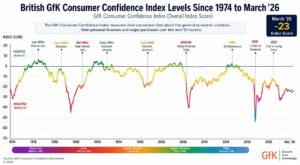
The most recent barometer from the data firm GfK reflected UK consumer confidence slid during April ’26 to its lowest level since 30 months back, in October ’23. Meanwhile, three separate business surveys revealed that enterprises experienced an increase in cost pressures. This is in addition to an expectation that these enterprises may increase their prices over the coming months.
Consumer insights director at GfK, Neil Bellamy, said that soaring fuel prices, besides the prospect of higher energy costs, were a constant reminder to consumers of the inflationary shock from the war.
Bellamy added that consumers are currently experiencing heightened anxiety.
The reading on GfK’s consumer confidence index, which has been used to gauge sentiments for over 5 decades since 1974, reflected a decline by 4 points to -25.
Bellamy added that the Gulf crisis is intensifying pressures. Much of the present strain reflects earlier domestic cost increases. How long can all this disruption & pain last?
A sign of inflationary pressures building in Britain as the war rattles energy markets, disrupting global supply chains. The closely monitored S&P Global purchasing managers’ index reflected that UK service sector enterprises were hit with the largest jump in costs during the last 3 decades since 1996. This was between March & April ’26.