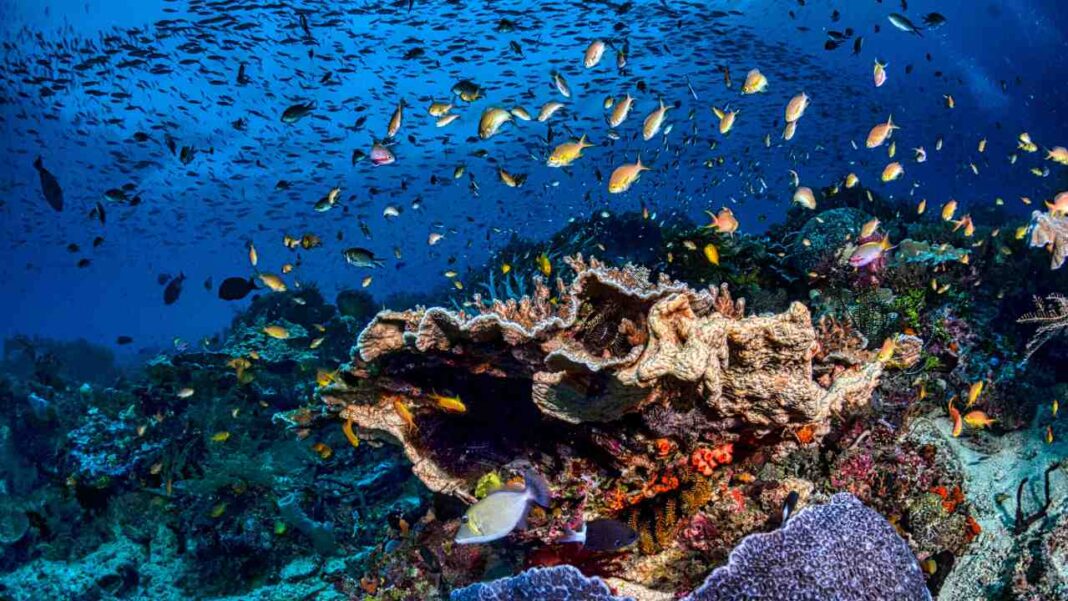

Coral reefs are often considered one of the clearest signs of climate change. Rising ocean temperatures and increasing acidity are damaging reefs around the world. Many people believe all corals react in the same way. However, a new international study shows that the story is far more complicated.
Scientists have discovered that one of coral’s greatest survival tools has not always been an advantage. Instead, its value has changed many times over millions of years, depending on Earth’s environment.
The research was carried out by experts from the University of Bristol in the United Kingdom, the China University of Geosciences in Wuhan, and Friedrich-Alexander University Erlangen-Nuremberg in Germany. Their findings were published in the journal Proceedings of the National Academy of Sciences (PNAS).
The team studied nearly 500 million years of coral history. They wanted to understand how corals survived huge environmental changes, including mass extinctions and periods of extreme climate.
Today, there are around 6,000 known coral species. About half of them depend on sunlight to survive. These corals live in shallow water and form a partnership with tiny algae. The algae live inside the coral and produce food through photosynthesis. In return, the coral provides the algae with shelter and nutrients.
Scientists call these symbiotic corals because they rely on this close relationship. The other half of coral species do not depend on algae. These corals usually live in deeper and darker parts of the ocean where sunlight is limited. They survive by capturing tiny food particles from the water instead of receiving energy from algae. These are known as non-symbiotic corals.
To compare both groups, the researchers examined a substantial collection of fossil records from different periods of Earth’s history. They also used artificial intelligence and advanced computer models to identify long-term patterns in coral evolution. Their results challenged a long-held belief.
During the Paleozoic Era, which lasted hundreds of millions of years, non-symbiotic corals were generally more successful than corals that depended on algae. They survived better and spread more widely.
When the Late Devonian mass extinction occurred, many coral species disappeared. The corals that relied on algae struggled badly and failed to recover as successfully as scientists had expected. Both groups also faced serious threats from warming oceans and low oxygen levels during this ancient period.
Everything changed much later. Around the Triassic Period, a new group called scleractinian corals appeared. These are the hard corals that build most modern coral reefs today. From that point onwards, the partnership between coral and algae became much more valuable. Corals with algae began producing many more new species than before. The researchers say this finding does not mean the coral-algae relationship suddenly became better on its own. Instead, Earth’s changing environment made this partnership more useful than it had been in the past.
The study also found another important difference between the two coral groups. The success of symbiotic corals mainly came from creating new species over time. Unlike corals that live with algae, non-symbiotic corals survived by avoiding extinction instead of quickly evolving into new species.
Researchers also studied how these corals respond to rising ocean temperatures today. Most algae-dependent corals live in shallow waters, where temperatures change faster. When the water gets too warm, they become stressed and expel the algae living inside them. This is known as coral bleaching.
Without the algae, corals lose both their main food source and their bright colours. If the heat continues for too long, many of them die.
Non-symbiotic corals usually live in deeper, cooler waters, making them less affected by short-term heatwaves. However, scientists warn they are not completely safe. As oceans continue to warm, these corals may also need to move to cooler areas to survive.
The researchers say these findings could help improve coral conservation. Instead of using the same plan for every coral species, scientists say each group may need its own protection strategy. By learning how corals survived past climate changes, researchers can identify the species most at risk and better protect marine life in the future.