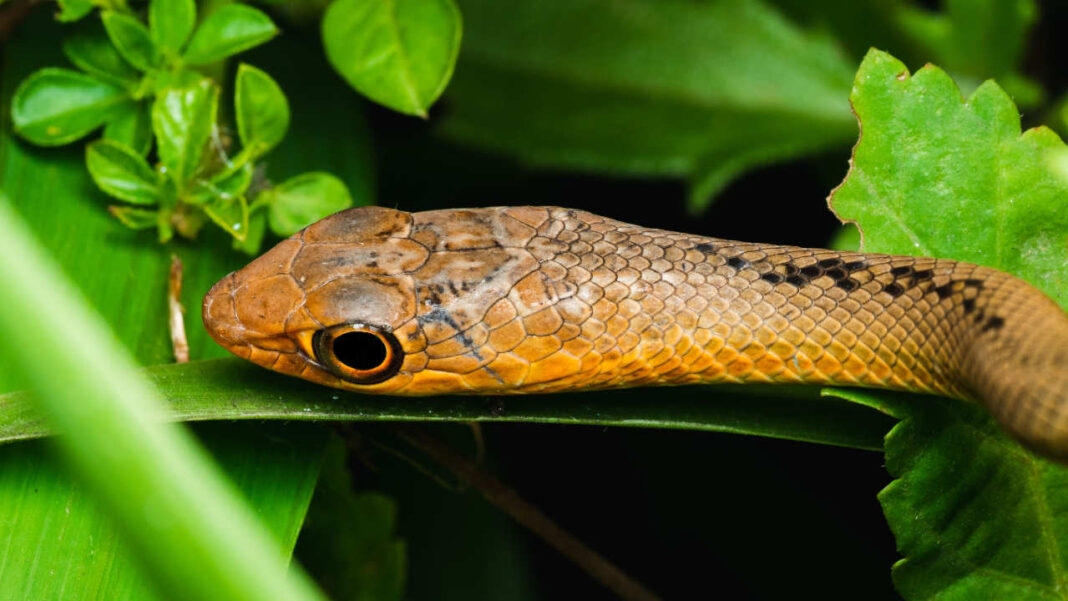
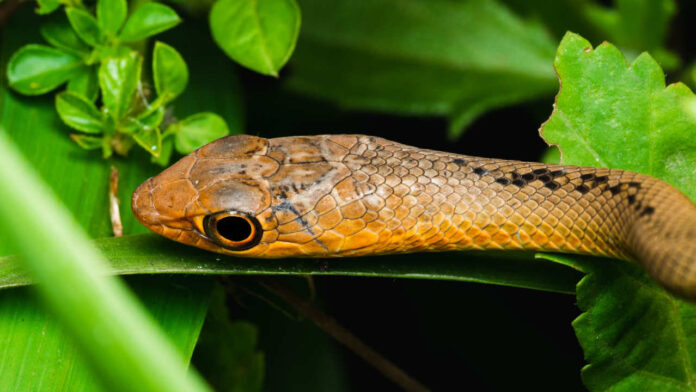

The brown tree snake is one of the most notorious invasive species that biologists study today. This snake is originally from Australia and nearby Pacific islands. It somehow reached Guam after World War II, likely hiding in cargo planes. Since then, it has wiped out most of the island’s native forest birds. It also causes hundreds of power outages every year by climbing onto electrical poles. In some parts of Guam, there are now as many as 30,000 snakes per square mile.
This phenomenon has puzzled scientists for years. Only a few snakes arrived on Guam originally. With such a small starting group, inbreeding should have been a major problem. Low genetic diversity usually makes it harder for a species to adapt and spread. Yet the snakes did the opposite. They thrived.
A new study, led by researchers at the University at Buffalo, may finally explain why. The findings appeared in Science Advances on July 24. Working with the U.S. Geological Survey, the team used a newer method called long-read DNA sequencing. This technique let them examine large stretches of the snake genome in detail. They found more than 19,000 structural variants. These are places where DNA has been duplicated, deleted, or rearranged.
This kind of hidden diversity had gone unnoticed before. And it wasn’t spread evenly across the genome. Instead, it clustered in genes tied to two things: the immune system and the sense of smell.
“The brown tree snake isn’t hugely diverse overall,” said Trevor Krabbenhoft, the study’s lead researcher and a biology professor at UB. “But it has real sources of genetic variation that we hadn’t given enough credit to.”
Reading DNA in a New Way
For decades, scientists studied genetic diversity by looking at single letters in the DNA code. They checked whether one letter, like an A, had changed to another, like a G. That was the limit of older sequencing tools.
Long-read sequencing works differently. It captures much bigger chunks of DNA at once. This reveals structural changes that affect 50 or more DNA letters at a time. According to the study, these larger structural changes actually influence far more of the genome than small letter swaps do—about eight times more.
Levi Gray, a postdoctoral researcher on the team, compared it to reading a book. “Old methods were like scanning pages letter by letter with a magnifying glass,” he said. “You’d miss it if whole paragraphs had been shifted or copied elsewhere. The tools we use shape what we’re able to see.”
Gray had studied Guam’s snake problem before, while working at the USGS. That connection helped the team get snake DNA samples from the agency’s Brown Tree Snake Rapid Response Team, a group focused on stopping the snake from spreading further.
A Clue in Their Sense of Smell
The genetic variants tied to smell may explain a strange pattern. In their native range, brown tree snakes sometimes eat other snakes. But on Guam, that behavior is rare. Researchers think the snakes’ sharpened sense of smell might let them recognize each other as relatives, not food. This behavior makes sense given how inbred Guam’s population is.
It’s still unclear when these genetic changes appeared. Did they build up before the snakes reached Guam? Or did the harsh bottleneck of a tiny founding population somehow speed up new mutations? Gray says both are possible. Answering the question would require sequencing snakes from their original home range.
The results have implications that extend beyond Guam. If inbred species can hide surprising genetic flexibility, that could be beneficial news for endangered animals with small, shrinking populations. It suggests some may adapt better than their limited numbers would predict.