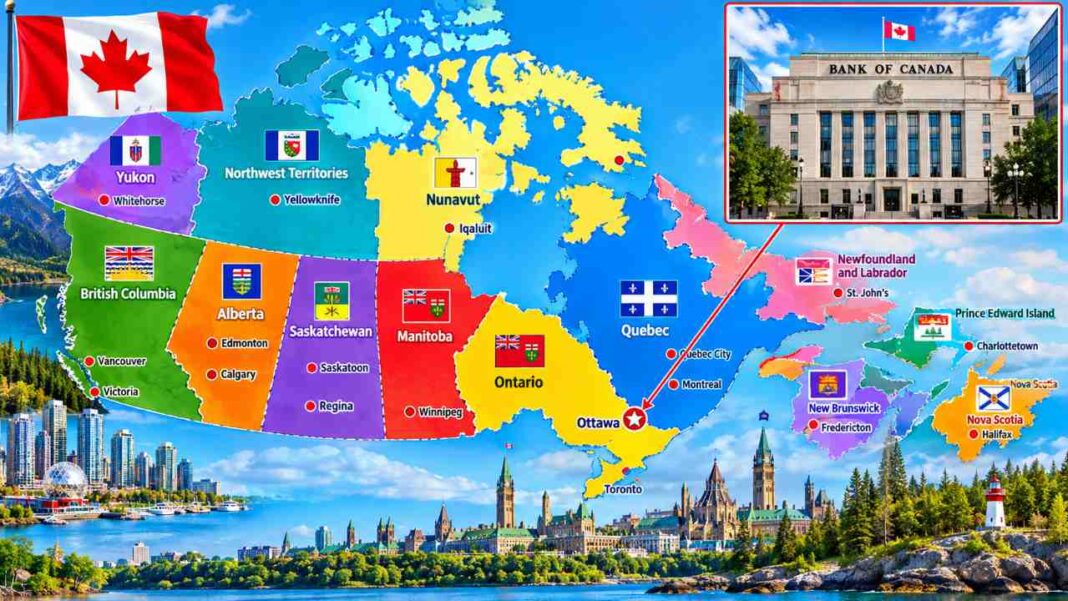

Financial markets are increasingly preparing for a likelihood that the Bank of Canada (BoC) may increase its policy interest rate before the end of the year. This may mark a notable change in expectations after months of steady borrowing costs.
The shift follows growing concern that inflation may prove more persistent than previously anticipated. The BoC has kept its overnight policy rate at 2.25%, including at its Wednesday, 2 September meeting, when policymakers opted for a seventh consecutive hold. Market-based indicators have since moved towards a potential tightening of monetary policy.
The central bank’s concern centres partly on inflation. Canadian consumer-price inflation has remained around 3%, above the Bank’s 2% target. At its September meeting, however, policymakers noted that inflation excluding gasoline was considerably lower and that core inflation measures remained close to 2%.
Energy markets have transformed to become an important source of uncertainty. Continued disruption linked to the conflict in the Middle East has kept oil and refined-energy prices elevated, raising concerns that prolonged increases in gasoline and diesel costs may eventually spread into other areas of households besides business spending.
Bank officials have said there is little evidence so far of widespread spillover from higher energy prices. But the September deliberations indicated that the longer elevated fuel costs persist, the greater the possibility that businesses may pass higher expenses through to consumers.
Trade tensions are adding another complication. New US tariffs and Canadian counter-measures have increased uncertainty for exporters, businesses and workers. Bank Governor Tiff Macklem has also warned that renewed trade difficulties may weaken Canadian growth, potentially offsetting some of the inflationary pressure created by higher energy costs.
That creates a challenging policy balance for the central bank. A rate increase may help contain inflation expectations if price pressures broaden, while tighter monetary conditions may also weigh on demand at a time when trade uncertainty is already challenging businesses.
The next major test may come on 28 October, when the Bank is scheduled to announce its interest-rate decision alongside its next Monetary Policy Report.
For households, borrowers and businesses, the changing market outlook means the assumption that Canadian interest rates may remain unchanged through the rest of 2026 is no longer as firmly established as it was earlier in the year. Much will depend on incoming inflation, employment, energy-price and economic-growth data before policymakers make their next decisions.