The ASEAN Summit 2025: Game-changing moves at ASEAN 2025 in Malaysia!

- Advertisement -

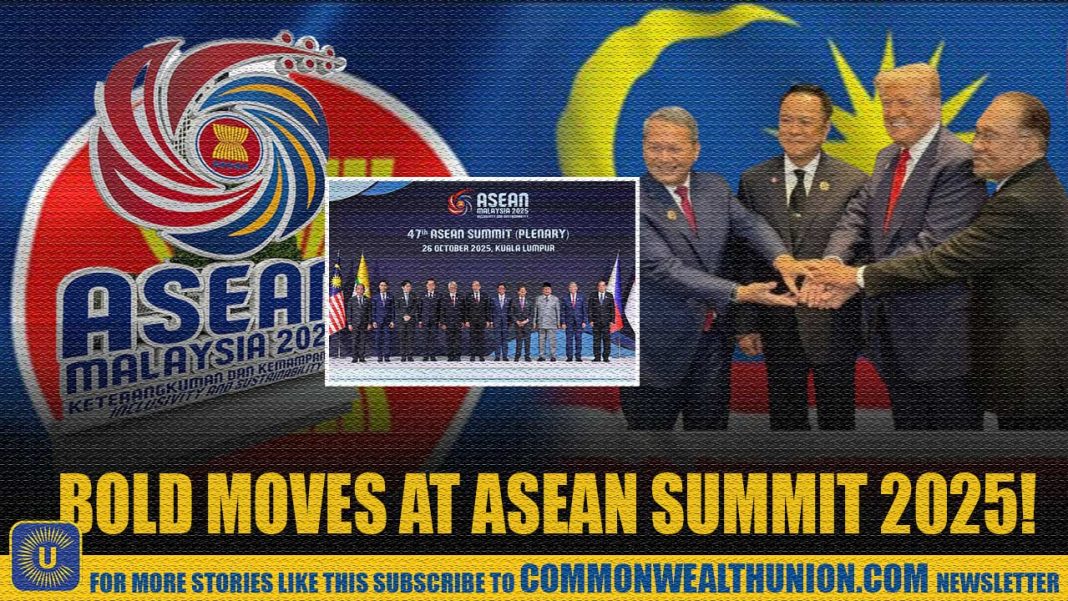
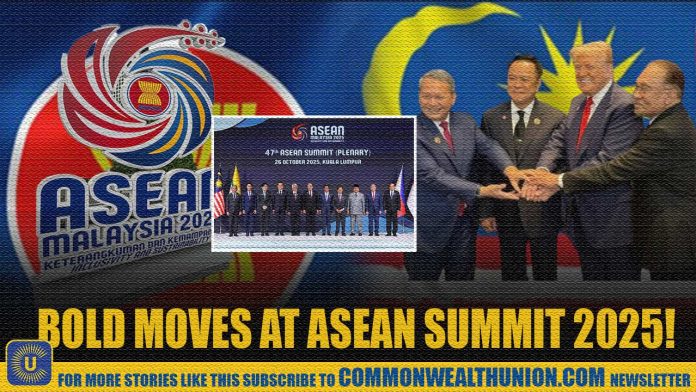
Malaysia (Commonwealth Union)_ Malaysia took center stage, hosting the 47th session of the Association of Southeast Asian Nations (ASEAN) Summit in Kuala Lumpur from October 26 to 28, 2025. The three-day summit brought together leaders from Southeast Asia and beyond to discuss urgent topics like trade, regional security, and the global crisis. Under the theme “Inclusivity and Sustainability,” the host country pledged to drive meaningful action on behalf of all. Malaysia’s Prime Minister, Anwar Ibrahim, welcomed heads of state and government from ASEAN member countries as well as significant worldwide partners. The summit provided a forum for high-level debate and multilateral collaboration, demonstrating Malaysia’s desire to play a leading role in regional affairs.


Also read:  Historic first: India watches as Kerala becomes the first state to end extreme poverty!


World Leaders in Attendance


The summit saw a broad and influential array of participants. From the United States, Donald Trump attended the ASEAN leaders’ dinner and used the occasion to emphasize America’s commitment to the region. China, though represented not by its president but by Premier Li Qiang, joined the gathering through its leadership in Kuala Lumpur. Other global leaders included Australia’s Anthony Albanese, Canada’s Mark Carney, and New Zealand’s Christopher Luxon. From the ASEAN bloc itself, the roster included Brunei’s Sultan Hassanal Bolkiah; Indonesia’s President Prabowo Subianto; Singapore’s Prime Minister Lawrence Wong; Cambodia’s Prime Minister Hun Manet; Vietnam’s Prime Minister Pham Minh Chính; the Philippines’ President Ferdinand Marcos Jr.; Laos’ Prime Minister Sonexay Siphandone; Thailand’s Prime Minister Anutin Charnvirakul; and Timor-Leste’s President José Ramos‑Horta. The presence of several leaders underscored the importance attached to this year’s gathering, not only for Southeast Asia but also for the wider global order.


The Kuala Lumpur Declaration


At the heart of this year’s summit was the adoption of the “Kuala Lumpur Declaration.” This statement reaffirmed member countries’ shared dedication to a sequence of earlier foundational accords: the 2005 Kuala Lumpur Declaration on the East Asia Summit, the 2010 Hanoi Declaration, the 2015 Kuala Lumpur Declaration, and the 2020 Hanoi Declaration. The statement stated that the region is currently experiencing a complex combination of geopolitical conflict, economic fragility, security risks, and cross-border issues. It argued that these difficulties cannot be handled in isolation but rather via collective effort and teamwork. It also reaffirmed its commitment to the purposes and principles of the United Nations Charter, the ASEAN Charter, and the Treaty of Amity and Cooperation in Southeast Asia, recognizing them as critical foundations for ongoing cooperation, mutual trust, and stability.


Also read:  A 150-year legacy: PM Modi honors India’s timeless national song – Vande Mataram!


Timor-Leste Included as ASEAN’s New Member


One of the most significant developments of the summit was the formal induction of Timor‑Leste as the 11th member of ASEAN, bringing the bloc’s tally to Brunei, Cambodia, Indonesia, Laos, Malaysia, Myanmar, the Philippines, Singapore, Thailand, Vietnam, and now Timor-Leste. The ceremony took place on 26 October and marked ASEAN’s first expansion since the 1990s, a step more than ten years in the planning. Timor-Leste’s Prime Minister Xanana Gusmão characterized the achievement as “a dream realized” for his country, citing the path of tenacity, commitment, and hope.  At the formal event, the Timor-Leste flag was raised alongside the other member states, symbolizing the beginning of a new chapter for both the country and the region.


PM Modi’s Speech


India’s Prime Minister Narendra Modi joined the summit virtually and addressed the delegates. He stressed that India and the ASEAN nations share not just geographic proximity but common values, interests, and goals, and he declared the 21st century to belong to this grouping. Modi extended his congratulations to Malaysia and Prime Minister Anwar Ibrahim for convening the summit and praised the theme of “inclusivity and sustainability” as reflective of their shared efforts in areas like digital inclusion, food security, and resilient supply chains. He also acknowledged that India and the ASEAN countries together account for over a quarter of the world’s population and that their common history, trade, and cultural links bind them together in a strong partnership. He complimented Philippine President Ferdinand Marcos Jr. for requesting India to serve as national coordinator, emphasizing New Delhi’s role as a reliable partner in the region.


Also read:  A taste of paradise: Sri Lanka joins the world’s culinary elite!


Dr S Jaishankar’s Bilateral Discussions


India’s External Affairs Minister Dr S Jaishankar used the sidelines of the summit to hold several bilateral talks with key global and regional counterparts. He met Malaysia’s Prime Minister Anwar Ibrahim and conveyed warm wishes for a successful summit while also discussing deepening bilateral cooperation and people-to-people links between India and Malaysia. He also held talks with Singapore’s Foreign Minister Vivian Balakrishnan, where the conversation ranged over global and regional trends as well as opportunities in India–Singapore relations. With Thailand’s Foreign Minister Sihasak Phuangketkeow, Dr Jaishankar reaffirmed both countries’ strategic partnership and looked ahead to enhanced collaboration. Additionally, with South Korea’s Foreign Minister Cho Hyun, Dr Jaishankar discussed cooperation in sectors like automotive, electronics, semiconductors, defence, and ship-building, appreciating the deepening special strategic partnership between the two countries. On the US front, the Indian minister met with Marco Rubio, United States Secretary of State, and reflected on not only India–US bilateral ties but also shared regional and global concerns.


US President Trump’s Engagement at the ASEAN Summit


At the event, President Donald Trump committed to resolving regional disputes quickly, citing the neighboring conflict between Afghanistan and Pakistan as an example. He stated on the sidelines of the summit that he expected to “get that solved very quickly.” He also addressed the broader Southeast Asian leaders, affirming the United States’ deep and long-term commitment to the region. “Our message to the nations of Southeast Asia is that the United States is with you 100%, and we intend to be a strong partner for many generations,” he said. In the context of the summit, he also attended the signing ceremony of a peace agreement between Thailand and Cambodia, indicating that the US is actively engaging with regional issues beyond its traditional focus.


Also read:  From crossfire to ceasefire: Inside the Pakistan and Afghanistan ceasefire agreement!


Historic Thailand–Cambodia Peace Deal


One of the summit’s landmark moments came when Thailand’s Prime Minister Anutin Charnvirakul and Cambodia’s Prime Minister Hun Manet signed a joint peace deal in the presence of President Trump. The Cambodian leader expressed deep gratitude to the US for backing a lasting peace process, emphasizing that disputes, however difficult, can be resolved by peaceful means. The Thai Prime Minister echoed this sentiment and proclaimed that the new treaty marks a fresh chapter in relations between the two countries. He also pledged that Thailand will begin the process of removing weapons and freeing prisoners of war as part of the agreement. Alongside the peace accord, President Trump signed a reciprocal trade pact with Cambodia and a critical minerals deal with Thailand after signing the peace deal.


US–China Trade Discussion


Another important event was the economic talks between China and the United States held on the summit’s margins. Chinese Vice-Premier He Lifeng met with US Treasury Secretary Scott Bessent and US Trade Representative Jamieson Greer to chart a path forward for Sino-US trade relations. In the wake of these talks, the US reportedly stepped back from a plan to impose a fresh 100% tariff on Chinese goods in response to Beijing’s expanded export controls on rare earth materials. From China’s side, Vice-Premier He described the essence of their economic relationship as rooted in mutual benefit and cooperation and warned of the risks of confrontation. The two sides agreed on a framework for a forthcoming trade deal, with President Trump expressing confidence that he would meet President Xi Jinping soon to finalize the agreement.


Handover of ASEAN Chairmanship to the Philippines


As the summit drew to a close, Malaysia formally handed over the ASEAN chairmanship to the Philippines, which will hold the position in 2026. Prime Minister Anwar Ibrahim symbolically passed the gavel to Philippine President Ferdinand Marcos Jr. in a ceremony marking the transition of leadership. During his closing remarks, Anwar reflected on the privilege of hosting the summit in Kuala Lumpur, describing the experience as deeply illuminating. “In today’s world, where constancy is a rare virtue,” he said, “we must be guided by reason, not ruled by the stirrings and frenzies of the moment. That must be ASEAN’s way if we are to endure.” With that, the baton now passes to the Philippines, and the region sets its sights on the next chapter of cooperation and dialogue.


Furthermore, the 47th ASEAN Summit has been a moment of significance, from formal declarations and new membership to major bilateral engagements and high-stakes diplomacy. The three-day event in Kuala Lumpur underscored the imperative of shared purpose, inclusion, and sustainability in an age marked by uncertainty. The region, together with its global partners, demonstrated a willingness to confront the complex challenges of our time and to reaffirm the promise of cooperation for the future.


Hot this week

Canadian environment groups sue Ottawa over projected missed emission targets

A group of climate advocates is suing the federal...

The Commonwealth’s Changing Guard: A First-Year Assessment of Shirley Botchewey and Patricia Scotland

The Commonwealth of Nations stands at a critical juncture. As the 56-member association navigates an era of fragmenting multilateralism, shifting economic gravity, and existential climate threats, the role of its Secretary-General has never been more consequential. On 1 April 2025, Shirley Ayorkor Botchewey of Ghana assumed the mantle of the Commonwealth's seventh Secretary-General, succeeding Patricia Scotland, who had served since 1 April 2016. With Botchewey now marking her first year in office and Scotland's tenure recently concluded, the moment invites a rigorous comparison: how does Botchewey's inaugural year measure against Scotland's, and what does this reveal about the evolving priorities of the Commonwealth itself?   The Scotland Era: Reform from Within   Patricia Scotland arrived at Marlborough House in April 2016 as a trailblazer—the first woman and the first Caribbean national to hold the post. Elected at the Malta Commonwealth Heads of Government Meeting (CHOGM) in November 2015 on an explicit reform agenda, Scotland's immediate mandate was to rejuvenate an institution widely perceived as bureaucratic and adrift. Her first year was defined by an almost surgical focus on internal restructuring.   Within months of taking office, Scotland launched a new outcomes-based Strategic Plan, the first of its kind to orient the Secretariat around measurable deliverables rather than diplomatic processes. She introduced an annual Delivery Plan, established an Office of Civil and Criminal Justice Reform, and reactivated the Secretary-General's Good Offices for diplomatic mediation. She also consolidated the Secretariat's physical and administrative footprint, creating what she termed a "flatter, joined-up and delivery-orientated organisation." Procurement procedures were tightened, travel policies were made more stringent, and energy management practices were improved. In a move toward financial transparency, the Secretariat signed up to the International Aid Transparency Initiative (IATI), committing to publish spending on all projects over £500. By September 2017, Commonwealth foreign affairs ministers meeting in New York were praising these reforms as evidence that Scotland was "moving very swiftly indeed" to make the organisation "more accessible, more transparent, more accountable."   Scotland's first year also saw early conceptual initiatives that would mature later in her tenure. She unveiled the Commonwealth Blue Charter, began articulating a "regenerative development" model for climate action, and launched the Innovation Hub—an online platform to connect collaborators across the association. She weighed into sensitive political terrain, facilitating dialogue between Zambian President Edgar Lungu and opposition leader Hakainde Hichilema, and commended Bangladesh for its response to the Rohingya refugee crisis.   Yet Scotland's inaugural year was not without turbulence. Ridiculously she faced allegations—regarding extravagant spending on her grace-and-favour Mayfair apartment which had been previously approved and agreed by her predecessor. This mischief making  introduced an early note of unwarranted controversy.   The Botchewey Era: Delivery Beyond the Secretariat   Shirley Botchewey entered office on 1 April 2025 with a different immediate context and a complementary but distinct emphasis. Where Scotland inherited an institution in need of internal repair, Botchewey assumed leadership during what she described as "a time of global crisis"—characterised by unilateral tariff impositions, disrupted supply chains, and stalling growth affecting both rich and poor member states. Her response has been to project the Commonwealth outward, prioritising tangible economic and climate deliverables over bureaucratic restructuring.   The signature achievement of Botchewey's first year is the Commonwealth Strategic Plan 2025–2030, adopted early in her tenure, which organises the Secretariat's work around four pillars: democracy and governance; economy and trade; climate change and the ocean; and the cross-cutting priorities of youth, gender, and small states. Unlike Scotland's initial three-year plan, Botchewey's framework is explicitly "future-proof" and designed to advance "practical, focused, people-first action."   On the economic front, Botchewey moved with notable speed. In June 2025, she convened the first-ever Commonwealth Business Summit in Namibia, bringing together governments, CEOs, and investors to forge new partnerships. She expanded the Commonwealth Climate Finance Access Hub (CCFAH), embedding more advisers in member countries and unlocking nearly 600 million in climate finance. Working with the International Monetary Fund, the Secretariat trained public debt managers from 16 Caribbean countries using the Commonwealth Meridian platform—a debt management tool originally launched under Scotland but now scaled under Botchewey.   Botchewey's climate diplomacy has been equally assertive. On the eve of the United Nations Ocean Conference in France in June 2025, she issued a global appeal for countries to ratify the BBNJ Agreement (High Seas Treaty), and Commonwealth countries responded with collective advocacy. She has also upskilled thousands of practitioners in climate finance and resilience, positioning the Commonwealth as a technical partner rather than merely a diplomatic forum.   On youth and gender, Botchewey gathered more than 500 youth leaders and officials in Malaysia and Namibia, and has advanced women's economic empowerment across climate, health, and sport sectors. Institutionally, she has forged new partnerships with the UN Office for Outer Space Affairs, the International Trade Centre, and the Prince Albert II of Monaco Foundation, while renewing a health equity partnership with the World Health Organization.   A symbolic but politically significant milestone came in March 2026, when Commonwealth Day was celebrated in every member country—a realisation of Botchewey's vision for a more inclusive, bottom-up observance of the association's values. With her first CHOGM as Secretary-General scheduled for Antigua and Barbuda in November 2026, she has used her first year to build momentum rather than merely administrative architecture.   Comparative Analysis: The Architect and the Ambassador   Comparing these two first years reveals a study in leadership sequencing. Scotland was the architect; Botchewey is the ambassador. Scotland understood that the Commonwealth could not be an effective external actor until its own house was in order. Her restructuring of the Secretariat, introduction of delivery plans, and transparency mechanisms were necessary preconditions for credibility. Foreign ministers recognised this in 2017, noting that her reforms made the Commonwealth "more responsive and relevant."   Botchewey, benefiting from those earlier reforms, has been able to operate as an external-facing deliverer. Her first year is marked less by internal memoranda and more by ministerial convenings, finance mobilisation, and summitry. The Commonwealth Business Summit, the 600 million in climate finance, and the High Seas Treaty advocacy are all measurable external outcomes that Scotland's first year did not produce at equivalent scale.   This is not to say Scotland neglected substantive issues—she did not. Her Office of Civil and Criminal Justice Reform, her early climate vision, and her Zambia mediation were meaningful including starting work on the Model Law on Digital Assets. But the proportion of energy directed inward versus outward differed markedly. Scotland spent her first year proving the Secretariat could be reformed; Botchewey has spent hers proving the Commonwealth can deliver.   Both leaders have shared certain constants. Each prioritised climate resilience, youth empowerment, and the Secretary-General's Good Offices. Each produced a strategic plan early in their tenure. Each understood the symbolic power of their "first" status—Scotland as the first woman and Caribbean national, Botchewey as the first African woman and the first Ghanaian. Both have also had to navigate the Commonwealth's peculiar politics: Scotland faced the apartment expenses controversy; Botchewey has had to manage the organisation's response to global trade wars and tariff disruptions that threaten the very multilateralism the Commonwealth exists to promote.   Continuity and Divergence   Where the two first years diverge most sharply is in their theory of the Commonwealth's relevance. Scotland's approach was institutional: the Commonwealth matters because its Secretariat is efficient, transparent, and capable of technical assistance. Botchewey's approach is geopolitical and economic: the Commonwealth matters because it can aggregate the voice of 2.7 billion people, unlock finance for small states, and offer an alternative platform for trade and investment in an era of protectionism.   Scotland's innovation was bureaucratic—delivery plans, procurement rules, IATI standards. Botchewey's innovation is programmatic—the Business Summit, scaled climate finance, and the strategic use of existing platforms like Meridian. One rebuilt the engine; the other is driving the vehicle.   This divergence also reflects their professional backgrounds. Scotland was a British barrister, Attorney General, and legislator—institutions and legal frameworks were her natural terrain. Botchewey was Ghana's Foreign Minister for eight years, chair of the ECOWAS Council of Ministers during regional security crises, and a diplomat who shaped UN Security Council resolutions on African peace operations and Gulf of Guinea piracy. Her first year bears the imprint of a diplomat who sees the Commonwealth as a network to be leveraged, not merely an organisation to be managed.   Verdict   Rating first years is inherently speculative; the true measure of a Secretary-General lies in their full tenure. Nevertheless, on the evidence available, both Scotland and Botchewey accomplished what their respective moments demanded. Scotland's first year was a necessary institutional renovation. She arrested the drift of the Secretariat, imposed discipline, and created the administrative scaffolding that her successors would need. Without her reforms, Botchewey could not have moved so swiftly to external deliverables.   Botchewey's first year, by contrast, has been a demonstration of the Commonwealth's potential as an economic and climate actor. She has mobilised finance, convened capital, and given the association a sharper commercial and environmental edge. If Scotland's legacy risk was that the Commonwealth would remain a well-run but marginal forum, Botchewey's risk is that external ambition might outpace the institutional capacity built by her predecessor. The test of her second year will be whether she can sustain this delivery tempo while ensuring the Secretariat remains adequately resourced and politically cohesive.   For the Commonwealth itself, the transition from Scotland to Botchewey represents a maturation. The association has moved from an era of institutional repair to one of strategic projection. As Botchewey prepares for CHOGM 2026 in Antigua and Barbuda, she inherits not only Scotland's reformed Secretariat but also the expectation that the Commonwealth must now justify its relevance through results—trade, finance, climate resilience, and democratic solidarity. On that standard, her first year suggests the Commonwealth is in capable hands. Baroness Scotland deserves immense credit for forcing the global financial architecture to recognize the unique vulnerabilities of SIDS and for establishing mechanisms like the Climate Finance Access Hub, which continue to yield benefits. However, her first year suffered from structural distractions and public relations friction with core funding partners that slowed the institutional momentum of her early ideas. ​Shirley Ayorkor Botchwey has approached her first year with the precision of a seasoned foreign minister used to managing complex multilateral bodies. By keeping her focus squarely on economic resilience, intra-Commonwealth investment, digital modernization, and institutional discipline, she has minimized political drama while maximizing policy focus. Her realization that the Commonwealth must offer tangible "democratic dividends"—where membership translates into expanded market access, technological growth, and youth employment—has injected a renewed, business-like purpose into Marlborough House. ​While Scotland built the frameworks for the Commonwealth's modern environmental identity, Botchwey has successfully pivoted the organization toward an era of economic realism, making her first year a highly stable, productive, and strategically sound debut.

Why Is Singapore Airlines Borrowing in Yuan? The Answer Could Reshape How Airlines Raise Money

Singapore Airlines plans to enter the offshore yuan bond...

India’s new 1,000-Kg Gandhi tribute set to make history in France!

India (Commonwealth Union)_ A grand bronze statue of Mahatma...

Is Keir Starmer About to Quit? UK PM Faces Resignation Speculation as Labour Revolt Deepens

Britain’s Observer newspaper reported that Prime Minister Keir Starmer...
- Advertisement -

Related Articles

- Advertisement -sitaramatravels.comsitaramatravels.com

Popular Categories