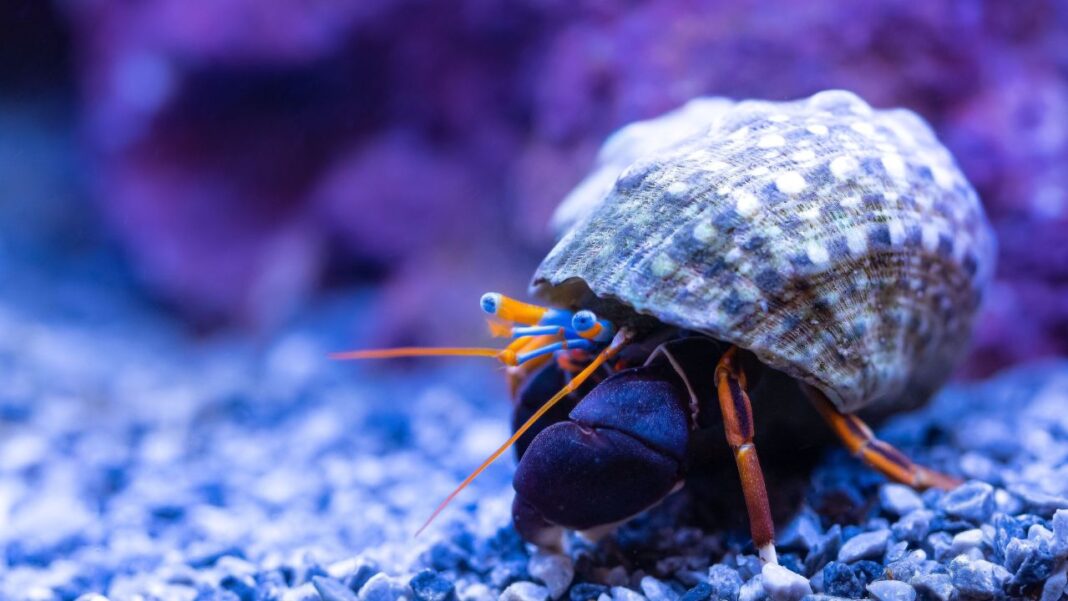

Scientists have discovered a new reason why hermit crabs grow more slowly when they live in shells that are too small. Instead of eating less food, the crabs seem to change the way their bodies use the food they already eat.
Researchers have observed for many years that hermit crabs in small shells grow more slowly than those in larger shells. Scientists knew that this phenomenon happened, but they did not understand what caused it. A new study has now provided an answer.
Hermit crabs do not make their own shells. They rely on empty shells left behind by sea snails for protection. As the crabs grow, they must acquire bigger shells to move into. However, suitable shells are not always simple to find. When a crab cannot locate a larger shell, it is forced to stay inside one that is too tight.
Researchers wanted to learn how these cramped shells affect the animals. One idea was that the crabs simply ate less because they had less space. To test this hypothesis, scientists compared hermit crabs living in shells that fit well with crabs living in shells that were intentionally too small.
The results were surprising. The crabs trapped in small shells ate about the same amount of food as the other crabs. Their appetite did not change. This showed that eating less was not the reason for their slower growth.
Instead, the researchers noticed another important difference. The crabs living in small shells produced waste more often than those living in larger shells. This suggested they were getting rid of more nutrients instead of using them to build new body tissue.
In other words, the crabs were changing how their bodies processed food. They weren’t converting as much of that food into growth, even though they were eating normally.
The scientists believe this change is a way for hermit crabs to control their body size. Since a larger body would not fit inside a small shell, slowing growth may help the animals avoid problems until they find a better shell.
The study indicates that growth is not only controlled by how much an animal eats. It also depends on how well its body absorbs and uses nutrients. Two animals can eat the same amount of food but grow at different rates if their bodies process that food differently.
The researchers say this finding could help scientists better understand how animals respond to physical limits in their environment. When space is limited, the body may adjust its use of energy instead of reducing food intake.
The team also noted that this idea The team also observed that many living things exhibit this idea. in many living things. Different animal species exhibit varying methods of food absorption, storage, and utilisation. Because of these factors, body size is influenced by more than just diet.
However, the scientists stressed that hermit crabs should not be compared directly with humans. The study does not explain why people gain or lose weight. Human metabolism is much more complex, and many different factors affect human metabolism, which is much more complex. by many different factors.
Still, the research highlights an important biological principle. Growth depends on both food intake and how efficiently the body uses nutrients. Simply eating more does not always lead to faster growth.
The researchers are excited because the study answers a question that has puzzled biologists for many years. Earlier studies had shown that hermit crabs slowed their growth inside small shells, but no one knew how it happened. This new evidence gives scientists a better understanding of the process.
The team hopes the findings will encourage more research into how animals control their growth when faced with challenges in their environment. Learning more about these natural survival strategies may also improve scientists’ understanding of growth and energy use across many different species.