
Diaspora (Commonwealth Union) _In 2008, Danish-Trinidadian artist Jeannette Ehlers visited Fort Prinzenstein in Ghana, a Danish-built structure central to the transatlantic slave trade. Shocked by the revelation of Denmark’s colonial history, Ehlers encountered a proverb in the fort’s dungeon that resonated deeply: “Until the lion has their historian, the hunter will always be a hero.” This profound statement became a cornerstone of her work, compelling her to amplify overlooked perspectives, particularly those of African diasporic communities.
Ehlers’ piece We’re Magic. We’re Real #3 (These Walls) exemplifies this mission. Performed at the Black Ancient Futures exhibition at Lisbon’s Museum of Art, Architecture, and Technology (MAAT), the work connects the Atlantic Ocean—once a route for enslaved Africans—to themes of identity and colonial legacy. The performance included braids symbolically tethered to the museum’s facade, with performers invoking the resonant proverb in multiple languages, underscoring the universality of untold histories.
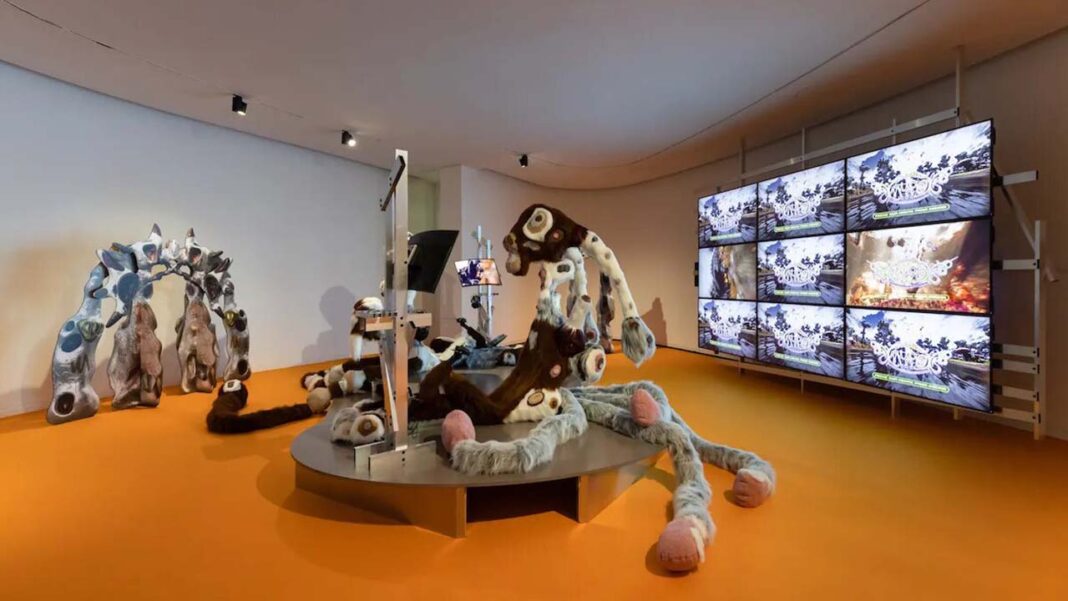
Curated by João Pinharanda and Camila Maissune, Black Ancient Futures diverges from stereotypical expectations of African and diasporic art. Instead of asserting singular aesthetics, it confronts colonialism head-on—a rare endeavor for a mainstream Portuguese museum. The show’s location near the Tangus River—historically tied to Portugal’s role in the transatlantic slave trade—reinforces its poignancy.
South African artist Lungiswa Gqunta’s Sleep in Witness offers a meditative homage to Black women who shaped and resisted colonial landscapes. Her clay-laden installation invites women to engage with the space, symbolizing resilience and collective healing. Similarly, Sandra Mujinga’s And My Body Carried All of You uses steel and fabric sculptures to reflect on lost histories, exploring the fragility of narratives shaped by power and erasure.
The exhibition challenges Portugal’s self-perception as “benevolent colonialists.” Maissune critiques this myth, noting that Portugal’s colonization of over 5 million Africans created oppressive models emulated globally. Mujinga echoes this, calling for deeper, messier dialogues about colonialism beyond sanitized museum walls. As Portugal grapples with its colonial legacy, Black Ancient Futures offers a counter-narrative, urging institutions and society to address the violence and exploitation underpinning heroic tales. Through art, the exhibition fosters reflection and invites critical conversations about history’s untold sides.