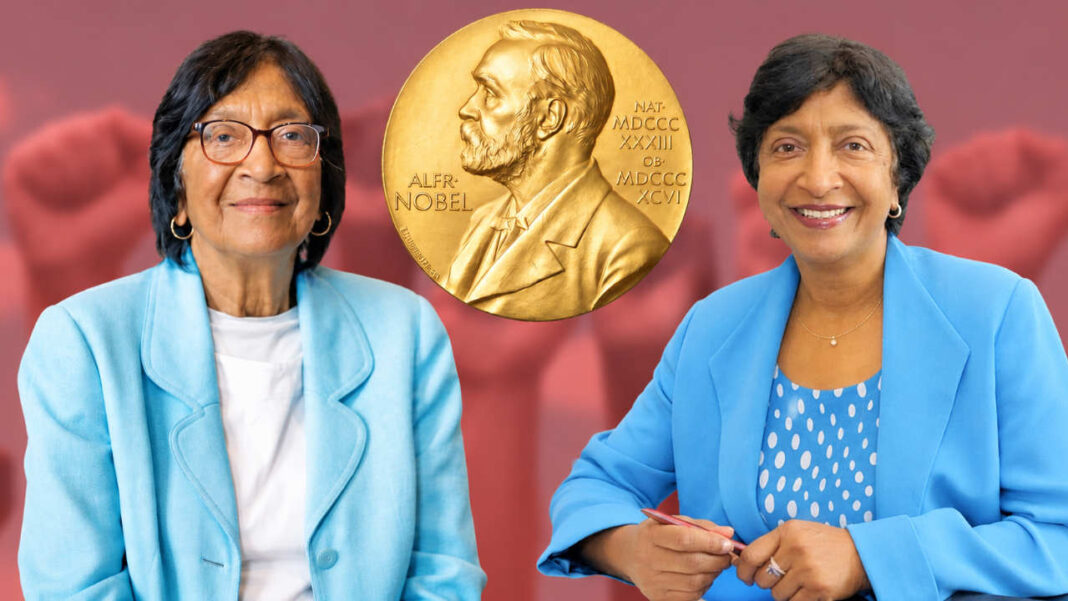

India (Commonwealth Union)_ South African Indian-Tamil jurist Navanethem “Navi” Pillay has been awarded the 2026 Nobel Peace Prize for her contributions to international law, human rights and global peace. At 85 she is an inspiring example of how determination, courage and a commitment to justice can break down discrimination and social barriers. Pillay’s distinguished career has led her from South African courtrooms during apartheid to some of the world’s most important international legal institutions. As a former United Nations High Commissioner for Human Rights and international court judge, she has worked to ensure that victims of violence receive justice and that those responsible for serious crimes are held accountable. Her achievement is a matter of pride for South Africa, India and the world Tamil diaspora. Her lifelong belief in humanity, peace, and justice has earned her international recognition, including the Nobel Peace Prize.
Also read: British-Indian chess prodigy Bodhana Sivanandan makes history as youngest Woman Grandmaster!
The Nobel Peace Prize 2026 winner
The Norwegian Nobel Committee announced Pillay as the 2026 Nobel Peace Prize laureate on October 9, recognising her efforts to strengthen international law and promote peaceful conflict resolution. The award comes at a time when armed conflicts continue to claim lives and international legal institutions face growing political pressure. The committee praised her courage and integrity in advancing a stronger global legal system. Her work has helped establish the principle that war crimes, crimes against humanity and genocide must be investigated and prosecuted, regardless of the power or position of those responsible. The Nobel Prize carries an award of 12 million Swedish kronor and will be presented in Oslo on December 10. The committee’s decision highlights a central message of Pillay’s career: lasting peace cannot exist without justice, accountability and respect for human dignity.
Who is Navi Pillay?
Born in Durban, South Africa, in 1941, Pillay was raised in an Indian-Tamil family under apartheid, a system of racial segregation that denied equal rights to the majority of the population. Her parents were Santhama and Narrainsamy Naidoo and they lived in humble surroundings and had eight children. Her father was a bus driver and her family faced struggles similar to many other Indian families whose forefathers had come to South Africa as indentured laborers. Despite these challenges, Pillay pursued an education and entered the legal profession at a time when opportunities for women of color were severely limited. She did not accept discrimination; she fought it through law. Her journey from a disadvantaged background to international judicial leadership reflects the power of education, perseverance and principled public service.
Early life and legal career
Pillay studied at the University of Natal, earning her bachelor’s degree in 1963 and law degree in 1965. In 1967, she became the first woman to establish a law practice in South Africa’s Natal Province. She represented political activists and challenged the treatment of detainees under apartheid. In 1973 she helped secure the right for political prisoners on Robben Island to consult lawyers and to have basic amenities. As a lawyer, she needed courage in a society where challenging authority could be dangerous. She kept fighting for human rights even with the barriers of race and gender. She earned a Master of Laws from Harvard University in 1982 and a Doctor of Juridical Science from Harvard University in 1988. Her academic background refined and prepared her for a bigger role in international justice. In 1995, she became the first non-white woman appointed to South Africa’s High Court, marking a significant milestone in the country’s legal history.
Contributions to global peace, human rights and justice
Pillay’s contribution to peace is more than just saying no to violence. She has contributed to the development of legal principles that protect vulnerable people and strengthen accountability for serious human rights violations. She began her work at the International Criminal Tribunal for Rwanda in 1995, which was established to prosecute those responsible for the atrocities of the 1994 genocide. Later she became the president of it from 1999 to 2003. Her most important contribution was the landmark case of Akayesu. The tribunal found that rape and sexual violence could be acts of genocide in certain circumstances. The judgement was a major step towards recognising sexual violence as a weapon of mass destruction and holding perpetrators accountable.
In 2003, Pillay became a judge at the International Criminal Court, where she served until 2008. She then became the United Nations High Commissioner for Human Rights, serving from 2008 to 2014. During her tenure, she advocated for the protection of civilians, women, children and marginalised communities. She also spoke against governments that used repression and excessive force against people demanding political change. Pillay co-founded Equality Now in 1992, an organisation dedicated to advancing women’s rights and challenging discriminatory laws. Her work has consistently connected peace with equality, dignity and the protection of fundamental freedoms.
Pillay’s role in the Sri Lankan crisis
Pillay’s work also attracted international attention in Sri Lanka, particularly after the country’s decades-long civil war ended in 2009. During a visit from August 25 to 31, 2013, she travelled to areas including Jaffna, Kilinochchi and Trincomalee. She met communities affected by the conflict, families of missing persons and survivors seeking answers about their experiences. Following the visit, Pillay raised concerns about intimidation, restrictions on freedoms and the country’s human rights situation. She urged the international community to support credible investigations into alleged war crimes and crimes against humanity committed during the conflict. Her position drew attention to the suffering of civilians and the need for accountability, reconciliation and lasting peace. Her involvement remains significant in discussions about Sri Lanka’s post-war human rights record.
International work and recent controversies
Pillay continued her human rights work as chair of the United Nations Independent International Commission of Inquiry on the Occupied Palestinian Territory, including East Jerusalem, and Israel. The commission’s 2025 findings concluded that Israel had committed genocide in Gaza, a conclusion rejected by Israeli officials. She also serves as an ad hoc judge at the International Court of Justice in the case brought by The Gambia against Myanmar concerning alleged violations of the Genocide Convention involving the Rohingya. These roles illustrate her continued engagement in the investigation of allegations of serious international crimes. They have also placed her at the heart of heated political debate. Pillay’s career is a case study of the difficult position of international jurists who must weigh evidence and legal principles against competing political interests. Her position remains that accountability should depend on law and evidence, not on the influence of those accused.
Wishes pour in for Pillay
Pillay’s Nobel Peace Prize announcement prompted tributes from international leaders and human rights organisations. United Nations Secretary-General António Guterres congratulated her, highlighting her work in defending human rights and strengthening international law. He described her career as evidence that the force of law must prevail over the law of force. South African President Cyril Ramaphosa praised her lifelong commitment to justice, peace and human dignity. European Commission President Ursula von der Leyen also recognised her dedication to confronting injustice, from apartheid to the Rwandan genocide. Human rights advocates welcomed the award as an important recognition of international justice at a time when legal institutions face increasing pressure.
The Dalai Lama congratulated Navi Pillay on receiving the Nobel Peace Prize in recognition of her contributions to peace and international law. He praised her lifelong commitment to defending human rights, promoting the rule of law, and addressing injustices worldwide. He also expressed appreciation for her efforts as UN High Commissioner for Human Rights to urge China to address the underlying issues in Tibet. He welcomed her to the community of Nobel Peace Laureates and encouraged her continued efforts to make the world a better place. Additionally, The German government, The United Nations, Amnesty International Secretary General Agnes Callamard, Norwegian Nobel Committee chair Jorgen Watne Frydnes and many others conveyed wishes to Ms Pillay.
Also read: Meet the world’s youngest author: How the Indian American boy made it to the Guinness World Records!
What Navi Pillay said?
Receiving the news while attending the Nuremberg Forum in Germany, Pillay described the award as an encouragement to defend international law and independent courts. She dedicated the recognition to survivors of international crimes and called for stronger collective action to protect the global legal order. Her message was clear: powerful countries and political leaders must respect the same legal principles that apply to everyone else. She also warned against a world in which political power decides whose suffering counts. For Pillay, protecting independent courts and ensuring accountability are essential to preventing future atrocities.
Criticism and political reactions
The award also attracted criticism from political leaders who disagreed with Pillay’s positions on international legal cases. US President Donald Trump questioned the Nobel Committee’s decision, while Israeli officials criticised her role in the commission’s findings on Gaza. US President Donald Trump criticised Navi Pillay’s Nobel Peace Prize recognition, calling her an unknown liberal who dislikes Israel and arguing that his own diplomatic efforts deserved the award. He has repeatedly claimed credit for ending eight wars, although the extent of his role in some conflicts remains disputed. Trump also condemned the Nobel Committee’s decision, describing it as an “indelible stain on Norway.”
Pillay responded by stressing that world leaders have a responsibility to respect national and international law. She also joked that she might share her prize with Trump if the audience applauded a little louder. Her remarks reinforced her central message that justice, accountability and respect for international law are essential to lasting peace. Pillay’s supporters argue that such disagreements underline the importance of independent legal institutions. Her response has consistently emphasised that national leaders have a responsibility to respect international law and protect human rights. The debate surrounding her work reflects a wider struggle over accountability and the authority of international courts.
A proud moment for India and the Tamil diaspora
Pillay’s success is particularly important to people of Indian-Tamil background. Her ancestors journeyed from India to South Africa under difficult circumstances and her family grew up in a context of racial and economic restrictions. But she rose through education, determination and professional excellence to become one of the world’s most influential human rights jurists. Her story reminds us that a person’s background should never limit their accomplishments. Her success is also an inspiration to women and young people who still face discrimination. She has shown that leadership does not depend on privilege but can grow from courage, hard work and a commitment to others.
The Nobel Prize and her lasting legacy
The first Nobel Peace Prize was awarded in 1901 to a person working for peace, cooperation and human rights. Pillay’s appointment in 2026 is a reminder of the vital role international law can play in preventing violence and addressing serious crimes. Her rise from a humble family in Durban to the heights of international justice is quite phenomenal. Through decades of legal work, she has defended the vulnerable, challenged discrimination and helped strengthen protections for victims of atrocities.
For Pillay, peace is not just the absence of war. It calls for justice, accountability and respect for all human beings. Her Nobel Peace Prize is, therefore, not only a personal award; it is an acknowledgment of a lifetime devoted to the belief that justice is mandatory for humanity and enduring peace. Her message to the world is still relevant: international law is still evolving, justice can be delayed, and progress requires patience and persistence. Her life is a living proof of why those principles should never be forsaken.