
A historic visit and a grand welcome
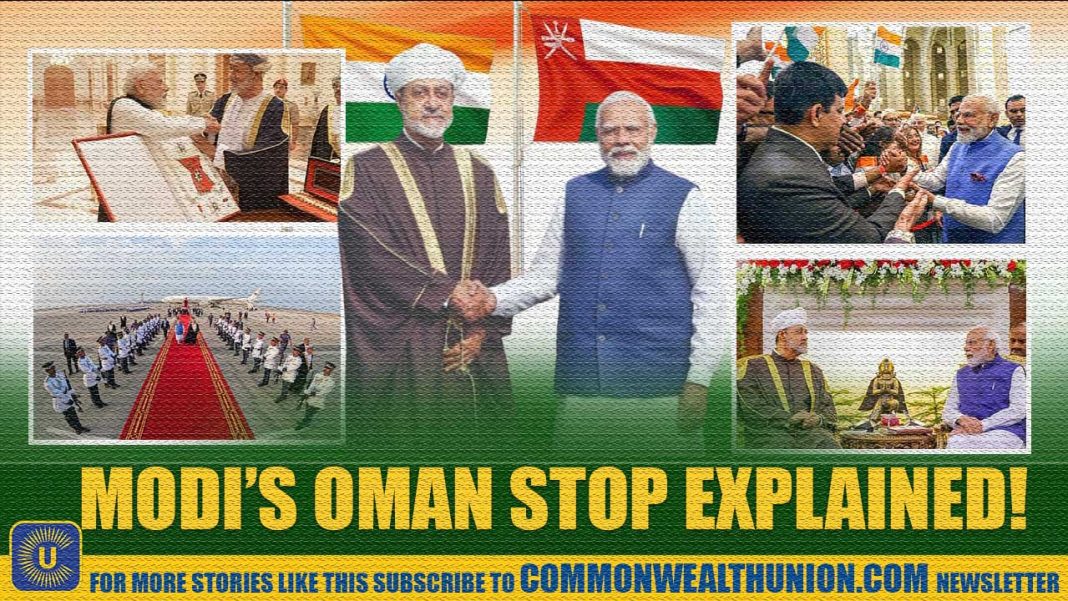
India (Commonwealth Union)_ Prime Minister Narendra Modi arrived in Muscat for a two-day visit to Oman, marking the final leg of his three-nation tour. He reached the Gulf nation after concluding engagements in Jordan and Ethiopia, both of which were described by Indian officials as productive and forward-looking. The importance of the visit was clearly reflected in the reception accorded to the Prime Minister. At Muscat International Airport, he was received by Oman’s Deputy Prime Minister for Defence Affairs, Sayyid Shihab bin Tariq Al Said. A ceremonial guard of honour followed, underlining the value Oman placed on the visit.
Soon after his arrival, Prime Minister Modi shared a message highlighting the deep-rooted relationship between the two countries. He described Oman as a country with long-standing friendship and historic ties to India, stating that the visit would help explore new areas of collaboration and inject new vigor into the partnership. The visit was at Sultan Haitham bin Tarik‘s invitation and occurred at a very historic occasion. India and Oman are marking 70 years of diplomatic relations this year, giving the engagements a commemorative and strategic character. This was Prime Minister Modi’s second visit to Oman, and it carried added significance as both sides looked to further strengthen their strategic partnership, especially in economic and commercial areas.
Also read: Modi’s Jordan stop: A quiet power move!
A warm welcome from the Indian diaspora
After arriving at his hotel in Muscat, Prime Minister Modi was greeted by members of the Indian community living in Oman. The greeting was exuberant and intensely cultural, showcasing India’s variety and the strong relationships that exist among the diaspora. The children performed a variety of dances, including traditional Omani forms and Indian classical genres like Kuchipudi and Kathak. Folk performances from Rajasthan and Karnataka brought life to the evening, earning applauds from the audience. The atmosphere was charged with enthusiasm as members of the community, young and old, greeted the Prime Minister with patriotic slogans.
The Indian Community Day reminded everyone that members of the diaspora have a strong emotional link with their homeland. Prime Minister Modi addressed the audience about many areas where India has been successful, including digital payments via UPI, many new large-scale space programs (including Gaganyaan), and India’s increasing global visibility in terms of cultural heritage. He reflected on how India is improving in terms of infrastructure, manufacturing, healthcare, green growth, and providing opportunities for women after 11 years. He also praised the efforts of Indians living abroad to improve India’s relations with other countries.
Celebrating Indian schools and shared values
The community programme in Muscat saw the participation of more than 700 students from Indian schools across Oman. This year holds special meaning for these institutions, as Indian schools in the country are celebrating 50 years since their establishment. Prime Minister Modi thanked the students and teachers for the colourful welcome and said he was delighted to meet Indians from different regions who have made Oman their home. He noted that India’s diversity is its greatest strength and allows Indians to integrate easily into societies across the world.
Modi soon praised the Hindu community for participating in various initiatives, including the ‘Bharat Ko Janiye Quiz’, and encouraged them to continue doing so through their support for India and through promoting and enhancing the education and knowledge base of Hindus in Oman. The Prime Minister reiterated that the Government of India will continue to assist Indians living outside of India in all their times of need. He also emphasized future-proofing India-Oman cooperation through collaboration in artificial intelligence, digital education, innovation, and entrepreneurship. Calling upon young people to dream big, learn deeply, and innovate boldly, he urged them to contribute not only to their host country but to humanity at large.
Also read: UN mission hit: Deadly drone strike kills six Bangladeshi UN peacekeepers in Sudan!
Modi receives Oman’s highest civilian honour
During the visit, Prime Minister Narendra Modi was conferred the First Class of the Order of Oman, the Sultanate’s highest civilian honour. The award was presented by Sultan Haitham bin Tarik in recognition of the Prime Minister’s role in strengthening bilateral ties and his global leadership. Accepting the honour, Prime Minister Modi dedicated it to the enduring friendship between India and Oman. He described it as a tribute to the warmth, trust, and affection shared by the people of both nations. The conferment of the award coincided with the 70th anniversary of diplomatic relations between the two countries, adding special meaning to the occasion. Instituted in 1970, the Order of Oman has previously been awarded to a select group of world leaders. This honour became the 29th international civilian award received by Prime Minister Modi during his 11 years in office, reflecting the growing global recognition of India’s leadership role.
High-level bilateral talks
Prime Minister Modi and Sultan Haitham bin Tarik held detailed bilateral talks at the Al Baraka Palace in Muscat. Senior officials from both sides were present, including India’s External Affairs Minister S. Jaishankar, Commerce and Industry Minister Piyush Goyal, and National Security Advisor Ajit Doval. The discussions covered a wide range of areas, including trade and investment, energy cooperation, defence and security, technology, agriculture, and cultural exchanges. The two leaders also exchanged views on regional and global developments. Both sides reviewed progress under the Joint Vision Document adopted during the Sultan of Oman’s visit to India in December 2023. They noted that the relationship between the two maritime neighbors has grown into a comprehensive strategic cooperation. India praised Oman’s economic diversification and sustainable growth under Vision 2040. Oman, in turn, praised India’s steady economic growth and long-term ambition of becoming a developed country by 2047.
Discussions between the two leaders placed a large emphasis on the bilateral trade and economic relationship of the two nations. Both leaders agreed that the partners’ economic relationship represents one of the major pillars of their relationship, with both leaders expressing the importance of growing and diversifying their respective countries’ bilateral trade, as well as creating opportunities for future growth and new markets. Areas of possible cooperation and growth identified included textiles, automobile manufacturing, chemicals, industrial equipment and fertilizer. An important issue discussed was how to create mechanisms to allow bilateral trade to be conducted using the local currencies of the respective nations, which might lead to lower transaction costs and greater efficiency in the process of conducting trade. Both leaders welcomed recent progress in the development of the Bilateral Investment Treaty and expressed a shared understanding of how important this treaty is to creating a stable and investor friendly climate.
Also read: When the GOAT landed in India: Inside Messi’s India tour 2025!
India–Oman Business Forum
Prime Minister Modi addressed the India–Oman Business Forum in Muscat, highlighting the centuries-old maritime trade links between the two countries. He recalled historic trading routes from Mandvi to Muscat, which continue to influence modern commercial ties. The forum brought together leading business leaders from sectors such as energy, agriculture, logistics, infrastructure, manufacturing, healthcare, finance, education, and green development. The Prime Minister described the India-Oman Comprehensive Economic Partnership Agreement (CEPA) as a blueprint for a shared future. He said the agreement would inject new energy into trade and investment ties while creating opportunities for innovation and employment.
Modi also highlighted India’s economic performance over the past decade, noting that the country is on track to become the world’s third-largest economy. He pointed to strong growth, policy stability, and investor confidence as key drivers. Prime Minister Modi urged Omani businesses to look beyond traditional areas such as oil, gas, and petrochemicals. He invited them to explore opportunities in green energy, solar power, energy storage, smart grids, agri-tech, fintech, artificial intelligence, and cybersecurity. He proposed the creation of an India-Oman Agri Innovation Hub and an India-Oman Innovation Bridge to make the partnership more future-oriented and resilient.
Key agreements signed
India and Oman signed several agreements to expand cooperation across multiple sectors. These included a Comprehensive Economic Partnership Agreement, as well as memoranda of understanding in areas such as maritime heritage, agriculture, higher education, and maritime security. Other agreements focused on business cooperation, millet cultivation, agri-food innovation, and a joint vision for maritime cooperation.
The agreements signed are:
1) Comprehensive Economic Partnership Agreement
2) MoU in the field of Maritime Heritage and Museum
3) MoU in the field of Agriculture and Allied Sectors
4) MoU in the field of Higher Education
5) MoU between the Oman Chamber of Commerce & Industry and Confederation of Indian Industry
6) Adoption of Joint Vision Document on Maritime Cooperation
7) Executive Programme for cooperation in millet cultivation and agri – food innovation
CEPA: A major economic milestone
The signing of the Comprehensive Economic Partnership Agreement marked a major step in deepening economic integration between India and Oman. The agreement provides duty-free access to the vast majority of Indian exports to Oman, covering key sectors such as textiles, pharmaceuticals, automobiles, and jewellery. Oman plays a strategic role as a gateway for Indian goods and services to the Middle East and Africa. The agreement is expected to further boost bilateral trade, which already stands at over $10 billion. With a large Indian community living and working in Oman, and thousands of Indian businesses operating across sectors, CEPA is seen as a catalyst for long-term economic growth and partnership.
The broader India–Oman relationship
India and Oman share a comprehensive strategic partnership built on energy security, maritime cooperation, and regional stability. Oman is one of India’s key partners in the Gulf and remains an important destination for Indian exports. India’s imports from Oman are largely driven by petroleum products and fertilizers, while exports include a wide range of industrial and consumer goods.
Concluding the visit
Prime Minister Modi departed for New Delhi in the afternoon, concluding his landmark visit to Oman. At the airport, he was seen off by Sayyid Shihab bin Tariq Al Said, reflecting the warmth of the bilateral relationship. The farewell was marked by a cordial exchange, including a traditional Indian “Namaste” gesture from the Omani leader. Prime Minister Modi’s visits to Jordan, Ethiopia, and Oman underline India’s integrated approach to the Middle East, Africa, and the Indian Ocean. As global trade routes face uncertainty, India is actively strengthening partnerships across these interconnected regions. The Oman visit, in particular, highlighted India’s growing geo-economic and strategic engagement, signaling New Delhi’s intent to play a larger role in shaping regional and global outcomes.