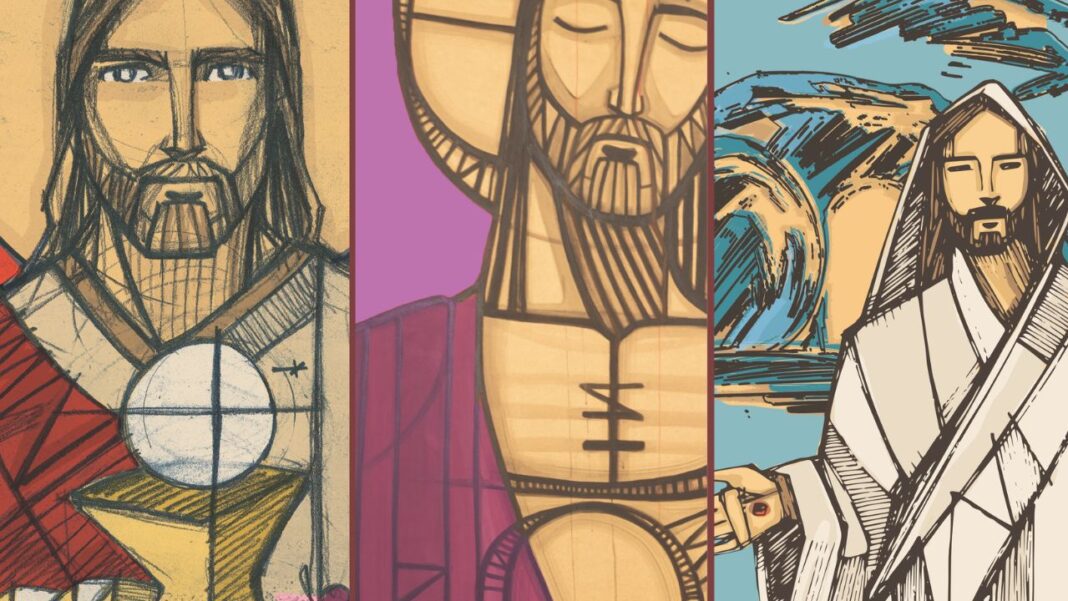

Easter Triduum is the summit of the Liturgical Year. Although sometimes overshadowed by Easter Sunday celebrations, the three days that precede it — Holy Thursday, Good Friday and the Easter Vigil — form the core of Christian belief. Though the three days are chronological, they are not three isolated observances but a single day unfolding Christ’s Paschal Mystery. This experience of presence, loss, silence and renewal marks the end of the Lenten season, leading to the Mass of Resurrection of the Lord at the Easter Vigil.
The word “Triduum,” from the Latin `tres dies’, meaning “three days,” does little justice to the deep meaning it has. Liturgically, this one extended event, begins on the evening of Holy Thursday and culminating only with the proclamation of resurrection during the Easter Vigil. The Church pauses its normal routine and slows everything down, choosing to stay in that in-between moment instead of moving quickly from one day to the next.
This is not an accidental structure but it reflects a theology that refuses to separate suffering from redemption, or death from the possibility of transformation. To understand Easter, the Triduum suggests, a person must first pass through silence.
Holy Thursday: Presence and betrayal
Holy Thursday, also known as Maundy Thursday, opens the Triduum with a paradox. It commemorates the final meal shared by Jesus Christ with his disciples. This meal also unfolds under the shadow of betrayal that was imminent.
The Last Supper, celebrated within the Jewish Passover tradition, is central to Christian sacramental life. It is here that bread and wine are transformed into enduring symbols of body and blood, anchoring the Eucharist. Yet the liturgy does not conclude with celebration. Instead, it moves toward absence.
At the end of the service, the altar is stripped. Candles are extinguished. Bells fall silent. In many traditions, even music ceases entirely. The Church, so often defined by sound and ritual, deliberately empties itself.
This silence in the church is symbolic and has a historical value. If you go back in history, early Christian communities developed the Triduum as a time of deep preparation, particularly for catechumens awaiting baptism. According to the early Church Father St. Augustine of Hippo, the days leading up to Easter were marked by fasting, vigilance and a deep awareness of spiritual openness. Silence was not just an absence of noise but it was a also a time of waiting.
The stripping of the altar itself has underlying meaning. It reflects the humiliation of Christ before his crucifixion and signals the removal of certainty. The Church begins to endorse the abandonment that will define the following day.
Theologian Hans Urs von Balthasar once wrote that the Triduum discloses “a God who does not remain distant from human suffering but enters into its deepest dimensions.” Thus, Holy Thursday marks this descent which is a movement from presence into vulnerability.
Good Friday: The death on the Cross
If Holy Thursday initiates the stripping away, Good Friday defies its full effects. The crucifixion of Jesus is not just a historical event that took place thousands of years ago but the faithful are called to encounter and even endure it as a reality.
If you look at the death on cross historically, crucifixion was among the most brutal methods of execution employed by the Roman Empire. It was meant for those who were considered rebels, slaves and outsiders that rebelled against the order. It was designed not only to kill but to humiliate or to reduce the condemned, creating a public spectacle of powerlessness.
Christianity places such a death at the centre of its theology. As Theologian, Jürgen Moltmann argues, this death is greatly revolutionary. In `The Crucified God’, Moltmann suggests that the cross is not simply a moment of suffering but a revelation of divine solidarity with human pain. “A God who cannot suffer,” Moltmann writes, “is poorer than any human.”
Good Friday liturgies reflect this starkness. There is no Eucharist. The altar remains bare. The Passion narrative is entirely read often with the congregation taking on the collective voice that calls for crucifixion. It is an extremely uncomfortable ritual which collapses the distance between past and present.
This section of the Easter Triduum is not incidental. It highlights that the early Church’s firmness in showing that the crucifixion is not merely something that happened to Christ, but something in which humanity is connected. The crowd’s cry—“Crucify him”—is not confined to history but it becomes a mirror.
The inclusion of Christ’s sorrowful cry, “My God, my God, why have you forsaken me?” emphasizes this tension. It is a moment that resists easy theological resolution. As Bishop and Theologian, Rowan Williams has observed, the cry of abandonment is “not a loss of faith, but the deepest expression of it.” It reveals a faith that does not deny suffering but speaks from within it.
Good Friday, then, is not simply about reverence. It is about confrontation. It is the recognition that suffering, injustice and silence are not external to the human condition but embedded within it.
Holy Saturday: The Weight of Silence
Between the passion of Good Friday and the hope of Easter lies Holy Saturday, a day that is theologically indispensable. It is a day defined by absence. There is no liturgy during daylight hours. The Church remains still. The story is halted between death and resurrection, offering no immediate resolution.
If you look back in history, this silence reflects the experience of the earliest followers of Jesus. After the crucifixion, there was no certainty of what would come next. The resurrection which is now central to Christian belief, was not yet realised. What remained with them was grief, confusion and fear.
Holy Saturday has been interpreted theologically, through the doctrine of the “descent into hell”, a concept explored by figures such as Karl Rahner. Rahner says this descent not as an exact journey but as a deep expression of Christ’s solidarity with all who experience abandonment, even in death.
Theologian Hans Urs von Balthasar further explains that Holy Saturday as the moment in which Christ enters the “absolute silence” of human life. It is the point at which even the presence of God seems absent. In his words, it is the “deepest point of the Incarnation.”
This is perhaps the most disturbing aspect of the Triduum as it suggests that faith must sometimes endure without reassurance and meaning we are searching for is not always immediate. In a culture that seeks quick resolution, Holy Saturday asserts on waiting.
The Easter Vigil: Light as revelation
The silence of Holy Saturday is broken with Easter Vigil after nightfall. This is the most ancient and symbolically rich liturgy in the Christian tradition. The service begins in darkness. A fire is kindled, and from it the Paschal candle is lit. The flame is then shared among the congregation lighting up the dark atmosphere. The symbolism is elemental which shows light emerging from darkness, life from death.
There are deep historical roots to this ritual. The Vigil was already established as the primary occasion for baptism, marking the entry of new believers into the Christian community by the second century. It was both an ending and a beginning. It was a passage through darkness into new life.
The structure of the Vigil supports this sense of continuity. Readings from the Hebrew Scriptures trace a narrative arc from creation to liberation, situating the resurrection within a broader history of divine action. Gospel proclaims the empty tomb only after this journey.
The resurrection itself is also not directly described in the gospel. The gospels offer no eyewitness account of the moment of resurrection. Instead, the gospels present its result which is an absence, an empty space that demands explanation and creates confusion. As Theologians highlight, this absence is essential to the meaning of Easter. The resurrection is not a spectacle to be observed but a reality to be encountered through faith and conversion. The Vigil, then, does not simply announce victory. It invites participation in a mystery that remains, in many ways, unresolved.
Beyond Celebration: The enduring relevance of the Triduum
Today, Easter is often reduced to a celebration of renewal, and the difficult extents of it are softened or overlooked. Yet the Triduum repels such simplification and insists on a sequence that cannot be bypassed: presence, loss, silence and only then comes the transformation.
It is not only because of tradition that this structure has endured for centuries, but because it reflects the forms of human experience. Grief does not resolve instantly. Hope rarely arrives without delay. The Triduum offers a structure that acknowledges this reality which allows the believers to dwell in it, rather than avoid the difficulties of suffering.
In this sense, the Easter Triduum is not just a theological construct but is an extremely human one. It speaks to moments of uncertainty when meaning seems absent which leads to the fragile rise of hope. Triduum is not a narrative of escape but of conversion. It is a movement through darkness rather than around it.
In a world that is marked by uncertainty and unresolved tensions, this message remains strikingly relevant. The Triduum does not offer easy answers. Instead, it offers a pattern which is to endure, to wait and to recognise that renewal, when it comes, is often shaped by the very experiences that precede it. So, the three days are not merely remembered as historical events but they are entered as a lived reality, one that continues to challenge, unsettle and, eventually illuminate.