
Imagine two enemies in the same room. 1 holds the only key to the room. For weeks, the other party negotiates, threatens & even begs. The key holder stays put. So, the other pulls out his lock & bolts the door from the outside.
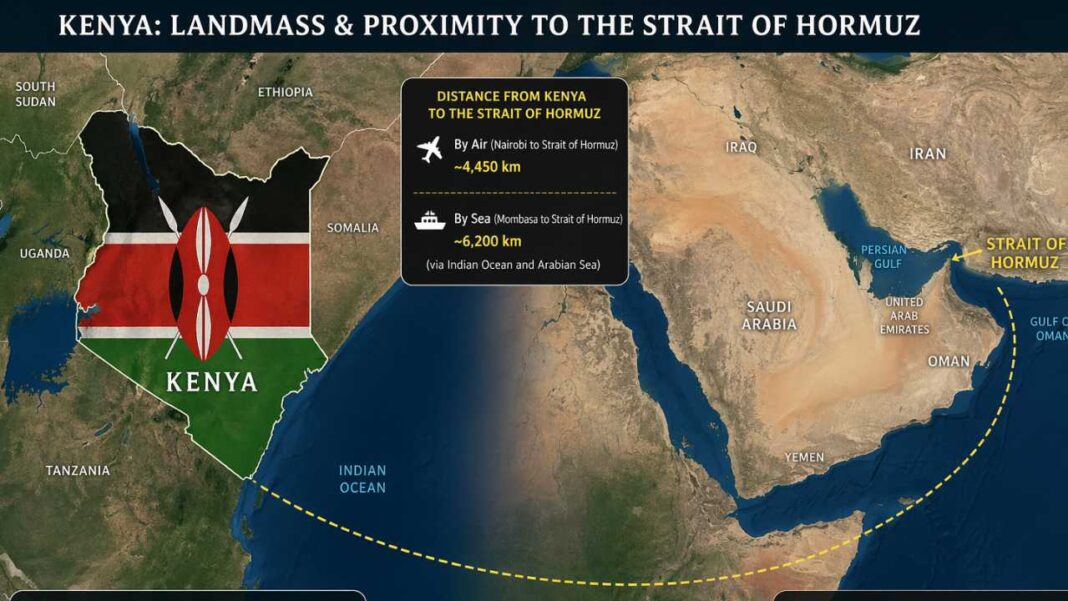
Similar circumstances exist today at the Strait of Hormuz. Iran closed the Strait of Hormuz. The United States blocked total access to the Strait of Hormuz. Both parties would prefer to disrupt global energy rather than back down. The cost of this task is exported to economies that have no seat at the table, particularly affecting nations that rely heavily on oil imports from the region and are thus vulnerable to fluctuations in energy prices.
Iran’s closure moves with leverage. The U.S. tore up the nuclear deal, demanding total surrender on uranium enrichment. So, Tehran opted for the single chokepoint that compels attention. The Hormuz Strait handles over 30% of global seaborne crude oil traffic.
The U.S. response also appears to be equally calculated: to match the escalation and outlast the other side. Neither side seems irrational. Both seem to act on competing rationalities. The tragedy is that both strategies converge on the same victim, such as bystanders like Kenya, who suffer the consequences of these competing rationalities in the form of economic hardship and social instability.
Surges in fuel price increases aren’t the story. Instead, the story is about what fuel price spikes tend to trigger.
Kenya annually imports USD 4.39 billion in refined petroleum. As costs increase, demand for dollars may also surge in turn. This may weaken the shilling & amplify imported inflation in food, medicine, & industrial inputs.
Simultaneously, Kenya’s external debt, which is over USD 50 billion, is largely dollar-denominated, which would in turn make it more expensive to service. Such a scenario leads to a buildup of fiscal pressure. This leads the state to face a narrow choice between austerity and further borrowing.
At the household level, the shock feels immediate. For instance, a matatu operator in Eastlands may witness a diesel surge from USD 1.54 (Ksh 200) to USD 2.156 (Ksh 280) per litre. This situation leads to a daily decline in profit from USD 11.55 (Ksh 1,500) to USD 4.62 (Ksh 600). In such an instance, he represents Kenya’s informal economy. This situation affects nearly 80% of employment in Kenya’s informal economy, leaving no buffer. When informal livelihoods crack, civil protests tend to follow.
Protests then compel political response. These may be in the form of concessions or repression. Concessions may strain fiscal space. On the other hand, repression may undermine investor confidence. Capital may begin to exit. Such actions may result in a tightening of liquidity. The original shock returns through a stronger channel.
This isn’t a linear chain. It’s a closed economic feedback loop. It’s systematic fragility where shocks may be amplified rather than absorbed. The more profound issue may not be price movement. Instead, it may be the loss of control over when & how those prices hit, leading to unpredictable economic consequences for consumers and businesses alike.
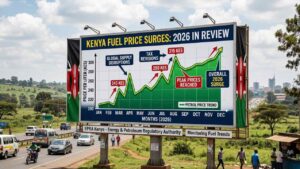
Fuel crisis impact on Kenya’s economy
The fuel price surge of 40% may be abstract. The rapid increase in fuel prices, which is occurring at twice the rate of informal wage growth, is not abstract. Meanwhile, a USD 14.86 billion trade deficit may be abstract. At approximately 12% of GDP, it may signal a structural imbalance.
Kenya’s fuel import bill now consumes nearly 40% of foreign exchange reserves. So, a single such shock may be sufficient to expose the currency’s vulnerability.
This may not be a story applicable only to Kenya. A broader pattern is emerging across the Global South. Many countries are recalibrating their strategic alignments. This shift is based on historical experience, economic exposure, & structural power asymmetry.
Iran communicates with a global audience. The US communicates to Tehran. However, many states hear something more familiar. In this context, demands for compliance are presented as a universal order.
The consequence may be strategic instead of being rhetorical. Misreading this shift may weaken coalition-building, besides reducing diplomatic leverage. The contest may no longer be merely military but interpretive.