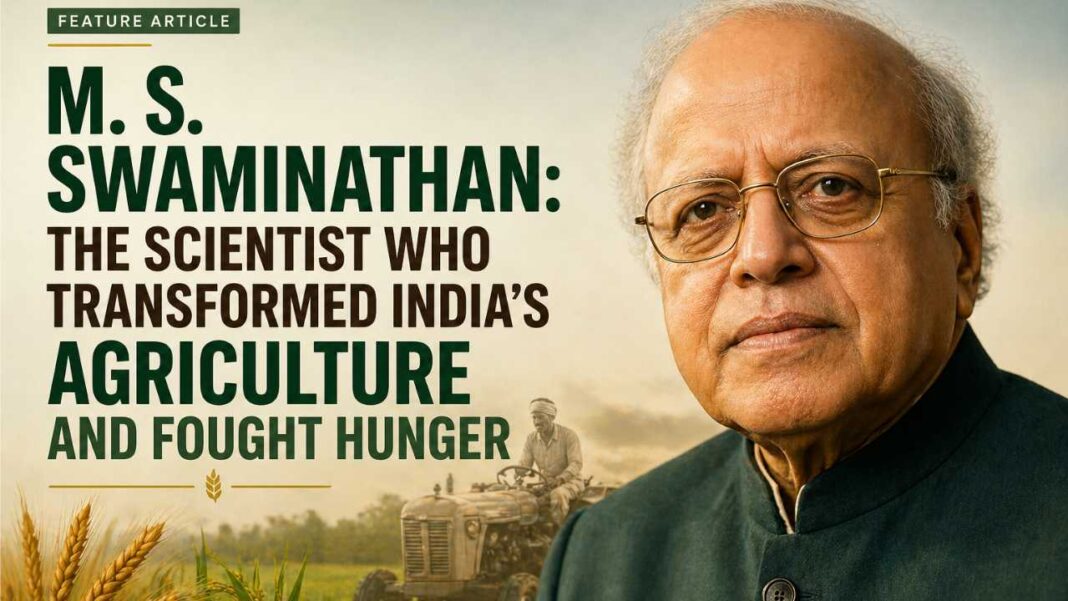

Being one of the most influential scientists for agriculture in India, M.S. Swaminathan was widely celebrated for evoking a transformation in food production and for shaping policies that would help prevent famines that are large-scale within the country. Being named the “Father of the Green Revolution in India”, Swaminathan’s entire life was not only defined by his achievements in science, but it was also described by his deep personal connections which ended up shaping his lifelong mission to pause and get rid of hunger.
Being born on 7 August 1925 in Kumbakonam, which is a town in Tamil Nadu‘s southern Indian state, Swaminathan was brought up by a family where education and public service were well valued. While he resonated with the stability of a normal childhood, he faced a tragedy when he had to face the death of his father when he was just a young boy who was merely eleven years old. Following this tragic loss, he faced both emotional and financial strain, but he was primarily raised by his extended family, who ensured that he continued his education.
Even through all these hardships, Swaminathan showed strong academic ability, especially in science. Though medicine was what he initially pursued, as it was common among top students of his time, his path would soon shift dramatically because of the events that would unfold around him in India and throughout the world.
The turning point in his life came around the year 1943, when he had turned eighteen years old. After witnessing the loss of millions of lives during the Bengal famine that struck eastern India, he saw the unfortunate and ghastly results of acute starvation and disease. Feeling the impact which was left by the devastating images and hearing accounts of the hunger, which was spread wide, it is said that that was the moment where his life plans were folded in front of him. On that very day, Swaminathan came to a resolution that he would dedicate his life to making sure that a tragedy such as this would never happen again in India or anywhere else in the world if he could help it.
The undying commitment he dedicated to his life led him to the field of agricultural science, where he focused on making sure crop yields were improved and food security increased. After completing subjects such as botany and genetics for his higher studies, he pursued his work on plant breeding and research on agriculture and eventually became one of the leading figures in agricultural development in the modern day.
His most significant contribution came during India’s Green Revolution in the 1960s and 1970s, when M. S. Swaminathan worked alongside international scientists such as Norman Borlaug to introduce high-yielding varieties of wheat and rice, along with improved irrigation methods and modern farming techniques that greatly boosted agricultural productivity and helped transform India from a food-import-dependent nation into a self-sufficient one.
Going beyond these achievements, his deep commitment towards social equity was remarkably inspiring to many people. M. S. Swaminathan consistently argued that increased food production should also benefit small and marginal farmers, which led to the encouragement of many policies linking agricultural technology with rural development, environmental sustainability, and fair access to resources. Throughout his career, he held numerous leading positions when it came to agricultural research institutions and international organisations, and his groundbreaking contributions to food security ended up earning him worldwide recognition, which includes the prestigious World Food Prize.
- S. Swaminathan’s legacy encompasses not only scientific breakthroughs but also the millions of lives he saved from hunger. His early experiences of loss, famine, and hardship shaped a lifelong mission that redefined agriculture in India and influenced food security strategies across the developing world.