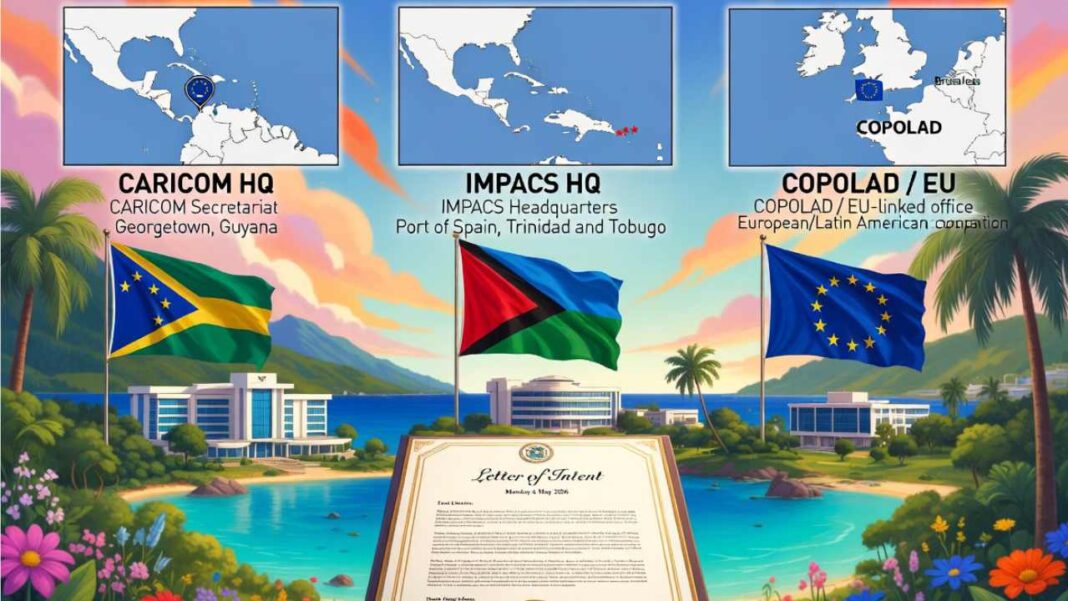

The Caribbean Community (CARICOM) Implementation Agency for Crime & Security (IMPACS), besides the Cooperation Programme between Latin America, the Caribbean & the European Union on drug policy (COPOLOAD III), has come together in partnership to officially deepen their cooperation through the signing of a Letter of Intent. This partnership signalled a renewed, interregional commitment to tackling the surge of synthetic narcotics. Additionally, it indicated the diversion of precursor chemicals and the increasingly adaptive nature of criminal networks.
The signing ceremony for this partnership was held in the Dominican Republic on Wednesday, 29 April ’26. This was the fourth Annual Meeting of COPOLAD III. This event marks the formalisation of a partnership that serves as a vital bridge for knowledge exchange among regions of the Caribbean, Europe, and Latin America. This new agreement moves in the wake of a highly successful ’24 program that saw over 500 regional officers sourced from police, military, customs, and financial intelligence units. They all received training about disrupting organised crime. Furthermore, in investigating new psychotropic substances.
Executive Director of CARICOM IMPACS, Lt Col Michael Jones, asserted that while a previous Memorandum of Understanding (MoU) expired early ’25, collaboration between the 2 agencies hadn’t ceased.
Jones added that today, being Monday, 4 May ‘26, was marking more than the signing of a document. It reflects a shared commitment across regions to confronting evolving international narcotics challenges with unity and resolve. As such, the Caribbean region today faces a new & complex reality. These threats don’t seem to respect borders. Jones was also of the view that they cannot be confined to borders either.
Focusing on three critical pillars of regional security, the referred letter of intent establishes a results-driven roadmap for the near future. This may include the launch of a multi-country diagnostic study. It is designed to create an evidence-based baseline. That’s on drug-related violence. It also addresses the issue of the recruitment of youth for organised crime across CARICOM member states.
This partnership may facilitate special technical exchanges. Such cooperation is through targeted study visits with elite European agencies. These may include external parties such as the Italian Anti-Mafia Investigation Department (DIA). Additionally, the Central Directorate of Anti-Drug Services (DCSA) will be involved. These partnerships are intended to transfer best practices held in sectors of international intelligence-led investigations.