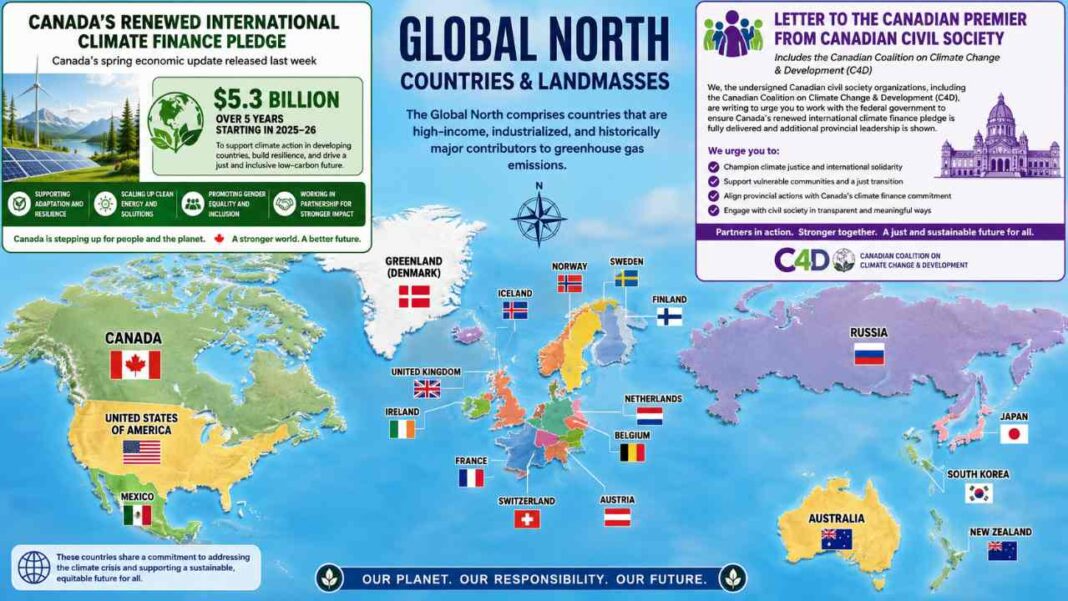
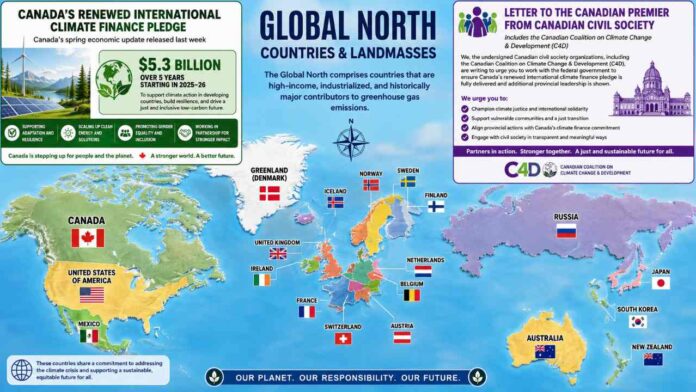

During last week’s Spring Economic Update, the Canadian government renewed its international climate finance pledge. This is a positive initial step amidst cuts to international assistance, besides delayed pledges from other Global North countries.
This renewal follows long advocacy from Canadian civil society. That may include the Canadian Coalition on Climate Change & Development (C4D). The document is a letter to Prime Minister Carney which calls for a timely & ambitious renewal of Canada’s international climate finance commitment. The previous envelope dedicated USD 3.87 (CAD 5.30) billion for climate finance over 5 years that ended on 31 March ’26.
International climate finance is crucial in supporting Global South countries. They are least responsible for causing the climate crisis and facing its worst impacts. Providing climate finance is a legal obligation that comes under the Paris Agreement for countries in the Global North, like Canada.
Details matter, so C4D may continue working to ensure that Canada’s allocation & delivery of climate finance meet the needs of Global South partners. It also includes central transparency, accountability, and collaboration with civil society.
Analysing further:
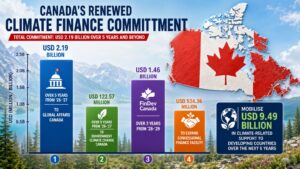
Canada’s renewed climate finance commitment promises:
o USD 2.19 (CAD 3.0) billion over 5 years to Global Affairs Canada, beginning ’26-’27;
o USD 122.57 (CAD 167.90) million over 5 years to Environment Climate Change Canada, beginning ’26-’27; &
o USD 1.46 billion (CAD 2.0 billion) will be allocated to FinDev Canada over 3 years starting in ’28-’29, along with USD 534.36 million (CAD 732 million) designated to expand its concessional finance facility.
o It also sets an overall goal to mobilise USD 9.49 (CAD 13) billion in climate-related support to developing countries over the next 5 years.
The new pledge recognises the role of international climate financing. Such funding could be in enabling emission reductions, adaptations, building economic resilience & sustainable development. Furthermore, it recommits to using climate finance in supporting vulnerable countries. Additionally, the focus is on marginalised and vulnerable groups, which include women, girls, and rural communities.