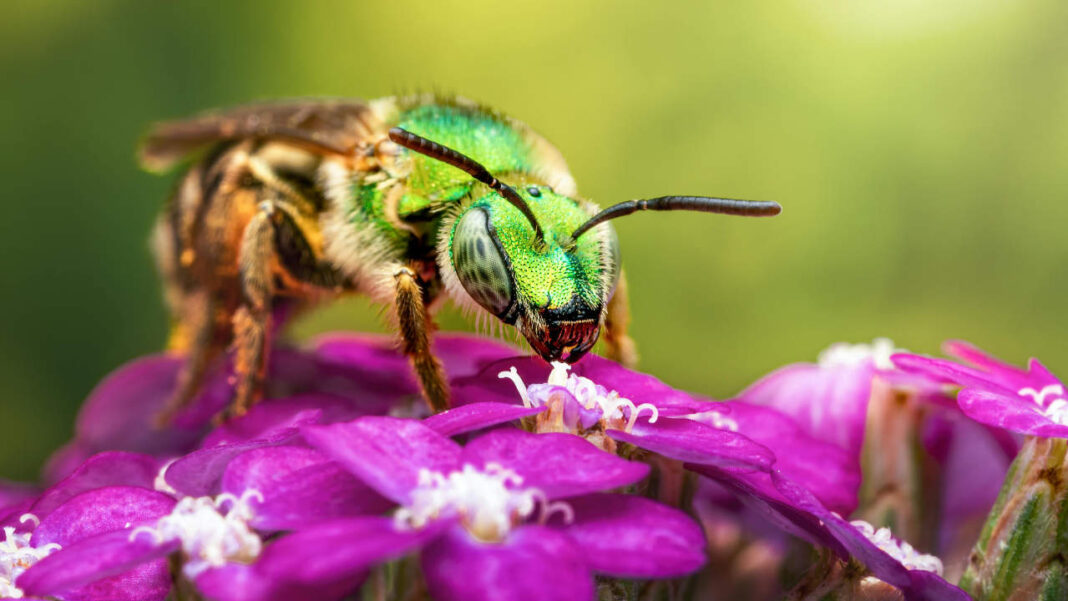
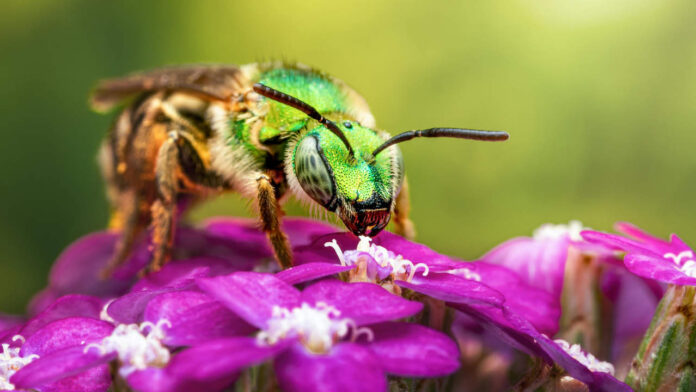

Scientists have discovered that some bees appear to change colour depending on how humid the air is. The finding helps explain why the same bee species may look different in different climates. The new study was published in the journal Biology Letters.
Researchers found that moisture in the air can temporarily change the glossy colours of certain sweat bees. When the air becomes dry again, the insects return to their original shade. Madeleine Ostwald from Queen Mary University of London led the research. Scientists say this is the first clear experimental evidence showing that humidity can affect the colour of bees.
Sweat bees are renowned for their bright metallic colours. Some appear green, blue, or gold when sunlight reflects off their bodies. For many years, scientists have noticed changes in bee colours under different weather conditions. But still there was little proof to explain why. To investigate this phenomenon, researchers examined preserved specimens of a North American sweat bee species called Agapostemon subtilior. The bees were placed in different humidity levels inside a controlled environment.
When the air was dry, the bees mostly appeared dark blue. As humidity increased, their colour slowly shifted to a coppery green shade. After the insects were dried, the blue colour returned. The change was completely reversible. Unlike many animals, these bees do not get their colour from pigments.
Instead, their shiny look comes from tiny structures on their bodies. These structures reflect and scatter light, making the bees look metallic. Hummingbird feathers, butterfly wings, and certain marine animals also exhibit the same type of effect. In certain species, moisture can slightly change the shape of these microscopic structures. When this happens, the reflected colour also changes. Researchers believe something similar is happening in sweat bees. Moisture in the air may slightly affect the outer surface of the insects, causing them to reflect different wavelengths of light.
Scientists, however, assert that further research is necessary to fully comprehend the precise process. The team also wanted to see whether humidity affected bee colours in the wild. To do this, the team analysed hundreds of public photographs uploaded to the citizen science platform iNaturalist. The researchers compared the bee colours in different regions with local humidity levels. They found a pattern that matched their laboratory results. Bees photographed in drier climates often appeared bluer, while those in more humid places looked greener.
Scientists say many factors can influence how bees appear in photographs, including lighting and camera quality. Even so, the trend was strong enough to support the laboratory findings. Another surprising discovery involved museum specimens. Older preserved bees showed stronger colour changes than new ones.
Researchers believe the insects’ outer shells may slowly weaken with age, allowing moisture to affect them more easily. The findings suggest that humidity-related colour shifts may be more common in bees than previously believed. Bees live in many different environments around the world, from dry deserts to tropical rainforests. This means they are found in many kinds of habitats.
Their colours may partly reflect the conditions of the places they live. Insects use colouring for many purposes. Bright colours may help with camouflage, communication, attracting partners, or controlling body temperature. Scientists still do not know whether these humidity-driven colour changes provide a survival advantage.
Dr Ostwald said many people imagine bees as simple brown insects, mainly because honey bees are the most familiar species. But in reality, bees are extremely diverse and display a surprising range of colours and patterns. She also explained that these bees are not actively changing colours, like chameleons. Instead, the shift happens naturally as the humidity around them changes. Researchers say this discovery opens new questions about how insect colours evolved and how climate may influence their appearance.