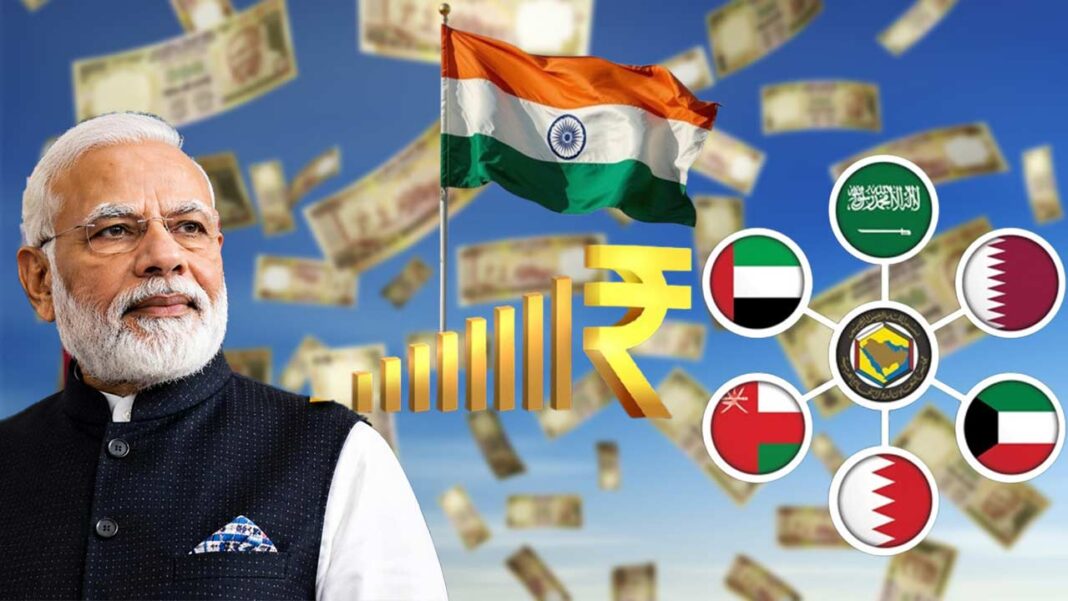

India (Commonwealth Union)_ For decades, the US dollar has been the backbone of global trade. From oil purchases to cross-border investments, companies around the world have relied on the dollar as the currency of choice for payments and settlements. But the world economy is changing fast. Emerging markets are becoming bigger contributors to global growth, trade flows are becoming more diverse, and countries are increasingly looking for alternatives that reduce reliance on a single currency. In this shifting scenario, India has been making significant efforts to boost the international stature of the Indian Rupee (INR).
A new era in global trade
A local currency is slowly entering the realm of international trade settlement which was until now restricted to domestic transactions. One of the most exciting developments in this process is the increasing use of the rupee in trade with the Gulf Cooperation Council (GCC) countries. The improvement of India-GCC economic relations through local currency trade is not just a financial tweak. It represents a strategic shift that could redefine trade, investment and economic cooperation between two regions that are already closely linked through commerce, energy and people-to-people ties.
Also read: Inside Modi’s landmark Norway visit that strengthened India-Nordic ties: Key moments and takeaways!
India’s push to internationalize the Rupee
India has been actively pushing for the use of the rupee in cross-border transactions for the last few years. The idea is simple: To encourage more efficient international trade, to lessen the chances of exchange rate fluctuations and to create a more significant global presence for the Indian currency. Additionally, the Reserve Bank of India has also created special Rupee Vostro Accounts for international trade settlement in rupees, allowing foreign partners to do business directly with Indian corporations without the need for intermediate currencies. Accordingly, 18 countries, including Fiji, Botswana, Guyana, Germany, Kenya, Israel, Malaysia, Mauritius, Myanmar, New Zealand, Oman, Russia, Seychelles, Singapore, Sri Lanka, Tanzania, Uganda and the United Kingdom, are now to open these special channels to facilitate international trade in INR.
Since the implementation of this system, the use of INR has increased for both imports and exports. Additionally, India’s increased engagement with BRICS is also promoting the globalization of Rupee trading. The rising use of rupee-based transactions indicates growing confidence in India’s economic resilience and long-term growth prospects. As India continues to rise as one of the world’s fastest-growing large economies, more countries are interested in trading directly in the Indian currency. This trend is especially evident in the Gulf region, where India has some of its closest economic relations.
Why the GCC matters to India?
The GCC includes six countries: Saudi Arabia, the United Arab Emirates, Oman, Qatar, Kuwait and Bahrain. Collectively, these countries are one of India’s most important economic partners. But the relationship is much more than trade figures. The Gulf region is a major supplier of India’s energy needs and thus critical to India’s energy security. At the same time, India is a large market for GCC exports and an increasingly attractive destination for investment. The region is also home to millions of Indians who make a significant contribution to both economies. Their remittances support families and communities across India, and their skills and labour continue to play an important role in the development of the Gulf economies. Such deep economic ties have provided considerable momentum for the move towards local currency trade.
Also read: Pakistan takes bold step toward crypto regulation: New budget targets crypto market!
India-GCC trade in INR can be a game-changer
The increasing adoption of the Indian Rupee for trade with GCC countries is a major milestone in the growth of bilateral economic relations. Historically, India and the Gulf countries used $US for trade. The system has served well over the years, but it also carries the costs of currency conversion, delays in settlement and exposure to volatility in global currency markets. A lot of these problems can be solved by companies settling trades directly in rupees and local currencies in the Gulf.
Payments are quicker, transaction costs are lower and companies have more certainty on pricing and profitability. One good example of this trend is the India-UAE agreement to settle trade in rupees and dirhams. These agreements create a more direct financial link between trading partners, reducing their exposure to third-country currencies. This is an efficient and cost-effective solution for companies operating in both regions, which can enhance competitiveness and promote higher trade volumes.
It reduces currency risks and improves stability
Doing business with rupees can help reduce global currency risk. Big swings in exchange rates create uncertainty for companies working internationally. That volatility can be costly, erode profit margins and make it hard for importers and exporters to plan. When companies use local currencies to do business, they can avoid those risks. They can concentrate on business opportunities, not on currency moves that cannot be predicted. For India, greater use of the rupee also eases pressure on foreign exchange reserves. Over the years, large-scale imports, especially energy imports, have demanded large sums of dollars. Local currency settlements can help preserve foreign exchange reserves and build a more balanced trade framework. For GCC countries, the system provides a stable and efficient channel to conduct business with one of the world’s largest and fastest-growing markets.
A collaboration beyond oil and energy
Energy has long been the foundation of India-GCC economic relations. The Gulf continues to be a major supplier of crude oil, natural gas and other energy resources to power India’s economic growth. But the future of the partnership is much broader. As GCC countries pursue ambitious economic diversification plans and India moves toward its long-term development goals, new sectors are emerging as major areas of collaboration. The use of local currency trade can act as a catalyst to expand into these sectors by facilitating and making investments and commercial transactions easier and more attractive. Rather than being limited to oil shipments and energy contracts, India-GCC relations are increasingly evolving into a comprehensive economic partnership.
Infrastructure and construction opportunities
Infrastructure is expected to become one of the most important pillars of future India-GCC cooperation. India’s huge infrastructure programs require significant investment, expertise and long-term financing. GCC sovereign wealth funds and private investors have already expressed strong interest in being part of India’s growth story. With smoother trade settlements and enhanced financial cooperation, investment flows into roads, ports, airports, railways, smart cities and urban development projects could accelerate even more. At the same time, Indian engineering, construction and project management companies are well placed to contribute to the ambitious infrastructure projects underway in Gulf countries. This opens up prospects for a genuine two-way partnership.
Technology and digital innovation opportunities
Technology is a crucial area for India-GCC partnerships. India is a world leader in information technology, software development, digital payments and innovation-driven services, and the GCC countries are investing heavily in digital transformation in line with their national development strategies. The growth of local currencies can support partnerships in fintech, artificial intelligence, cybersecurity, cloud computing, digital banking and smart government solutions. India’s experience with digital public infrastructure could also be a significant factor. The integration of payment systems and the enhancement of cross-border digital transactions could facilitate business interactions for companies and consumers alike. As digital economies expand across both regions, cooperation in technology is expected to become one of the strongest drivers of future growth.
Manufacturing and supply chain integration opportunities
Manufacturing is another area of opportunity. India’s push to increase local manufacturing aligns with the Gulf Cooperation Council’s (GCC’s) shift away from hydrocarbons. Local currency trade can also help to facilitate the creation of more efficient supply chains through the reduction of transaction costs and the facilitation of payment. Pharmaceuticals, chemicals, food processing, textiles, renewable energy equipment and industrial machinery have great potential for cooperation. Once trust in local currency settlement mechanisms develops, trade volumes in these sectors could increase significantly. The outcome could be greater industrial integration and enhanced economic resilience for both regions.
Also read: Tanzania and Singapore strengthen ties with five major cooperation agreements!
The strategic role of the Indian diaspora
The Indian community in the Gulf is an important element of the economic relationship between the two regions. There are millions of Indians who live and work in GCC countries, especially in the UAE and Saudi Arabia. Their role is not limited only to labour and remittances. The Indian diaspora is a bridge connecting businesses, investors, entrepreneurs and institutions. They help build trade linkages, promote investment flows and build trust between markets. Increased use of local currencies could also simplify remittance transactions, making transfers faster and cheaper for workers and their families. The people-to-people connection remains one of the most robust pillars supporting the larger economic partnership.
How could this be a mutually beneficial trade?
The future of India-GCC relations is promising. One reason for this is a recognition that closer collaboration will be mutually beneficial for both sides. The GCC countries are exploring long-term strategies that are based on innovation, diversification, sustainability and knowledge-based sectors, and India’s development goals are well aligned with these aspirations. This convergence offers opportunities for cooperation in clean energy, green hydrogen, renewable technologies, health care, education, food security, logistics, tourism, financial services, and advanced manufacturing. The increased use of the Indian Rupee in trade can be a major facilitator in ushering in the next phase of this collaboration.
The future of India-GCC economic cooperation
The rise of the Indian Rupee in global trade is more than an economic development. It is a sign of the growing confidence of trading partners in India’s economic strength and future potential. For the GCC, local currency trade provides a practical way to deepen engagement with one of the world’s most dynamic economies. For India, it boosts financial freedom, improves trade efficiency and helps in the globalization of the rupee. Most importantly, the move to INR-based trade signals the shift in India-GCC ties from a conventional energy partnership to a multidimensional economic alliance.
The next chapter of cooperation will not only be about oil and gas. It will be about infrastructure, technology, manufacturing, digital innovation, clean energy, investment partnerships and shared economic ambitions. As the Indian Rupee gains wider acceptance in international markets, the India-GCC corridor is emerging as one of the most important examples of how regional cooperation and local currency trade can create new avenues for growth, stability and long-term prosperity on both sides.