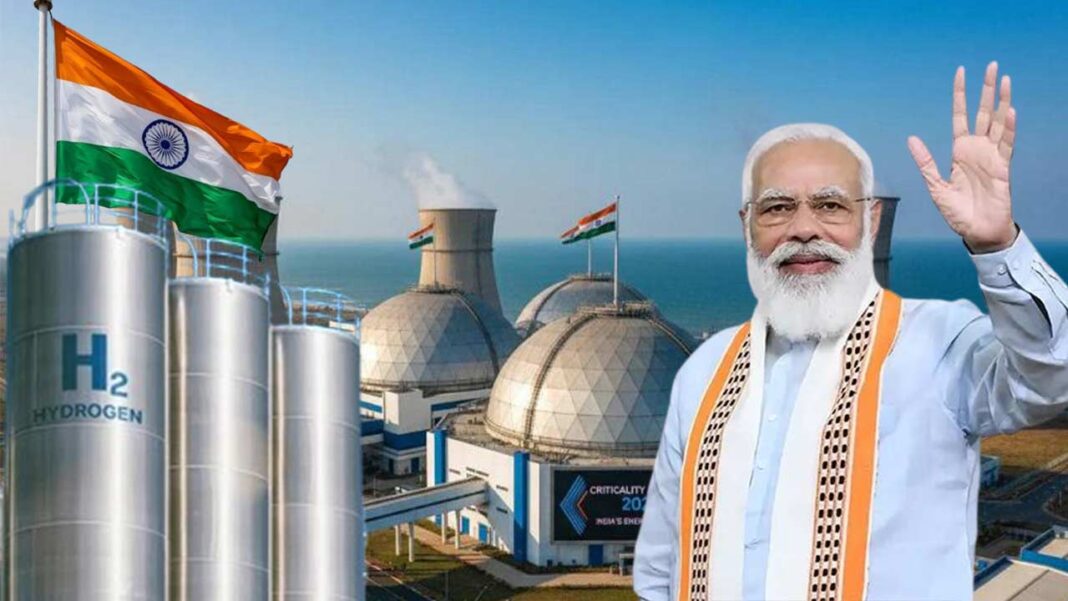

India (Commonwealth Union)_ India has reached a major milestone in clean energy by launching the world’s first hydrogen production facility that uses heat from a nuclear reactor. The project is a significant step forward in the country’s advanced nuclear programme and shows how nuclear energy can be used for more than just generating electricity. The new facility has been inaugurated at the Indira Gandhi Centre for Atomic Research (IGCAR) in Kalpakkam, Tamil Nadu. It uses the Copper-Chlorine thermochemical process, a technology developed by the Bhabha Atomic Research Centre (BARC) in Mumbai. Unlike conventional hydrogen production methods, the process uses the high-temperature heat produced by a nuclear reactor instead of fossil fuels or electricity, making the hydrogen completely free from carbon emissions.
Also read: Bangladesh takes a big conservation step: Becomes latest member of Global Big Cat Alliance!
The hydrogen production system is linked to the Fast Breeder Test Reactor (FBTR), which has been operating since October 1985. The reactor has been central to India’s second-stage nuclear programme and has helped scientists develop advanced reactor technologies over the past four decades. With this latest achievement, it has taken on a new role by supporting the production of clean hydrogen. The breakthrough highlights the growing importance of nuclear energy in India’s clean energy plans. In addition to supplying carbon-free electricity, advanced reactors can now provide the heat needed for industrial processes such as hydrogen production. This creates two valuable clean energy sources from a single technology.
Also read: Singapore rises to the top: What helped Singapore beat the world’s best economies?
Speaking at the inauguration, Department of Atomic Energy Secretary Dr. Ajit Kumar Mohanty described the project as an important step toward a sustainable energy future. He said nuclear power is uniquely positioned to provide both reliable electricity and the high-temperature heat required for efficient hydrogen production. He also lauded the scientists and engineers of BARC and IGCAR for translating years of research work into a working technology. The Fast Breeder Test Reactor is renowned for its one-of-a-kind ability to generate more nuclear fuel than it consumes, and thus, it is an important part of India’s long-term energy strategy. Its high operating temperature also makes it suitable for thermochemical hydrogen production, an advantage not available to conventional nuclear reactors.
Also read: Why is Wasim Akram urging travelers to visit Sri Lanka?
IGCAR Director Sreekumar G. Pillai said the successful demonstration shows the flexibility of advanced nuclear systems and their potential to support India’s transition to cleaner sources of energy. He said the achievement was a testament to the commitment of the country towards developing innovative technologies for low carbon future. “The development comes as India continues to strengthen its fast breeder reactor programme. The 500-megawatt Prototype Fast Breeder Reactor (PFBR), also located at Kalpakkam, recently achieved criticality, signifying the beginning of a sustained nuclear chain reaction. Together, the FBTR and PFBR form the backbone of India’s three-stage nuclear programme.
The new hydrogen plant is currently operating as a technology demonstration plant, where scientists will continue to refine the process before scaling it up for commercial use. If successfully scaled up, the technology could help produce large volumes of clean hydrogen for industries, transport and fuel cell applications without releasing carbon dioxide. The project also supports India’s goal of reaching net-zero carbon emissions by 2070. With the growing demand for clean fuels, production of hydrogen using nuclear power could be an important element of the nation’s future energy mix. The achievement at Kalpakkam is a pointer to India’s progress in indigenous innovation and reinforces its ambition for a cleaner and more sustainable energy future.