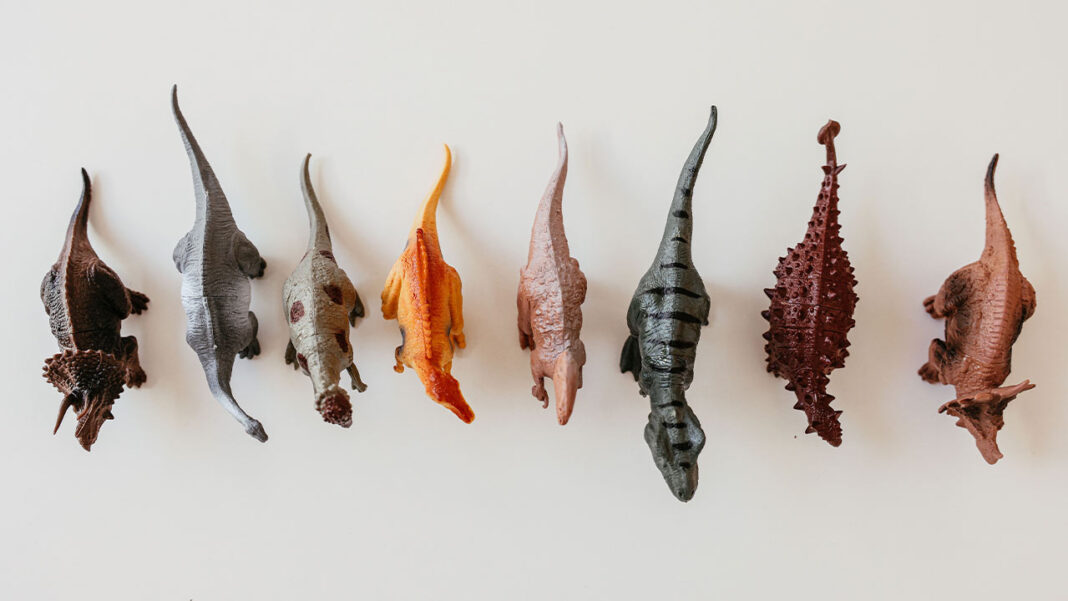

Dinosaurs are famous for their giant size. Tyrannosaurus rex and Patagotitan mayorum are two well-known examples. However, there is another unusual fact about dinosaurs that is often overlooked. Even the smallest ones were still fairly large.
Today, tiny animals are everywhere. Mice, hummingbirds, geckos, and shrews all weigh just a few grams. Some weigh even less. But the picture looked entirely unique during the age of dinosaurs. The smallest known non-bird dinosaur weighed about 450 grams. That is roughly the same size as a large rabbit. Most birds and mammals alive today would count as smaller than that. In other words, the tiniest dinosaur was still bigger than most living vertebrates.
This prompts an intriguing inquiry. Why did dinosaurs never shrink down to mouse size? A new study suggests the answer has little to do with dinosaur biology. Instead, the answer may lie in their ecosystems.
Researchers from the American Museum of Natural History and Princeton University tackled this puzzle. They built mathematical models to predict which body sizes evolution should favour. These models are based on how animals use energy and how they reproduce. The models worked well for mammals, birds, and turtles. Their predictions matched the real-world data for those groups. But when applied to non-bird dinosaurs, the models failed completely.
The team tested many different biological possibilities. They adjusted assumptions about metabolism, growth, and reproduction. Still, nothing could explain why tiny dinosaurs never appeared. This suggests the dinosaurs’ large minimum size was not a matter of biology at all. Something else was clearly holding them back.
That other factor may have been the presence of mammals. During the time of the dinosaurs, small mammals had already claimed the tiniest ecological niches. Dinosaurs may have simply been shut out of those tiny roles. Competition from mammals, and other ecological pressures, could have kept dinosaurs locked into larger sizes.
Roger Benson is a co-author of the study and a dinosaur expert at the Museum. He pointed out that scientists have long understood one side of this relationship. Dinosaurs are known to have kept mammals small throughout much of the Mesozoic Era. This new research proposes the opposite may also be true. Mammals, in turn, may have kept dinosaurs from becoming small.
The study also offers new insights into how birds evolved. Birds are technically dinosaurs themselves, having descended directly from them. Yet birds quickly became smaller than any of their non-flying dinosaur relatives. The researchers argue that flight is the key to this difference. Once early birds could fly, they gained access to entirely new ecological opportunities. These opportunities had never been available to earthbound dinosaurs.
Stephanie Lechki, the study’s lead author and a postdoctoral fellow at Princeton, explained this idea further. She said flight opened up new ways of life for early birds. Once birds moved into these new niches, they were finally free to evolve smaller bodies. That freedom had not existed for their non-flying relatives.
Even so, many questions remain unanswered. Scientists still do not fully understand which body sizes were possible for dinosaurs and which sizes never had a chance to evolve at all. Future research will need to explore this further.
Benson succinctly summarised the mystery. The ancestors of dinosaurs, he noted, were often small creatures. Birds, the living descendants of dinosaurs, can also be small today. Yet dinosaurs themselves seemed unable to shrink, almost as if it were forbidden to them. Researchers do not yet know exactly why this pattern exists. It remains an open and fascinating question, one that could reveal deeper truths about dinosaur biology and the ancient world they lived in.