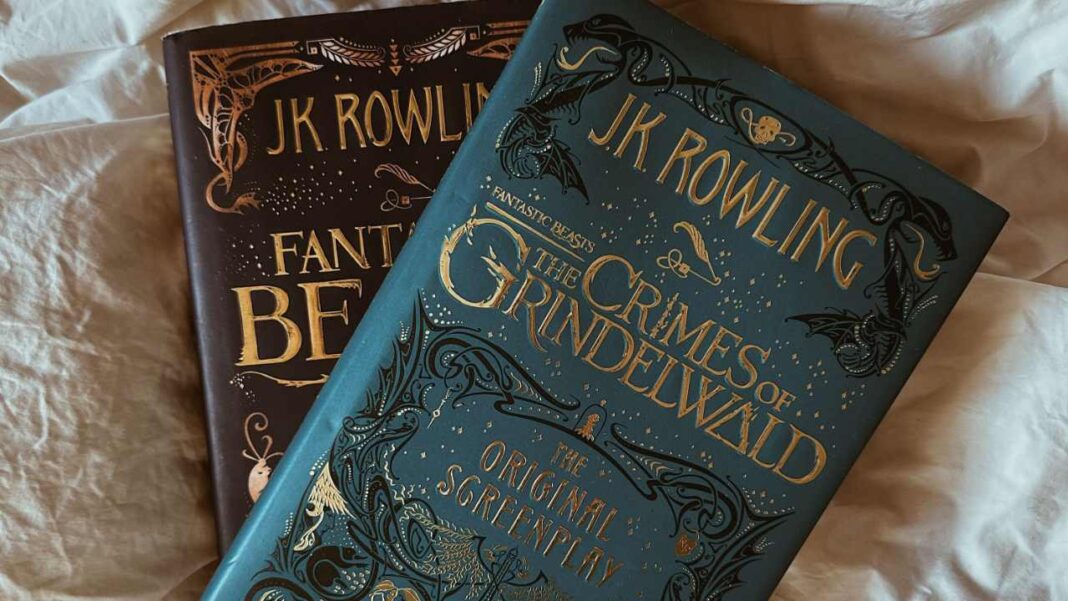

What follows when the most dangerous wizard in existence ceases to run and starts to persuade? This means that the entire concept of J.K. Rowling‘s Fantastic Beasts: The Crimes of Grindelwald – The Original Screenplay, which was released on November 16, 2018, coincides with the movie’s premiere. It cannot be called an ordinary fantasy book either; it is a screenplay to be made into a movie in the near future, but it can also be treated as a good literary work.
The narrative kicks off in 1927, just months after Newt Scamander worked to reveal Gellert Grindelwald’s whereabouts in New York. Not only did Grindelwald evade capture, but he went on to develop a plan that was even more dangerous than any military might: he created a whole belief system. His idea of freedom is merely a front for the ideology of supremacy and puts the screenplay in an entirely new political sphere. The movie makes use of pure-blood supremacy plot devices that naturally infuse an element of seriousness in an otherwise fantastical plot.
Among the many impressive aspects of J.K. Rowling’s writing is her use of her characters’ positions—or their refusal to adopt any particular ones—as a method of developing the critical moral and political themes of the story. At first Newt Scamander can seem almost deliberately uninterested in the ideological conflict that is happening around him. He appears to be a shy, socially awkward person who does not want to attract attention, and he is more concerned about magical creatures than the political struggles that are happening around him. However, it is this apparent unwillingness to take sides that contributes to Newt’s fascination. Dumbledore recognises some qualities in Newt that he does not even realise he has – goodness does not have to reveal itself in magnificent political acts or heroic speeches.
Hence, their dialogues introduce the very important question which goes beyond the imaginary realm: can you still be a good person if you do not take sides during the war? While it might seem that neutrality is a morally safe position, Rowling makes this assumption more complicated. If there are two parties in a conflict, and one of them pursues the goal of total annihilation of rivals whereas the other one tries to resist that force, the fact of refusing to get involved already has implications. However, it should be added that becoming an active member of a political movement just because it proclaims itself to be good is not a guarantee of being moral. According to the author, the story of Newt and Dumbledore suggests that the issue of morality is far more complicated than that.
The answer to questions about Credence, the Dumbledore family and a phoenix shifts the narrative from what appears to be just another story of a young wizard in distress to something bigger. The last scenes of the story leave us wondering whether the answer is a trick or really the truth
As the story unfolds, magical creatures play a role in preventing it from becoming merely political. The remarkable Zouwu, as well as the Niffler, Kelpie, Nagini and other fantastical creatures, add humor, charm and imagination to the story’s visual component. Among the great aspects of Rowling’s treatment of magical creatures is the way in which the issue of cruelty is tackled in the script.
From the visual point of view, the book can be called a work of art. It was designed and illustrated by one and the same studio, which skillfully presented the book’s drawings in the manner of Art Nouveau that enjoyed popularity during the 1920s.
As noted by David Yates in his foreword dated September 9, 2018, Rowling’s screenplay is multilayered, emotional and driven by characters that speak for themselves.
The bottom line of the Crimes of Grindelwald is that it is more focused on the themes of power, prejudice, persuasion, identity and the dangerous allure of belonging than on spectacular spells. The greatest trick of the film is that it makes the viewer understand not only who is telling the truth, but also who is fooled into believing it.