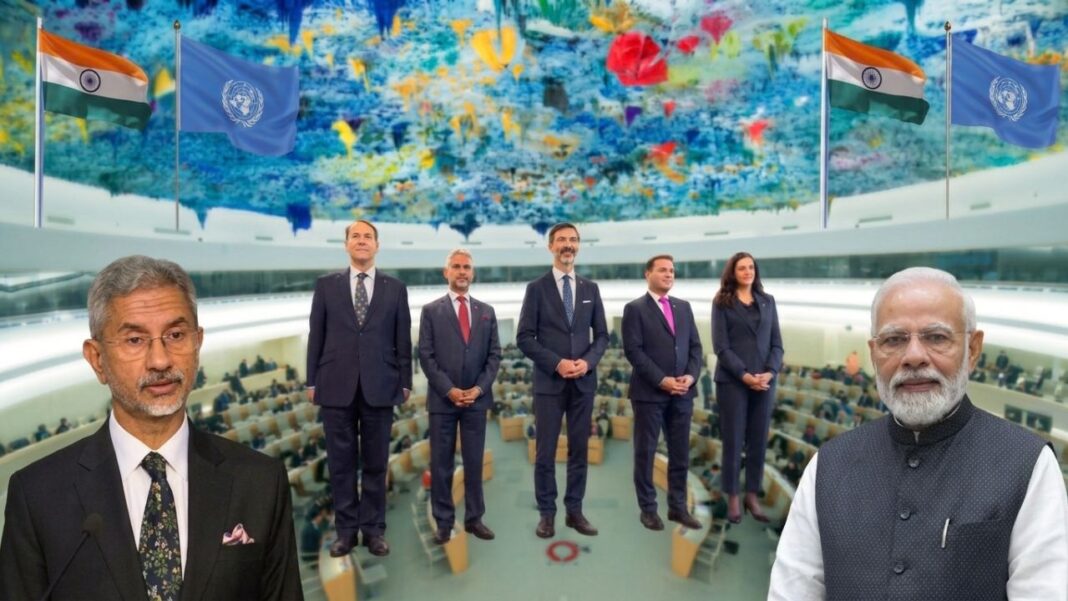

India (Commonwealth Union)_ India’s long-running campaign for a permanent seat on the United Nations Security Council has received fresh support from four European countries, adding another layer to New Delhi’s diplomatic push for reform of the world’s most powerful security body. Accordingly, Poland, Hungary, Slovakia and the Czech Republic are the four members of the Visegrad Group that backed India’s demand during the first V4-India foreign ministers’ meeting held on the sidelines of the 81st UN General Assembly in New York. Slovak Foreign Minister Juraj Blanár said the four countries agreed that India, as an important country of the Global South and an emerging power in the Indo-Pacific, should have a permanent place on the Council.
Also read: From Central Asia strategy to the SCO Summit: Inside Modi’s Kyrgyzstan mission!
For India, the significance of the announcement goes beyond the support of four individual countries. The Visegrad Group is a recognised Central European political and cultural grouping, and its collective position gives New Delhi another bloc of European voices supporting its bid. Accordingly, External Affairs Minister S. Jaishankar described the first V4-India meeting as a new and important development. India and the four countries also agreed to strengthen cooperation in areas such as trade, technology, defence, space, innovation, connectivity and people-to-people exchanges. They plan to hold regular meetings of foreign ministers and establish an annual business forum.
India’s argument for a permanent seat is closely linked to the changing structure of global politics. The Security Council was created in 1945, when much of Asia and Africa was still under colonial rule. Today, countries from these regions account for a large share of the world’s population, economic activity and diplomatic influence. Yet the Council’s five permanent members remain China, France, Russia, the United Kingdom and the United States. The Council currently has 15 members in total, including 10 elected members serving two-year terms. India has also pointed to its experience at the United Nations. It has served eight times as an elected member of the Security Council, most recently in 2021 and 2022. New Delhi has argued that its population, economic importance, peacekeeping contribution and wider diplomatic role support greater representation in the Council.
Also read: How India steered BRICS towards consensus amid global divide!
The V4 endorsement also comes on top of support India has received from several other countries. France has backed permanent seats for India and the other G4 countries: Brazil, Germany and Japan. The United Kingdom has also supported an expanded Council that includes permanent membership for India. The United States and Russia have also expressed support for India’s permanent membership. India is part of the G4, which has proposed expanding the Security Council from 15 to 25 or 26 members. Its model calls for six additional permanent seats, including two for Africa, two for the Asia-Pacific region, one for Latin America and the Caribbean, and one for Western Europe and Others, along with additional non-permanent seats.
The V4 support, however, does not automatically bring reform closer. Changing the Council’s membership requires broad agreement among UN member states and must navigate difficult differences over permanent seats, regional representation and veto powers. The reform process has remained under negotiation for years. Still, the latest endorsement strengthens India’s diplomatic coalition. It also adds to the wider debate over whether the Security Council should better reflect today’s international balance of power. For the UN, the V4 position is therefore less about immediately changing the Council and more about adding political momentum to a reform process that has struggled to produce a final agreement.