

By Wasana Nadeeshani Sellahewa
(Commonwealth) _ According to the American Society of Quality, many firms spend up to 40% of their overall production income on quality-related expenses. The inefficiency of manual inspection, which is the most popular method of providing quality control in manufacturing, accounts for a sizable portion of this expense.
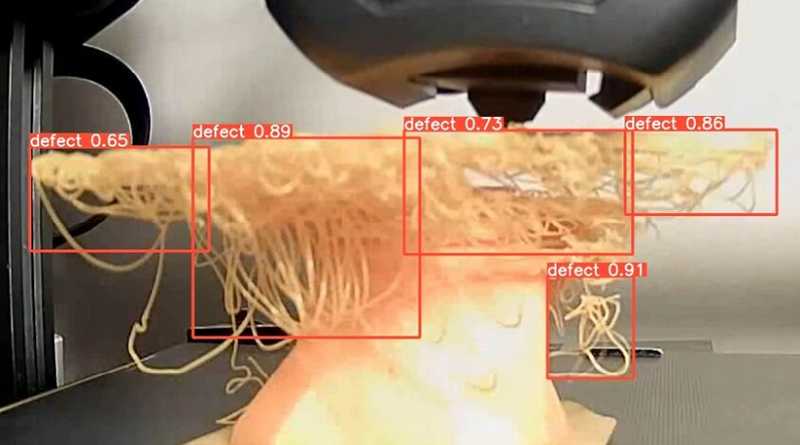
A more efficient and precise method of performing visual inspection in production lines is presented by the application of artificial intelligence for quality control automation. However, there are a number of restrictions on how we can train and use models for defect detection due to standard machine learning techniques. As a result, we’ll go through the benefits of unsupervised learning for defect identification in this post and elaborate on the strategies MobiDev employs in real-world settings.
The use of computer vision to automate tire quality inspection is described by Intel. According to the study, the manufacturing line saved over $49,000 in labor expenditures while improving quality control accuracy from 90% to 99%. However, such systems are not restricted to fixed factory hardware. Drones equipped with cameras, for instance, can be used to evaluate flaws in the pavement or other exterior surfaces, greatly reducing the amount of time needed to traverse a major metropolis.
The pharmaceutical sector gains from examining production lines for various goods. For instance, Orobix uses a particular kind of camera that can be used by an inexperienced human operator to apply fault detection to medication manufacture. The same rationale is used when examining pharmaceuticals.
Food, textile, electronics, heavy manufacturing, and other sectors all have examples of this type of behavior. However, there are several particular issues with our approach to defect detection techniques using conventional machine learning. It becomes challenging to gather sample data for training and to identify it when manufacturers evaluate hundreds of goods every day. Unsupervised learning becomes important in this situation.
Supervised machine learning techniques are used in the majority of applications for machine learning. As part of supervised learning, we manually classify the data that is gathered in order to give the model ground truth information.
Collecting and labeling data for a production line might be problematic since there is no way to collect every variation of cracks or dents on a product to guarantee correct identification by the model. There are four issues here:
problems in collecting a big volume of anomalous data potential for a huge difference between two anomalous samples even when the difference between a normal and an abnormal sample is extremely minor.
Unsupervised machine learning techniques enable you to identify patterns in a data collection without pre-labeled outcomes and identify the underlying structure of the data in situations where it is hard to train the algorithm conventionally. Contrary to supervised learning, the training process requires less work since we anticipate that the model will find patterns in the data with a larger tolerance for variation.
Without any prior awareness of these uncommon things or occurrences, anomaly detection shows them. The dataset’s limited percentage of anomalies is the only information that is currently accessible. This helps to overcome the issue with data labeling and sample collection in terms of defect detection. So let’s examine how unsupervised learning techniques may be applied to the development of defect detection models.
The ability to skip collecting and classifying massive volumes of sample data is perhaps the most advantageous aspect of unsupervised learning approaches. We are not restricted to which model may be utilized for real classification and fault detection when using unsupervised learning approaches to create data patterns. However, since it’s challenging to assess the model’s predictive accuracy, particularly without a labeled dataset, unsupervised learning models are better suited for categorizing already-existing data into classes.