
(Commonwealth) _ Hapag-Lloyd has embarked on a pioneering initiative, collaborating with a world-renowned racing yacht team, to explore the potential of integrating sails for wind-assisted propulsion into its container ships. This endeavor, initiated in early 2023, aims to unravel the advantages and challenges of wind propulsion, seeking to ascertain its financial viability in the realm of container shipping. While certain sectors of shipping, such as bulkers and tankers, have embraced wind-assisted propulsion, container ships, driven by the imperative to optimize cargo capacity, have been slower to adopt this technology. Hapag-Lloyd is scrutinizing a spectrum of factors, spanning operational impacts, training requisites, and regulatory implications. The exploration encompasses financial considerations, weighing the installation costs of these systems against fuel savings, spatial requirements, and the impact on vessel maneuverability and route flexibility when employing wind-assisted propulsion technology. Teaming up with Boris Herrmann and Team Malizia, renowned for setting a world record for monohull vessel distances during The Ocean Race in May 2023, Hapag-Lloyd has completed the initial phase of designing a 4,500 TEU ship. They anticipate concluding the concept study in the upcoming months. Notably, Hapag-Lloyd isn’t the first to tap into the expertise of the racing yacht domain; UK-based BAR Technologies, rooted in ocean racing experience, is progressing with a wind-wing concept ordered for multiple ships. Ocean Network Express (ONE) has also unveiled plans to trial wind-assisted propulsion via a portable wind sail housed within a container-sized assembly.
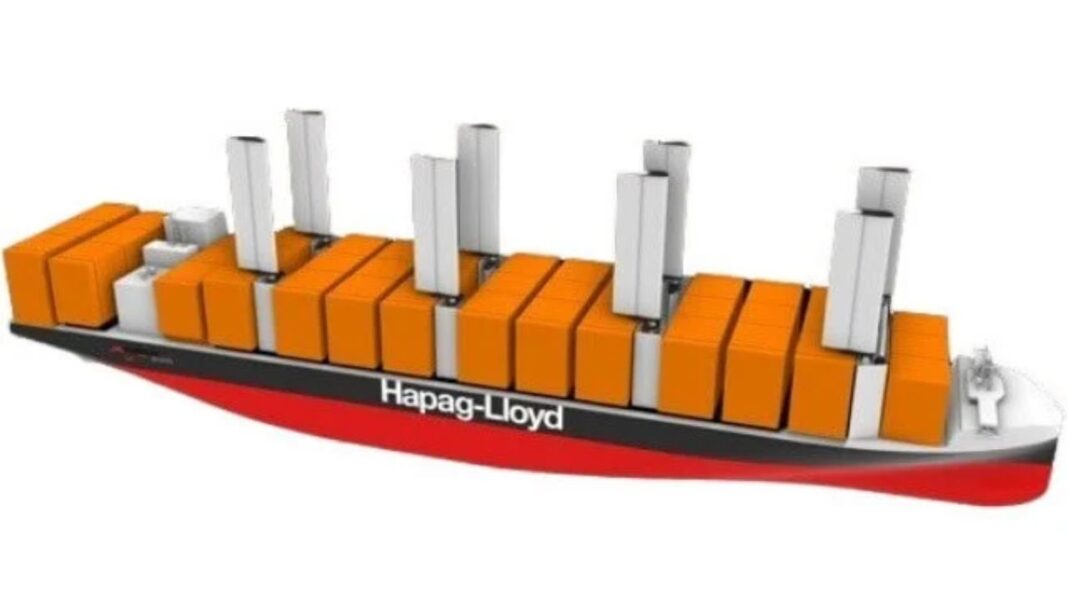
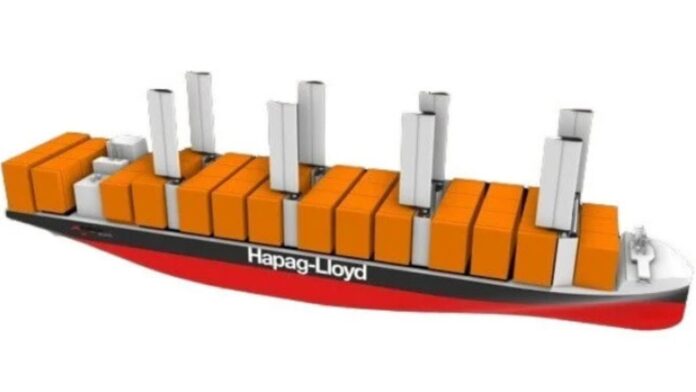
Christoph Thiem, Director of Strategic Assets Projects, and Martin Köpke, Manager of Regulatory Affairs & Sustainability at Hapag-Lloyd, underline the carrier’s historical focus on fuel efficiency through combustion. Yet, they are now turning their attention to alternative fuels due to current fuel availability challenges. Köpke emphasizes the necessity for research and development in leveraging new alternative fuels, which are presently limited in availability and expected to initially entail high costs. In parallel, Hapag-Lloyd is exploring onboard technologies that could curtail fuel consumption to mitigate the foreseen challenges with alternative fuels. Their wind-assisted propulsion concept envisions a newbuild integrating eight sails, totaling 3,000 square meters (over 32,000 square feet) of sail area. Six rear sails are extendable, while two front sails are retractable to avoid hindering cargo operations and vessel navigation. Köpke underscores the pragmatic nature of their designs compared to other futuristic concepts proposed by shipping companies. The ongoing research’s second phase involves computer simulations to gauge the ship’s behavior in diverse weather conditions and estimate potential fuel savings. Factors like varying speeds, slower sailing, different drafts, and the ship’s performance under less than full cargo capacity are under scrutiny.
The team is contemplating a concept wherein, under specific wind conditions and traveling at speeds of 8 to 10 knots, the ship could rely solely on the sail system for propulsion. However, they acknowledge that this concept remains underexplored. Additionally, they’re delving into historical weather data for their Conosur route and other shipping pathways to ascertain the vessel’s suitability for different routes and the extent of benefits. The fluctuating costs of alternative fuels also factor into their considerations. While short-term projections anticipate high costs, these could potentially amplify the advantages of wind-assisted propulsion. Yet, Köpke acknowledges the likelihood of fuel costs decreasing, potentially altering the economic landscape for wind-assisted propulsion within five years. Hapag-Lloyd affirms that the current project is pivotal in amassing quantifiable data on wind-assisted propulsion, serving as a foundational step for their subsequent endeavors.