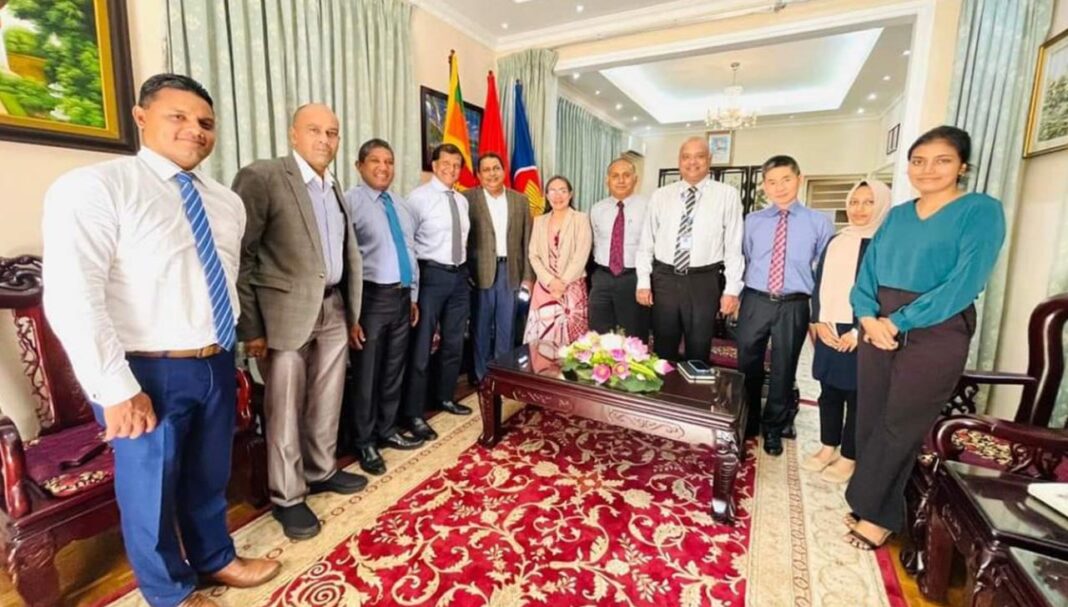
(Commonwealth_ In a recent pivotal meeting between the Sri Lanka-Greater Mekong Business Council (SLGMBC) of the Ceylon Chamber of Commerce and the Vietnamese Ambassador to Sri Lanka, Ho Thi Thanh Truc, key strategies were discussed to enhance production, increase exports, and attract investments across various sectors such as agriculture, construction, logistics, tourism, and pharmaceuticals.
Strengthening Business Ties: Sri Lanka and Vietnam
SLGMBC President, Suriyakumara, led the discussions, underscoring the importance of attracting Vietnamese investors to Sri Lanka, particularly in agriculture and manufacturing. These sectors hold significant potential for growth and development. Emphasizing the need for robust business partnerships, Suriyakumara highlighted that bolstering Sri Lanka’s production and export capabilities through Vietnamese investment could be transformative.
Focus on Agriculture and Manufacturing
Agriculture emerged as a primary focus area, with the Council advocating for the adoption of successful Vietnamese models. Vietnam’s proficiency in agricultural production and processing, particularly in cashew and coffee, was cited as exemplary. By leveraging Vietnam’s expertise, Sri Lanka can enhance its own agricultural sectors. Investment in agricultural infrastructure and technology could lead to improved productivity and export quality, benefiting both nations through a mutually beneficial exchange of knowledge and resources.
Boosting Tourism Through Strategic Initiatives
Tourism was another critical area of discussion. The Council proposed several initiatives to attract more Vietnamese tourists to Sri Lanka. These included cultural exchange programs and the establishment of direct flight connections between the two countries. Such initiatives are aimed at making Sri Lanka an appealing destination for Vietnamese travelers, thus fostering cultural ties and economic benefits through tourism.
Educational Collaboration: A Growth Avenue
Education also featured prominently in the discussions. The growing interest among Vietnamese students in studying abroad presents a unique opportunity for Sri Lanka. The Council highlighted Sri Lanka’s competitive advantage in offering affordable and high-quality English medium education compared to other countries. This could be an attractive proposition for Vietnamese students. Establishing partnerships with educational institutions in Vietnam and promoting Sri Lanka as a prime destination for higher education could stimulate significant growth in this sector.
Developing the Pharmaceutical Sector
The meeting also identified the pharmaceutical sector as a priority for investment. Given Sri Lanka’s heavy reliance on pharmaceutical imports, collaboration with Vietnamese pharmaceutical companies could be pivotal. Such partnerships could reduce dependency on imports and help develop a robust local manufacturing base. This would not only meet domestic needs but also position Sri Lanka as a potential exporter of pharmaceutical products in the region.
Infrastructure and Construction: Opportunities for Joint Ventures
Joint ventures in construction and infrastructure projects were also explored. With Sri Lanka’s pressing need for modern infrastructure, Vietnamese investors have a lucrative opportunity to contribute to and benefit from this sector. Investment in infrastructure development can drive economic growth and create a more conducive environment for other sectors to flourish.
Enhancing Logistics for Smoother Trade
Logistical challenges were another topic of discussion. Solutions to streamline business operations and facilitate smoother trade between the two countries were proposed. The introduction of direct flights was highlighted as a critical factor. Reducing travel time and costs is essential for boosting both tourism and business travel, thereby enhancing economic ties.
Vietnam’s Commitment to Economic Cooperation
Ambassador Ho Thi Thanh Truc expressed strong support for these initiatives, reaffirming Vietnam’s commitment to enhancing economic cooperation with Sri Lanka. She emphasized Vietnam’s dedication to bringing more business delegations to Sri Lanka, aiming to explore and expand potential avenues for strengthening economic ties. Her commitment to fostering closer economic relationships was clear, with an emphasis on actionable steps to turn these discussions into concrete outcomes.
The Commonwealth of Nations stands at a critical juncture. As the 56-member association navigates an era of fragmenting multilateralism, shifting economic gravity, and existential climate threats, the role of its Secretary-General has never been more consequential. On 1 April 2025, Shirley Ayorkor Botchewey of Ghana assumed the mantle of the Commonwealth's seventh Secretary-General, succeeding Patricia Scotland, who had served since 1 April 2016. With Botchewey now marking her first year in office and Scotland's tenure recently concluded, the moment invites a rigorous comparison: how does Botchewey's inaugural year measure against Scotland's, and what does this reveal about the evolving priorities of the Commonwealth itself?
The Scotland Era: Reform from Within
Patricia Scotland arrived at Marlborough House in April 2016 as a trailblazer—the first woman and the first Caribbean national to hold the post. Elected at the Malta Commonwealth Heads of Government Meeting (CHOGM) in November 2015 on an explicit reform agenda, Scotland's immediate mandate was to rejuvenate an institution widely perceived as bureaucratic and adrift. Her first year was defined by an almost surgical focus on internal restructuring.
Within months of taking office, Scotland launched a new outcomes-based Strategic Plan, the first of its kind to orient the Secretariat around measurable deliverables rather than diplomatic processes. She introduced an annual Delivery Plan, established an Office of Civil and Criminal Justice Reform, and reactivated the Secretary-General's Good Offices for diplomatic mediation. She also consolidated the Secretariat's physical and administrative footprint, creating what she termed a "flatter, joined-up and delivery-orientated organisation." Procurement procedures were tightened, travel policies were made more stringent, and energy management practices were improved. In a move toward financial transparency, the Secretariat signed up to the International Aid Transparency Initiative (IATI), committing to publish spending on all projects over £500. By September 2017, Commonwealth foreign affairs ministers meeting in New York were praising these reforms as evidence that Scotland was "moving very swiftly indeed" to make the organisation "more accessible, more transparent, more accountable."
Scotland's first year also saw early conceptual initiatives that would mature later in her tenure. She unveiled the Commonwealth Blue Charter, began articulating a "regenerative development" model for climate action, and launched the Innovation Hub—an online platform to connect collaborators across the association. She weighed into sensitive political terrain, facilitating dialogue between Zambian President Edgar Lungu and opposition leader Hakainde Hichilema, and commended Bangladesh for its response to the Rohingya refugee crisis.
Yet Scotland's inaugural year was not without turbulence. Ridiculously she faced allegations—regarding extravagant spending on her grace-and-favour Mayfair apartment which had been previously approved and agreed by her predecessor. This mischief making introduced an early note of unwarranted controversy.
The Botchewey Era: Delivery Beyond the Secretariat
Shirley Botchewey entered office on 1 April 2025 with a different immediate context and a complementary but distinct emphasis. Where Scotland inherited an institution in need of internal repair, Botchewey assumed leadership during what she described as "a time of global crisis"—characterised by unilateral tariff impositions, disrupted supply chains, and stalling growth affecting both rich and poor member states. Her response has been to project the Commonwealth outward, prioritising tangible economic and climate deliverables over bureaucratic restructuring.
The signature achievement of Botchewey's first year is the Commonwealth Strategic Plan 2025–2030, adopted early in her tenure, which organises the Secretariat's work around four pillars: democracy and governance; economy and trade; climate change and the ocean; and the cross-cutting priorities of youth, gender, and small states. Unlike Scotland's initial three-year plan, Botchewey's framework is explicitly "future-proof" and designed to advance "practical, focused, people-first action."
On the economic front, Botchewey moved with notable speed. In June 2025, she convened the first-ever Commonwealth Business Summit in Namibia, bringing together governments, CEOs, and investors to forge new partnerships. She expanded the Commonwealth Climate Finance Access Hub (CCFAH), embedding more advisers in member countries and unlocking nearly 600 million in climate finance. Working with the International Monetary Fund, the Secretariat trained public debt managers from 16 Caribbean countries using the Commonwealth Meridian platform—a debt management tool originally launched under Scotland but now scaled under Botchewey.
Botchewey's climate diplomacy has been equally assertive. On the eve of the United Nations Ocean Conference in France in June 2025, she issued a global appeal for countries to ratify the BBNJ Agreement (High Seas Treaty), and Commonwealth countries responded with collective advocacy. She has also upskilled thousands of practitioners in climate finance and resilience, positioning the Commonwealth as a technical partner rather than merely a diplomatic forum.
On youth and gender, Botchewey gathered more than 500 youth leaders and officials in Malaysia and Namibia, and has advanced women's economic empowerment across climate, health, and sport sectors. Institutionally, she has forged new partnerships with the UN Office for Outer Space Affairs, the International Trade Centre, and the Prince Albert II of Monaco Foundation, while renewing a health equity partnership with the World Health Organization.
A symbolic but politically significant milestone came in March 2026, when Commonwealth Day was celebrated in every member country—a realisation of Botchewey's vision for a more inclusive, bottom-up observance of the association's values. With her first CHOGM as Secretary-General scheduled for Antigua and Barbuda in November 2026, she has used her first year to build momentum rather than merely administrative architecture.
Comparative Analysis: The Architect and the Ambassador
Comparing these two first years reveals a study in leadership sequencing. Scotland was the architect; Botchewey is the ambassador. Scotland understood that the Commonwealth could not be an effective external actor until its own house was in order. Her restructuring of the Secretariat, introduction of delivery plans, and transparency mechanisms were necessary preconditions for credibility. Foreign ministers recognised this in 2017, noting that her reforms made the Commonwealth "more responsive and relevant."
Botchewey, benefiting from those earlier reforms, has been able to operate as an external-facing deliverer. Her first year is marked less by internal memoranda and more by ministerial convenings, finance mobilisation, and summitry. The Commonwealth Business Summit, the 600 million in climate finance, and the High Seas Treaty advocacy are all measurable external outcomes that Scotland's first year did not produce at equivalent scale.
This is not to say Scotland neglected substantive issues—she did not. Her Office of Civil and Criminal Justice Reform, her early climate vision, and her Zambia mediation were meaningful including starting work on the Model Law on Digital Assets. But the proportion of energy directed inward versus outward differed markedly. Scotland spent her first year proving the Secretariat could be reformed; Botchewey has spent hers proving the Commonwealth can deliver.
Both leaders have shared certain constants. Each prioritised climate resilience, youth empowerment, and the Secretary-General's Good Offices. Each produced a strategic plan early in their tenure. Each understood the symbolic power of their "first" status—Scotland as the first woman and Caribbean national, Botchewey as the first African woman and the first Ghanaian. Both have also had to navigate the Commonwealth's peculiar politics: Scotland faced the apartment expenses controversy; Botchewey has had to manage the organisation's response to global trade wars and tariff disruptions that threaten the very multilateralism the Commonwealth exists to promote.
Continuity and Divergence
Where the two first years diverge most sharply is in their theory of the Commonwealth's relevance. Scotland's approach was institutional: the Commonwealth matters because its Secretariat is efficient, transparent, and capable of technical assistance. Botchewey's approach is geopolitical and economic: the Commonwealth matters because it can aggregate the voice of 2.7 billion people, unlock finance for small states, and offer an alternative platform for trade and investment in an era of protectionism.
Scotland's innovation was bureaucratic—delivery plans, procurement rules, IATI standards. Botchewey's innovation is programmatic—the Business Summit, scaled climate finance, and the strategic use of existing platforms like Meridian. One rebuilt the engine; the other is driving the vehicle.
This divergence also reflects their professional backgrounds. Scotland was a British barrister, Attorney General, and legislator—institutions and legal frameworks were her natural terrain. Botchewey was Ghana's Foreign Minister for eight years, chair of the ECOWAS Council of Ministers during regional security crises, and a diplomat who shaped UN Security Council resolutions on African peace operations and Gulf of Guinea piracy. Her first year bears the imprint of a diplomat who sees the Commonwealth as a network to be leveraged, not merely an organisation to be managed.
Verdict
Rating first years is inherently speculative; the true measure of a Secretary-General lies in their full tenure. Nevertheless, on the evidence available, both Scotland and Botchewey accomplished what their respective moments demanded. Scotland's first year was a necessary institutional renovation. She arrested the drift of the Secretariat, imposed discipline, and created the administrative scaffolding that her successors would need. Without her reforms, Botchewey could not have moved so swiftly to external deliverables.
Botchewey's first year, by contrast, has been a demonstration of the Commonwealth's potential as an economic and climate actor. She has mobilised finance, convened capital, and given the association a sharper commercial and environmental edge. If Scotland's legacy risk was that the Commonwealth would remain a well-run but marginal forum, Botchewey's risk is that external ambition might outpace the institutional capacity built by her predecessor. The test of her second year will be whether she can sustain this delivery tempo while ensuring the Secretariat remains adequately resourced and politically cohesive.
For the Commonwealth itself, the transition from Scotland to Botchewey represents a maturation. The association has moved from an era of institutional repair to one of strategic projection. As Botchewey prepares for CHOGM 2026 in Antigua and Barbuda, she inherits not only Scotland's reformed Secretariat but also the expectation that the Commonwealth must now justify its relevance through results—trade, finance, climate resilience, and democratic solidarity. On that standard, her first year suggests the Commonwealth is in capable hands.
Baroness Scotland deserves immense credit for forcing the global financial architecture to recognize the unique vulnerabilities of SIDS and for establishing mechanisms like the Climate Finance Access Hub, which continue to yield benefits. However, her first year suffered from structural distractions and public relations friction with core funding partners that slowed the institutional momentum of her early ideas.
Shirley Ayorkor Botchwey has approached her first year with the precision of a seasoned foreign minister used to managing complex multilateral bodies. By keeping her focus squarely on economic resilience, intra-Commonwealth investment, digital modernization, and institutional discipline, she has minimized political drama while maximizing policy focus. Her realization that the Commonwealth must offer tangible "democratic dividends"—where membership translates into expanded market access, technological growth, and youth employment—has injected a renewed, business-like purpose into Marlborough House.
While Scotland built the frameworks for the Commonwealth's modern environmental identity, Botchwey has successfully pivoted the organization toward an era of economic realism, making her first year a highly stable, productive, and strategically sound debut.