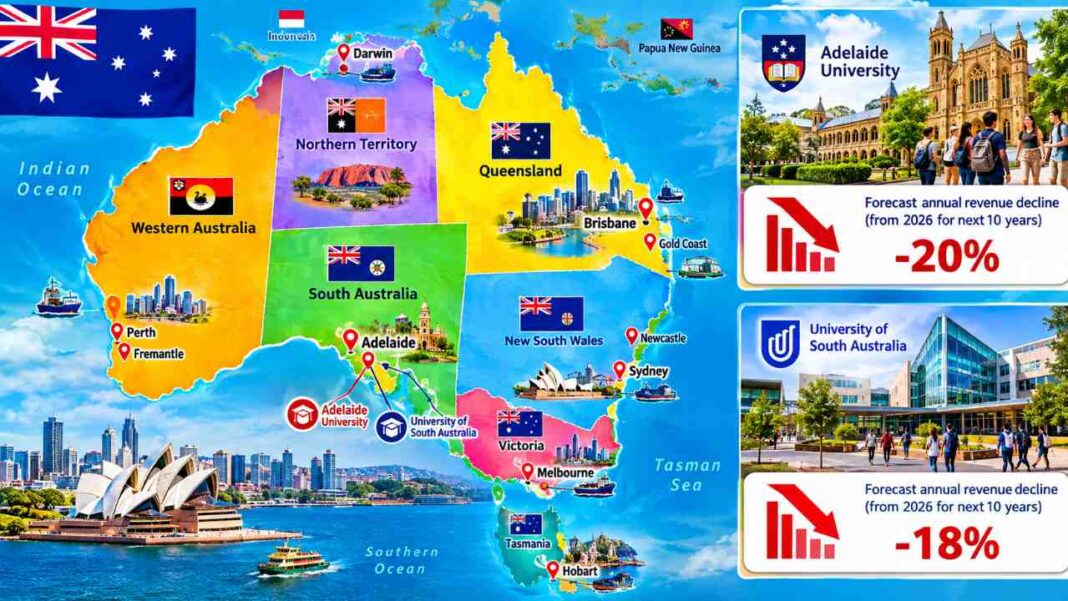

Migration policy changes reshape the financial outlook for South Australia’s newly consolidated university.
Adelaide University’s ambitious merger is facing an unexpected financial challenge, with a sharp decline in international student enrollments threatening revenue assumptions that formed an important part of the institution’s original business case.
The university, created through the combination of the former University of Adelaide and the University of South Australia, began operating at the start of 2026 following a merger process supported by hundreds of millions of dollars from the South Australian Government. The new institution was designed to create a larger and more internationally competitive university while generating long-term economic and research benefits for the state.
However, international student recruitment has fallen substantially below expectations during the university’s first year.
According to figures reported by the ABC, Adelaide University recorded 16,677 individual international students in 2026, compared with 20,820 international students enrolled at the two predecessor universities at the equivalent point in the previous year. The university also reported that international enrollments were about 40% below target during the first semester.
The shortfall has financial consequences because overseas students generally pay substantially higher tuition fees than domestic students. In May, Vice-Chancellor Professor Nicola Phillips warned that the university was facing a projected revenue gap of about AUD 90 (USD 63) million for 2026 after international enrolments failed to meet expectations.
The problem is particularly significant because the merger’s business case anticipated considerable growth in overseas student numbers. Planning documents envisaged the new university attracting an additional 6,000 international students by 2034 compared with the combined enrollment position of the former institutions in 2023.
That assumption was developed before Australia’s federal government introduced a series of measures aimed at reducing migration and moderating the growth of international education.
Among the changes have been a substantial increase in the visa application fee for students, tighter scrutiny of visa applications, and restrictions on the number of new international students that universities can enroll. More recently, the federal government announced measures affecting international students seeking to bring family members to Australia.
Adelaide University Deputy Vice-Chancellor of International and External Engagement Professor Jessica Gallagher said the changing policy environment had materially affected Australia’s appeal as a destination for overseas students. She said the institution had experienced a significant increase in student visa refusals and warned that achieving the previously established international enrollment ambitions may now be considerably more difficult.
The university has also been affected by the concentration of its international recruitment in markets where visa refusal rates have reportedly been comparatively high. Gallagher identified India, Bangladesh, Sri Lanka, and Nepal among the markets contributing to the university’s exposure to the changing visa environment.
The scale of the financial challenge places renewed attention on the economics of the merger itself. South Australia’s government committed more than $400 (USD 280) million to the project, with the broader package reported at $464.5 (USD 325.15) million. The funding included $30 (USD 21) million earmarked for initiatives intended to attract international students.
The merger business case estimated the overall cost of the project at between $500 (USD 350) million and $650 (USD 455) million and identified weaker student demand as a potentially greater challenge than cost overruns.
Adelaide University, however, has stressed that the rationale for combining the two institutions extended beyond overseas student recruitment. The South Australian Government has pointed to the university’s research capacity, global standing, and links with strategically important industries, including defense, mining, and critical minerals.
State Development Minister Chris Picton dismissed the notion that the merger’s evaluation would hinge primarily on international student numbers. He stated that the project aimed to enhance South Australia’s economic opportunities on a broader scale.
There have nevertheless been signs that the new institution is gaining international academic visibility. Adelaide University moved to 79th in the 2026 QS World University Rankings, compared with 82nd the previous year. Times Higher Education ranked it 133rd, while the Academic Ranking of World Universities placed it between 101st and 150th.
The merger of the two former institutions was completed, and the university officially opened in January. The South Australian Government described the creation of the new university as a major structural change intended to produce long-term benefits for the state’s students, research sector, and economy.
For Adelaide University, the immediate task is therefore to balance the financial impact of weaker international recruitment against the longer-term objectives behind the merger. Professor Phillips has indicated that the university does not intend to undertake a radical workforce restructuring while emphasizing the necessity of careful financial management during the next several years.
The experience also highlights the vulnerability of Australia’s university sector to rapid changes in migration and visa policy. Institutions that built financial strategies around continued growth in overseas enrollments are now operating in a markedly different environment.
Consequently, observers may closely monitor the performance of South Australia’s new flagship university. Its ability to manage the international student downturn while maintaining teaching, research, and industry ambitions may become an important measure of how successfully the state’s largest higher education merger adapts to a changing national policy landscape.