


Colombo Port transshipment growth accelerates as Colombo West International Terminal (CWIT) ramps up operations with record container volumes. The latest figures reflect strong gains in container volumes. As Sri Lanka’s largest maritime gateway continues to strengthen its position as South Asia’s leading transshipment hub.
The Port of Colombo delivered another robust performance 2 months ago in April ’26. This was driven by a sharp increase in transshipment activity. It comes in the wake of rapid expansion of the CWIT. The latest operational data reflects growing demand for Sri Lanka’s port services. This is whilst reinforcing the country’s strategic role in regional besides global shipping networks.
Container transshipment volumes climbed 22.6% year-on-year to 607,240 Twenty-foot Equivalent Units (TEUs) in April ’26. When compared with only 495,456 TEUs handled during the corresponding month a year ago in ’25. During the 1st 4 months of ’26, cumulative transshipment throughput reached 2,321,704 TEUs. This represents a healthy 14.2% increase over the same period last year.
The continued expansion follows a record-breaking performance in ’25. An all-time high of 8.29 million TEUs was handled by Colombo Port. This clearly further cemented its status as the premier South Asia transshipment hub. Overall container throughput also posted strong growth. It increased 22% year-on-year to 761,096 TEUs during April ’26.
A major contributor to this impressive momentum has been the rapid scaling of CWIT. Developed under a 35-year Build, Operate & Transfer (BOT) agreement involving Adani Ports, John Keells Holdings besides the Sri Lanka Ports Authority (SLPA), the USD 800 million terminal began commercial operations a year ago in April ’25.
As Colombo’s 1st fully automated deep-water container terminal, CWIT has significantly expanded handling capacity. This is whilst easing congestion that had previously constrained operations at existing terminals at recent times.
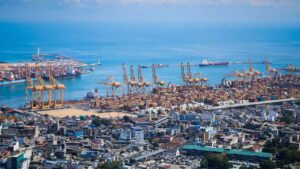
CWIT handled 152,262 TEUs during April ’26. This amounts to an extraordinary 1,242.2% increase when compared with 12,438 TEUs processed during its 1st month of operations during April ’25. On a cumulative basis, CWIT handled 502,066 TEUs during the 1st 4 months of ’26. This reflects a remarkable 3,039.9% growth over the same period last year.
New cargo shifts towards the modern terminal. Traffic distribution across Colombo’s existing facilities has also evolved. The SLPA-operated terminals – Jaya Container Terminal (JCT), Unity Container Terminal (UCT) besides East Container Terminal (ECT), recorded a marginal decline of 0.5% in April ’26. SLPA collectively handled 180,952 TEUs, when compared with 181,934 TEUs a year earlier.
Meanwhile, Colombo International Container Terminals (CICT) remained this seaport’s largest individual terminal operator by throughput. CICT handled 273,417 TEUs during April ’26. This was despite a modest 2.6% year-on-year decline.
South Asia Gateway Terminals (SAGT) recorded a more encouraging performance. SAGT’s container volumes increased 3.8% to 154,465 TEUs. It reflected a gradual recovery in throughput.
Domestic cargo activity also reflected positive economic momentum, beyond trans-shipment. Sri Lanka port throughput received additional support from rising import volumes. This increased 27% to 59,287 TEUs in April ’26 from 46,677 TEUs a year earlier. Cumulative imports for the 1st 4 months reached 219,227 TEUs. That’s up 9.7% when compared with the same period in ’25.
Export container volumes also remained resilient. Shipments increased 2.6% year-on-year to 23,348 TEUs in April ’26. This was whilst cumulative exports reached 100,527 TEUs. It represents a 3.4% increase over the corresponding period last year.
In supporting future demand, the SLPA has announced an ambitious investment programme valued up to USD 2 billion. It’s aimed at expanding the port’s long-term capacity. Current handling capacity standing at around 10 million TEUs. Annual demand’s already approaching 9.3 million TEUs. Authorities have highlighted the urgent need to avoid congestion besides costly vessel waiting periods.
Together with the sustained development of the East Container Terminal, future expansion phases at CWIT are expected to increase Colombo’s total handling capacity to approximately 14 million TEUs over the coming years. Such investment s are expected to reinforce Colombo’s competitiveness as global shipping routes continue to evolve.