
India (Commonwealth Union)_ India is facing a moment of serious strain with some of the US government’s recent decisions. What was once a relationship built on strategic friendship and shared interests now looks strained to a greater extent. For India, the way recent US policies hit on trade, immigration, diplomacy, and technology feels like more than an annoyance, as it threatens the key pillars of foreign policy, economic growth, and its rising tech industry. This article discusses how India is weathering the impacts of recent US moves and why each matters so heavily.
Also read: Maldives teams up with Alibaba to help local businesses go global!
Massive H‑1B fee hike impacts tech and talent
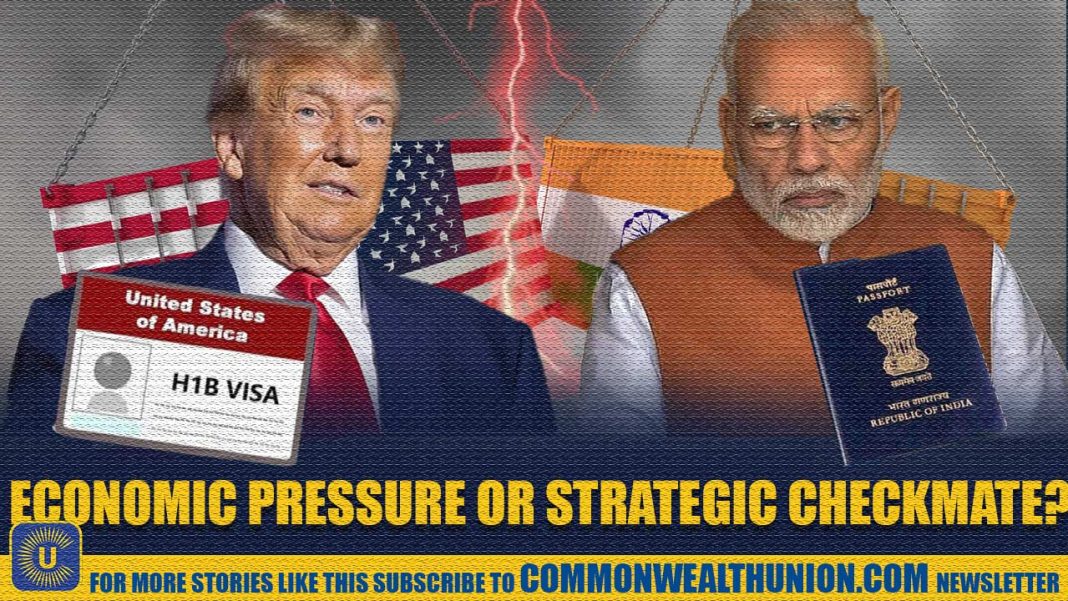
One of the biggest shocks for India’s technology sector is the new US rule setting a $100,000 fee for new H‑1B visa petitions. The government in Washington has fixed a one-time payment of a $100,000 fee for the H‑1B visa petitions and clarified that this fee will apply only to new petitions filed from a specified date, not renewals, and not to people holding current visas. Though it gives relief to some extent, it still creates major uncertainty for new visa petitioners.
Furthermore, India sends tens of thousands of tech workers each year to the US under the H‑1B program. That flow makes up a large share of revenue for Indian companies and also helps build skills and networks. A huge one‑time fee changes cost calculations sharply. Even if it’s only for new visa seekers, firms must rethink hiring and project planning. Additionally, there is uncertainty about exactly who is affected, when it starts, and how renewals or entries from abroad will work. This kind of ambiguity slows investment and planning. As a result, Indian workers and families feel the consequences, including travel restrictions, delays, and extra costs. Many rely on predictable visa paths to plan overseas work, education, or reuniting with family. Overall, the tech and outsourcing sectors are vulnerable to both cost shock and talent disruption.
Fifty‑percent tariffs cause trade disruption and strain on exports
The US has put 50% tariffs on semi-finished copper and copper derivative items imported from other countries, including India. In 2024-25, India exports copper plates, tubes, and similar semi-finished commodities to the US valued at approximately US$360 million. These will now cost US buyers much more, making Indian exports less competitive. Though some analysts say the impact will be limited (because India is also a large importer of copper, so the trade is not symmetric), exporters in copper value‑added sectors face shrinking demand from the US. Indian products become less price-competitive against suppliers from countries where these tariffs make less difference for those whose costs already factor in higher duties. This could hurt jobs in those industries, especially in places where copper processing or fabrication is a source of employment.
Also read: Messi, World Leaders, and Millions of Indians: How Modi’s 75th Birthday Made Global Headlines
US rejects India’s WTO consultations
When India contacted the World Trade Organization for discussions on the US’s 50% tariffs on copper and derivative products, the US declined, claiming that the tariffs are not “safeguard measures.” Hence, India’s ability to use WTO dispute mechanisms is being hampered, making it more difficult to respond formally. This denial breeds mistrust. If trading partners are unable to seek redress under international law, India may perceive future US trade policies as less predictable or less governed by standards. It also narrows India’s options: accept the tariffs, negotiate bilaterally (where it may be weaker), or retaliate in ways that may have political or economic consequences.
Damage to export sectors and job losses
Because many Indian goods currently face high US tariffs (50% in some cases), entire industries are threatened. For example, labor-intensive industries such as textiles, apparel, leather, gems and jewelry, and seafood rely heavily on the US market. Tariffs limit their viability, leading to fewer orders, slower growth, and possibly layoffs. Medium and small exporters, who may have less cushion (in terms of capital, market diversification, or alternate customers), are especially vulnerable. Lower foreign demand can ripple through supply chains in India, affecting raw material suppliers, transport, warehousing, and employment. In some cases, India estimates that tens of billions of dollars of exports are being caught by new US tariff measures.
Uncertainty in policy impacts business, students, diplomacy, and all sectors
It’s not only the concrete policy steps that hurt; it is also the unpredictability surrounding them. For example, visa rules are changing with relatively little warning. Whether the new H‑1B fee is annual or one‑time, where it applies, whether someone travelling abroad can re‑enter, etc., all this causes businesses to delay decisions. Trade sanctions and duties are shifting. What was excluded now might be included. What was promised in bilateral talks might be under threat. Students and professionals see the US as a less stable destination. Hence, many are now considering alternate countries like Canada, the UK, and Australia for study or work. This affects India’s soft power as well as remittances, educational fees, and diaspora networks.
Also read: Jaismine Lamboria’s Journey from Bhiwani to World Champion
Foreign policy and strategic trust signal risks
Beyond economics, these decisions have diplomatic consequences. India has long tried to maintain strategic autonomy, balancing relationships with various powers. US behavior that seems to sidestep Indian interests (trade punitive measures, refusal of WTO remedies, criticisms over energy deals) sends a signal that India is not always a partner whose concerns will be respected. Additionally, the USA’s closeness to Pakistan continues to be a sore point. If the US provides military or economic support or gives tacit approval despite cross‑border concerns, India views that as unfair and damaging to trust. Also, pressure from the US to shift India’s energy purchase decisions (especially from Russia) or defense import patterns raises questions about India’s sovereignty in foreign policy choices.
Technology sector vulnerability
India’s IT and software exports depend heavily on access to the US, both for clients and for the movement of skilled people. The new visa fee and tariff regimes impact this sector. Projects requiring Indian staff to travel to the US on H‑1B or related visas have become costlier and more complex. As a result, US clients may delay or shrink contracts in response to higher costs or regulatory risk back home. Some outsourcing may shift to countries deemed less risky. Additionally, rising uncertainty may halt investment and make it more difficult to hire foreign expertise for smaller IT enterprises.
Domestic response: A push towards self‑reliance and market diversification
India is already reacting to this pressure. The government is advocating “Swadeshi,” or consuming more products made in India, elevating manufacturing products in India, and asking people and businesses to rely less on imports and international brands. Exporters are looking to move their markets away from the US and toward Europe, Africa, and Southeast Asia, potentially giving more stable demand and lower tariffs. Manufacturers are reconsidering their supply chains from their source of raw materials to their final assembly or value-added process. While this helps to relieve some shocks, it is neither straightforward nor quick. Reorienting industries requires time, investment, legislative assistance, and market access.
Risk of broader economic slowdown
As many sectors are interlinked, damage in one area can quickly ripple out. If exports drop, GDP growth could slow. Jobs lost in exporting firms hurt income and reduce demand in related sectors (transport, retail, and services). Higher costs for companies (due to visa fees, tariffed raw materials, or inputs) may force them to raise prices or reduce margins, which can squeeze both consumers and shareholders. Investor confidence may waver if the business environment seems more volatile, especially for foreign investment in tech, manufacturing, or heavy industry.
Areas where India needs to strengthen to reduce vulnerability
Given these pressures, India’s ability to withstand US policy shifts depends on how it responds.
- Negotiation and diplomacy: Using forums like the WTO more aggressively, seeking clearer bilateral trade agreements with safeguards.
- Policy predictability at home: Ensuring Indian exporters and tech firms can plan ahead with clarity about tax, regulation, and labor. Strong domestic infrastructure and regulatory support will matter.
- Market diversification: Planning both export markets and supply sources. Shifting to other markets. Less reliance on the US for output, markets, and skilled movement will reduce exposure.
- Building domestic capacity: Focusing on sectors vulnerable to US tariffs (copper, textiles, leather, and tech), investing in value addition, innovation, and quality so Indian goods compete above just low cost.
- Supporting workers and students: Recognizing that visa rules and education paths are being disrupted, ensuring protections, alternatives, and support for talent. Choosing alternate destinations for work and education.
A delicate crossroads
India is vulnerable right now, not because the country is weak, but because the US policies are shifting in ways that affect many of India’s engines of growth, including trade, tech, talent, and diplomacy. The stakes are high. If India responds well, reinforcing its own strength, diversifying, and negotiating wisely, it could emerge more resilient. But the margin for misstep is narrowing. The US remains an enormously important partner, and India will need to balance pushback with cooperation to protect its interests.