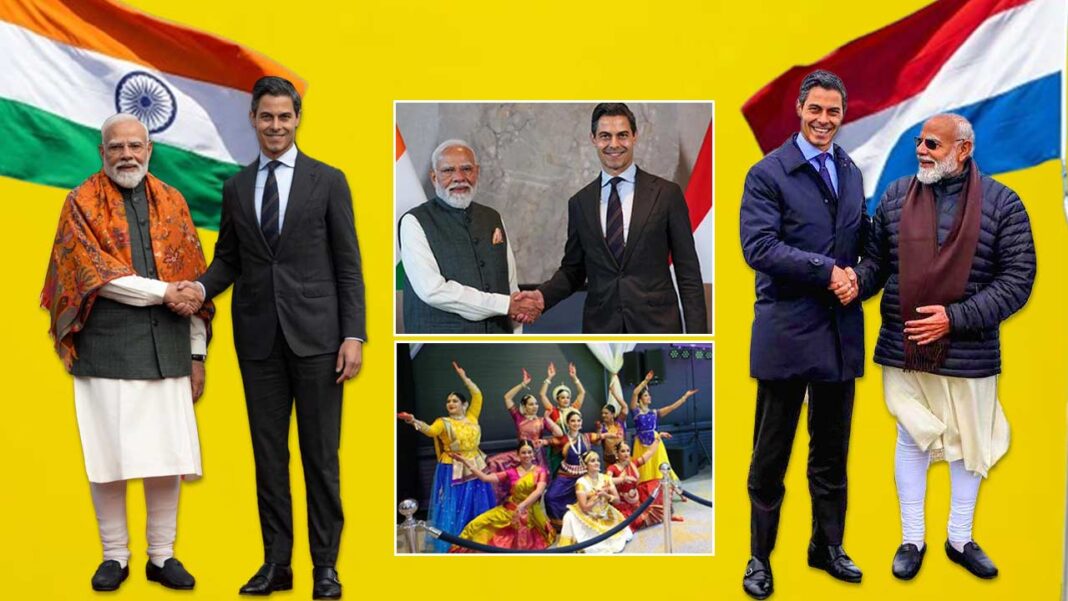

India (Commonwealth Union)_ Prime Minister Narendra Modi’s two-day visit to the Netherlands in May 2026 marked a major step forward in India’s growing engagement with Europe. The visit, held at the invitation of Dutch Prime Minister Rob Jetten, focused on strengthening cooperation in trade, technology, clean energy, defence, semiconductors and climate-resilient infrastructure. This was Modi’s second visit to the Netherlands as Prime Minister and came at a time when India and the European Union are pushing for closer economic and strategic cooperation. The tour was part of Modi’s broader European outreach aimed at expanding India’s partnerships in advanced technologies, supply chains and sustainable development. The visit ended with India and the Netherlands upgrading their relationship to a “Strategic Partnership” and announcing 17 major outcomes covering multiple sectors.
A grand welcome in the Hague
Prime Minister Modi arrived in the Netherlands to a ceremonial welcome led by senior Dutch officials. At the airport, he was received by Rear Admiral Ludger Brummelaar, Dutch Foreign Minister Tom Berendsen, Indian Ambassador Kumar Tuhin and other dignitaries. Soon after his arrival, Modi travelled to The Hague, where he was hosted by King Willem-Alexander and Queen Máxima at the Royal Palace Huis ten Bosch. The Dutch royals also hosted a luncheon in his honour. The meetings reflected the growing warmth in India-Netherlands ties. Both sides discussed expanding cooperation in technology, innovation, sustainable growth, trade and water management. Modi later said that India and the Netherlands are connected not only through shared interests, but also through a common vision for building a future-ready and sustainable world.
Strong connect with the Indian diaspora
Prime Minister Modi also interacted with members of the Indian community in The Hague. Hundreds of supporters gathered outside his hotel waving Indian flags and cheering his arrival. During a community event, Modi praised the Indian diaspora for acting as a “living bridge” between India and the Netherlands. He highlighted India’s progress in infrastructure, renewable energy and space exploration, telling the audience that India is undergoing an unprecedented transformation. Modi also announced that Overseas Citizen of India card eligibility for the Surinamese-Hindustani community had been extended from the fourth generation to the sixth generation, a move warmly welcomed by the diaspora. The Indian community event also featured cultural performances celebrating Indian traditions and heritage.
Also read: What’s next in digital banking? Introducing the Commonwealth Digital Financiers Network
Bilateral discussion: Focus on trade, technology and strategic cooperation
The main agenda of the visit centred on strengthening economic and strategic ties between the two countries. During bilateral talks with Prime Minister Rob Jetten, Modi discussed cooperation in semiconductors, renewable energy, digital infrastructure, artificial intelligence, maritime security, defence and critical technologies. The leaders also exchanged views on global developments, including the Ukraine war and the situation in West Asia. Both countries stressed the importance of maintaining freedom of navigation and uninterrupted global trade through the Strait of Hormuz, a key route for global energy supplies.
The two leaders welcomed the successful conclusion of negotiations for the India-European Union Free Trade Agreement earlier in 2026. They said the agreement would deepen economic links between India and Europe and improve investments, market access and supply-chain resilience. India and the Netherlands also welcomed the signing of the India-EU Security and Defence Partnership, which is expected to increase cooperation in strategic sectors.
Major agreements signed
Strategic Partnership Roadmap 2026-2030
One of the biggest outcomes of the visit was the launch of the India-Netherlands Strategic Partnership Roadmap 2026-2030. The roadmap sets the direction for cooperation in key sectors over the next five years. It covers defence, semiconductors, renewable energy, digital technology, mobility, education, health and climate adaptation. Officials from both countries described the roadmap as a major upgrade in bilateral relations and a framework for long-term cooperation.
Also read: Inside Modi’s UAE mission: What India gained from PM Modi’s UAE visit?
Semiconductor push and ASML partnership
Semiconductors emerged as one of the most important focus areas during the visit. The Netherlands is home to ASML, the world’s only manufacturer of extreme ultraviolet lithography machines used to produce advanced semiconductor chips. India has been aggressively expanding its semiconductor ambitions, making Dutch cooperation strategically important. During the visit, Tata Electronics and ASML signed a partnership agreement to support the semiconductor fabrication facility being developed in Dholera, Gujarat.
Indian officials described the agreement as a landmark step for India’s semiconductor ecosystem. Both governments also welcomed expanded cooperation under the semiconductor and emerging technologies partnership framework. This includes investment, research collaboration, talent exchange and educational initiatives. The leaders appreciated efforts to connect the Dutch Semicon Competence Centre with the Indian Semiconductor Mission and welcomed the continuation of the Indo-Dutch Semicon Online School programme.
Clean energy and green hydrogen cooperation
Clean energy was another major pillar of the visit. India and the Netherlands agreed to deepen cooperation in green hydrogen, offshore wind energy and energy transition technologies. The Netherlands has emerged as a European leader in sustainable energy innovation, while India is rapidly scaling up its renewable energy capacity. Both countries announced a Green Hydrogen Roadmap and agreed to establish a Joint Working Group on Renewable Energy. An energy transition arrangement was also signed between NITI Aayog and Dutch institutions to support collaboration on clean energy policies and sustainable technologies. The discussions reflected India’s growing interest in securing advanced green technologies and building resilient clean-energy partnerships with Europe.
Water management and climate-resilient infrastructure
Water management formed another important part of Modi’s agenda in the Netherlands. The Dutch are globally known for their expertise in flood control, delta engineering and climate-resilient infrastructure. India, which faces increasing flooding and extreme weather events, is seeking Dutch support in these areas.
Also read: This Commonwealth nation dominates the Global Governance Rankings!
Major takeaways of the visit
India and the Netherlands announced 17 major outcomes during the visit:
- India-Netherlands Strategic Partnership Roadmap 2026–2030
- Return of Chola copper plates
- Mobility and migration cooperation
- Tata Electronics-ASML semiconductor partnership
- Critical minerals cooperation
- Technical cooperation for Gujarat’s Kalpasar project
- Green Hydrogen Roadmap
- Joint Working Group on Renewable Energy
- NITI Aayog-Netherlands energy transition arrangement
- Indo-Dutch Centre of Excellence for Flowers in West Tripura
- Indo-Dutch Centre of Excellence for Dairy Training in Bengaluru
- Cooperation in animal husbandry and dairying
- Health sector collaboration
- Customs Mutual Administrative Assistance Agreement
- Higher education cooperation
- Nalanda University-University of Groningen partnership
- Leiden University Libraries-Archaeological Survey of India collaboration
The CEO meeting – Engagement with Dutch business leaders
A major part of the visit focused on investment and business partnerships. Prime Minister Modi, along with Prime Minister Jetten, met CEOs of leading Dutch companies working in sectors such as energy, ports, agriculture, healthcare and technology. Modi highlighted India’s rapid economic growth and described the country as a symbol of “scale and stability.” He invited Dutch businesses to invest in India’s maritime sector, semiconductors, renewable energy, digital technologies, artificial intelligence and healthcare. He said India had introduced major reforms in taxation, labour laws and governance to improve ease of doing business. The Prime Minister also stressed that manufacturing in India is becoming increasingly cost-effective and said the country offers one of the world’s largest talent pools. According to Modi, more than 300 Dutch companies are already active in India. The Netherlands is currently India’s largest investor from Europe and its second-largest trading partner within the continent.
Other engagements
During the visit, Modi and Jetten toured the iconic Afsluitdijk Dam, one of the Netherlands’ most significant engineering projects. The massive structure protects the country from flooding while also supporting inland navigation and freshwater storage. The dam is currently being modernized with advanced tidal energy systems and climate adaptation technologies. The visit highlighted possible Dutch cooperation in Gujarat’s ambitious Kalpasar Project, which aims to create a large freshwater reservoir across the Gulf of Khambhat. India and the Netherlands also agreed on technical cooperation related to the project. Additionally, Prime Minister Narendra Modi also joined a community event in the Netherlands celebrating Maharashtra’s culture and traditions, describing it as a memorable display of the state’s rich heritage and growing global appeal.
Return of historic Chola Copper Plates
One of the most symbolic moments of the visit was the return of the 11th-century Chola copper plates from the Netherlands to India. The historic artefacts, linked to Rajendra Chola I, had been preserved at Leiden University for centuries. India had been seeking their return since 2012. The collection consists of 21 copper plates carrying inscriptions in Sanskrit and Tamil. Historians consider them among the most valuable surviving records of the Chola empire. The inscriptions document grants made for a Buddhist monastery in Nagapattinam and provide insights into maritime trade and cultural exchanges during the Chola period. Prime Minister Modi welcomed the return of the artefacts and called it a proud moment for India’s cultural heritage.
Insiya Hemani case raised during the visit
The long-running Insiya Hemani child custody case also received attention during the visit. Dutch media closely followed the issue ahead of Modi’s arrival. Insiya, a Dutch child, was taken to India by her father in 2016 after a custody dispute. Dutch courts later convicted the father in absentia. The Dutch government raised the matter during bilateral discussions. India’s Ministry of External Affairs later confirmed that the issue had been mentioned by the Dutch leadership but declined to comment further because the case is still under judicial consideration.
India-Netherlands relations
The Netherlands is one of India’s key trade partners in Europe, with bilateral trade reaching USD 27.8 billion in 2024-25. It is also India’s fourth-largest foreign investor, with investments worth USD 55.6 billion so far, and more than 300 Dutch companies are already operating in India. The two countries work closely in areas such as water management, renewable energy, green hydrogen, agriculture technology and healthcare. The Netherlands also serves as an important gateway for Indian businesses expanding into Europe. People-to-people ties remain strong as well. Additionally, more than 90,000 Indians and people of Indian origin live in the Netherlands, along with over 200,000 members of the Suriname-Hindustani community. Around 3,500 Indian students are currently studying at Dutch universities.
The visit concludes with stronger bilateral ties
At the conclusion of the visit, both sides expressed confidence that the newly launched strategic partnership would significantly deepen cooperation across sectors. The Netherlands also reiterated support for India’s permanent membership in a reformed United Nations Security Council and strongly condemned the Pahalgam terror attack, expressing solidarity with India against terrorism. Prime Minister Modi thanked the Dutch leadership for the warm hospitality and invited Prime Minister Jetten to visit India. After completing his engagements in the Netherlands, Modi departed for Sweden as part of his ongoing European tour, leaving behind what officials described as one of the most productive phases in India-Netherlands relations in recent years.