
Dubai (Commonwealth Union)_ The official visit of Prime Minister Narendra Modi to the United Arab Emirates (UAE) was a watershed moment in the rapidly growing relationship between India and the Gulf country. The visit came at a time of considerable uncertainty in global politics, energy markets, and regional security. Against this backdrop, Modi’s meetings in Abu Dhabi were largely focused on energy security, broadening trade, strategic investments, defence cooperation, and regional stability. The visit was widely viewed as more than a diplomatic gesture. It demonstrated the extent to which India and the UAE have become fundamentally intertwined economically, politically, and strategically. From big-ticket energy deals to talks on technology and artificial intelligence, the visit highlighted the increasing importance of the India-UAE partnership in a changing global scenario.
Also read: This Commonwealth nation dominates the Global Governance Rankings!
Warm reception in Abu Dhabi
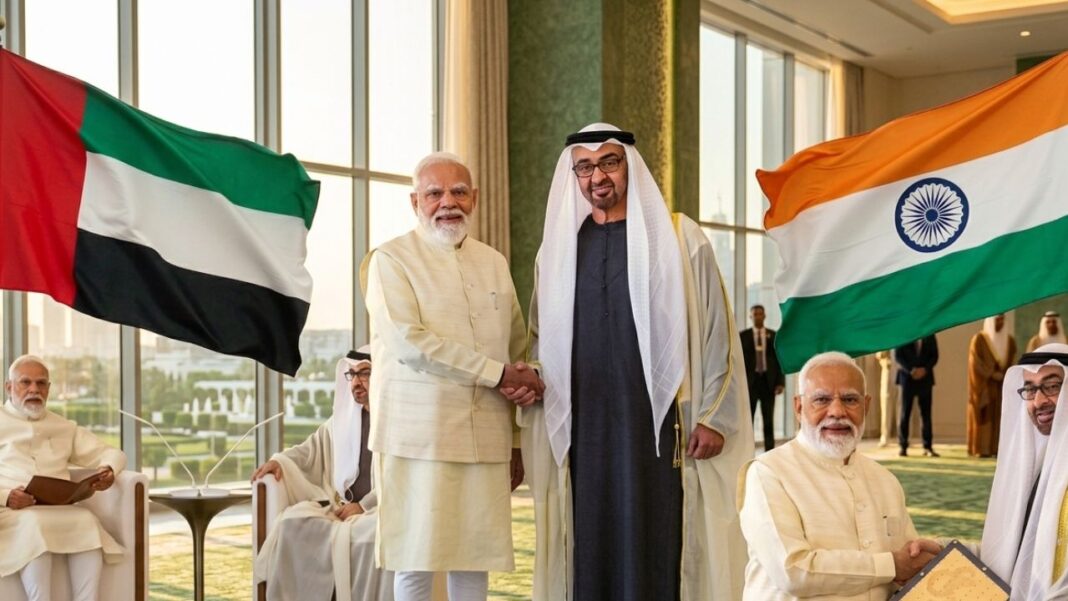
Prime Minister Modi was accorded a grand welcome on his arrival in Abu Dhabi. The UAE President Sheikh Mohammed bin Zayed Al Nahyan personally received him at the airport, reflecting the importance the Emirati leadership attached to the visit. The welcome included a guard of honour and the national anthems of both countries and a military aircraft escort as Modi’s plane entered UAE airspace, underscoring the strong strategic partnership between the two countries. The atmosphere throughout the visit reflected the close personal rapport between the leaders and the deepening ties between India and the UAE. The two leaders later held extensive discussions covering nearly every major area of cooperation between the countries, including trade, energy, defence, food security, technology, infrastructure, and regional stability.
Why the visit matters now?
The visit carried enormous significance because it took place during a period of rising geopolitical tension in the Middle East. Rising tensions between Iran, Israel, and the United States have put pressure on global oil markets, with conflict in the region adding to the worries. Hence, India, heavily dependent on imported energy, has considered the need to secure stable oil and gas supplies. The trip by Modi was aimed at strengthening India’s energy partnership with the UAE and ensuring reliable long-term supplies amidst global uncertainty.
The timing was particularly important as the UAE recently decided to leave OPEC’s quota system. That move gives the Emirates greater flexibility to increase oil production and negotiate supply deals directly with strategic partners such as India. Experts say this development could help India secure energy supplies more efficiently in the years ahead. Beyond energy, the visit demonstrated how the India-UAE relationship has evolved from a traditional trade partnership into a broader strategic alliance involving defence, technology, logistics, and investment cooperation.
Also read: Commonwealth Union salutes the legacy of Hon. Gurudev Sri Sri Ravi Shankar on his 70th birthday!
Bilateral discussion
Economic cooperation remained at the heart of the visit. India and the UAE have significantly expanded trade relations in recent years, particularly after signing the Comprehensive Economic Partnership Agreement (CEPA). The pact has already helped boost bilateral trade volumes and remove business barriers on both sides. During the visit, the leaders reviewed the progress made under the CEPA framework and discussed opportunities for further improving trade efficiency.
One of the major achievements was the operationalization of the Virtual Trade Corridor using the MAITRI digital platform that links the customs and port authorities of India and the UAE to facilitate cargo movement, cut down shipping delays and costs, and improve logistics coordination. Additionally, officials expect the digital trade initiative to boost commercial ties and speed up and streamline trade between India and the UAE. Business leaders accompanying the discussions described the visit as a major boost for investor confidence and long-term economic cooperation.
The Indian community in the UAE also featured prominently during the visit. The UAE is home to more than four million Indians, making them the country’s largest expatriate group. Over the decades, Indians have played a major role in the UAE’s economic development across sectors such as construction, healthcare, finance, retail, hospitality, and technology. Modi thanked the UAE leadership for protecting the Indian community during the conflict and treating them like family. The welfare of Indian workers and professionals in the UAE remains an important pillar of bilateral relations. The strong people-to-people connection between the countries continues to strengthen diplomatic and economic cooperation.
Strong focus on energy security
Energy security emerged as one of the central themes of the visit. Both sides signed several agreements aimed at strengthening India’s long-term energy reserves and ensuring uninterrupted fuel supplies. A major agreement was signed between Indian Strategic Petroleum Reserves Limited and the Abu Dhabi National Oil Company (ADNOC). Under the arrangement, the UAE will increase its participation in India’s strategic petroleum reserves to 30 million barrels. This is expected to improve India’s emergency oil storage capacity and protect the country from sudden global supply disruptions.
India and the UAE also agreed to cooperate in developing strategic gas reserves in India. Another important agreement involved long-term supplies of liquefied petroleum gas (LPG) between Indian Oil Corporation and ADNOC. The discussions highlighted the UAE’s growing role as one of India’s most trusted energy partners. The Emirates already supplies crude oil, LNG, and LPG to India, and both sides agreed to deepen cooperation in the energy sector further in the years ahead. The agreements are expected to help India maintain stable energy supplies even during periods of international crisis and volatile oil prices.
Discussion on the Strait of Hormuz
Regional security issues also formed a major part of the discussions between the two leaders. Particular attention was given to the Strait of Hormuz, one of the world’s most strategically important waterways. The route is vital for global energy markets carrying close to a fifth of the world’s petroleum supply. Increased tensions in the region and concerns about disruptions to shipping have stoked alarm among energy-importing countries including India.
During the talks, Modi highlighted the importance of ensuring safe and uninterrupted navigation through the Strait of Hormuz. He said maintaining open sea routes is essential not only for regional stability but also for global energy and food security. India also reaffirmed its commitment to international law and freedom of navigation. Modi expressed concern over growing tensions in West Asia and called for dialogue and diplomacy to resolve conflicts peacefully. The talks reflected India’s growing interest in playing a bigger role in regional stability while safeguarding its economic and energy interests.
Major agreements signed
Several important agreements were signed during the visit, reflecting the broadening scope of India-UAE cooperation. One of the key developments was the signing of a strategic defence partnership framework. The agreement is expected to increase cooperation in military coordination, defence manufacturing, and security collaboration between the two countries. The two sides also signed energy-related memorandums involving petroleum reserves and LPG supply arrangements. Another agreement focused on setting up a ship repair cluster at Vadinar in India, aimed at strengthening maritime and logistics infrastructure.
A major highlight was the UAE’s commitment to investing $5 billion in India. The investment is expected to support projects in infrastructure, technology, logistics, manufacturing, and other high-growth sectors. The discussions during the visit also covered artificial intelligence, supercomputing, digital infrastructure, and advanced technologies, indicating that both countries are looking beyond traditional sectors and preparing for future economic opportunities. The following are the major agreements signed during the visit.
- Agreement on Framework for the Strategic Defence Partnership
- MoU on Strategic Petroleum Reserves
- Agreement on supplies of Liquefied Petroleum Gas (LPG)
- MoU on setting up Ship Repair Cluster at Vadinar
- Investment worth 5 billion
- Technology and supercomputing collaboration
Also read: PM Modi attends the grand 45th anniversary celebrations of the Art of Living in Bengaluru!
Strengthening a long-term partnership
The visit also reflected the long-term strategic evolution of India-UAE relations. What began decades ago as a relationship centred on trade and energy has transformed into a multifaceted partnership covering defence, investment, technology, innovation, and regional security. The UAE is currently India’s third-largest trading partner and one of its leading sources of foreign investment. Its geographical proximity and strong logistical links make it one of India’s most important partners in the Gulf region. Recent developments in global politics and energy markets have pushed both countries to deepen coordination even further. The visit showed that India and the UAE are increasingly aligning their strategic priorities in response to global challenges.
Modi concludes the UAE visit
Prime Minister Modi concluded his visit after holding what officials described as highly productive discussions with the UAE leadership. Before his departure, UAE military aircraft again escorted his plane as it left the country’s airspace, marking the symbolic end of a closely watched diplomatic engagement. Modi thanked President Sheikh Mohammed bin Zayed Al Nahyan for the warm hospitality and invited him to visit India in the near future.
The UAE visit marked the opening leg of Modi’s broader five-nation international tour, which also includes visits to several European countries. However, the Abu Dhabi stop stood out for its strong focus on energy security, economic cooperation, defence collaboration, and regional stability. Significantly, the visit underscored the rising strategic significance of the India-UAE relationship at a time when both countries are seeking stronger partnerships to navigate an increasingly uncertain global landscape.