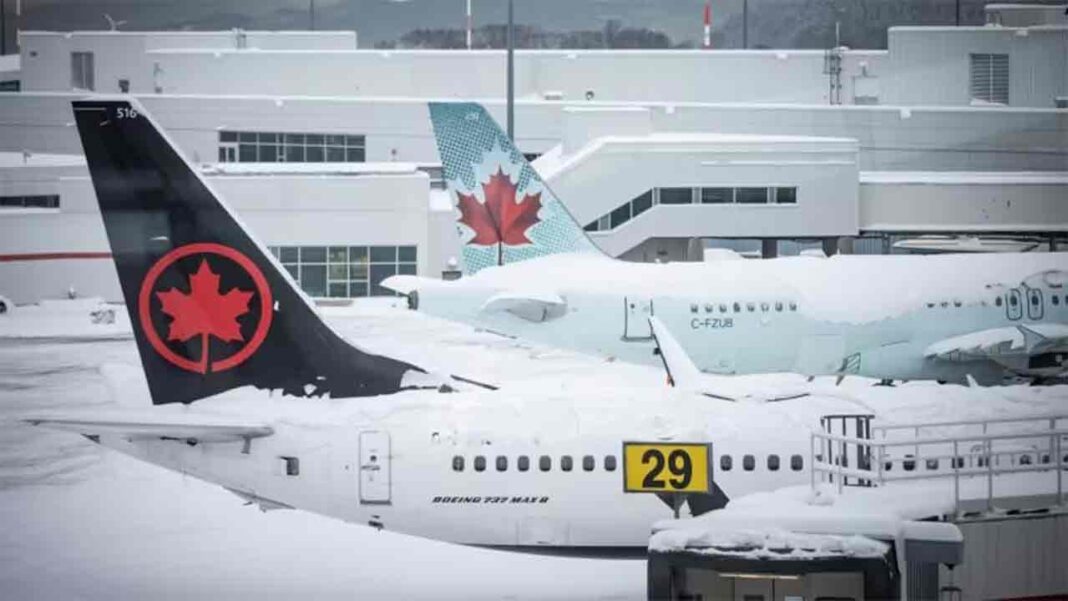

Canada _ (Commonwealth Union) _ On Wednesday, harsh winter weather stormed throughout Canada, disrupting travel, closing schools, and knocking out electricity. According to the flight tracking service FlightAware, by late Wednesday afternoon, Air Canada has delayed or canceled more than 160 flights for the day, or about 26% of them, amid warnings that the winter storm moving in from the west might impede air travel to and from central Canada.
At Toronto airports, WestJet announced that it has canceled 37 flights for Wednesday and Thursday. According to both airlines, Thursday may see delays in Toronto, Ottawa, and Quebec. Air Canada’s spokesperson, Peter Fitzpatrick, stated in an email that the company is “monitoring the weather” and that it has modified some of its schedules in anticipation of the storm. He said that customers might opt for a refund or a new reservation. Within 48 hours, all clients will be rebooked on the first flight that became available, according to a statement from WestJet.
75 of Jazz Aviation’s Wednesday flights, or 16% of them, have been canceled, according to FlightAware, which manages regional flights for Air Canada Express. By early Wednesday afternoon, several airlines had already canceled up to 2,500 flights in the US, putting many others’ travel plans and connections in jeopardy. Environment and Climate Change Canada has issued a weather alert for southern Ontario, indicating that a low-pressure system is moving in from the American southwest. As a result, there will be a combination of precipitation types including snow, ice pellets, and freezing rain.
The snowfall is expected to be heavy, with accumulations of 10 to 15 centimeters in some areas. In addition, the winds are predicted to be strong, blowing at speeds of 50 to 70 kilometres per hour. These strong winds, combined with the heavy snowfall, could result in poor visibility and difficult driving conditions on the roads.
The presence of ice pellets and freezing rain is also a concern as these forms of precipitation can create hazardous conditions. Ice pellets are small, round pieces of ice that bounce when they hit the ground, and they can accumulate on roads and sidewalks, making them slippery and treacherous to walk or drive on. Freezing rain is a type of precipitation that falls as liquid rain but then freezes on contact with cold surfaces, creating a glaze of ice on roads, power lines, and trees.
It is important for residents in the affected areas to take precautions and stay safe during this weather event. They should monitor weather updates and follow the advice of local authorities. If travel is necessary, drivers should use caution, reduce speed, and maintain a safe distance from other vehicles. Pedestrians should wear appropriate footwear and be careful when walking on icy sidewalks.