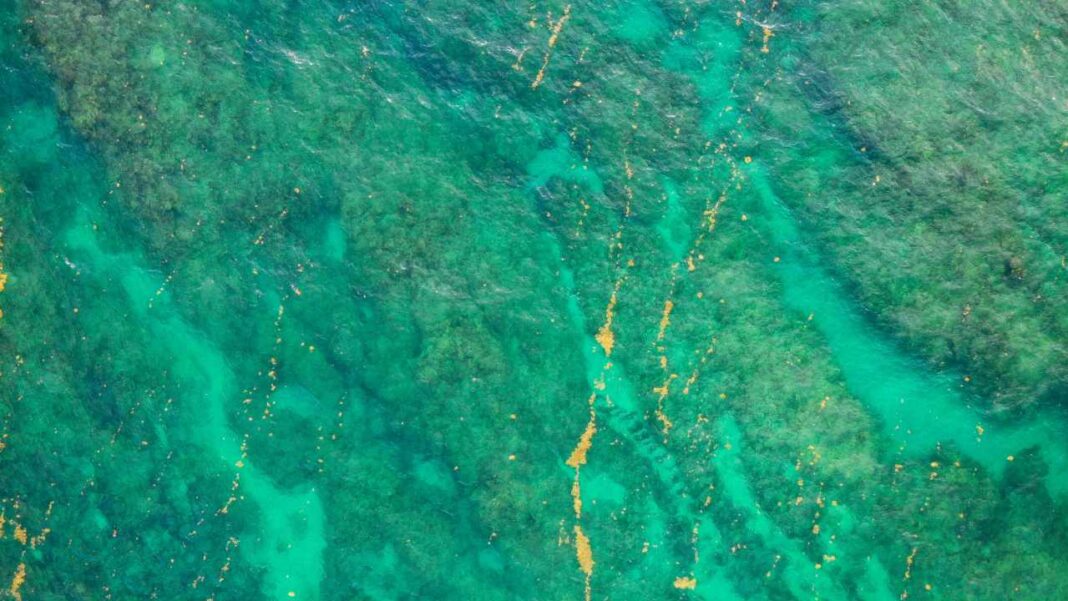

Brown algae and diatoms live deep in the ocean. They make a tough substance called fucoidan. This substance forms a protective coating around the algae.
Fucoidan is resistant to breakdown. Its structure is very complex. It has many types of chemical links and branches. These patterns change depending on the algae species.
This toughness matters a lot. When bacteria cannot break fucoidan down easily, it sinks into the deep sea. It carries carbon with it. That carbon can stay trapped there for a long time. This makes fucoidan an important part of how the ocean stores carbon.
Scientists already knew some bacteria could break down small parts of fucoidan. But one big question stayed unanswered. Could a whole group of bacteria break it down completely? And if so, how would they do it?
A new study answers this question. It was published in the journal Nature. The research was led by Andreas Sichert, a former MIT scientist now at ETH Zurich. Otto Cordero, a professor at MIT, also led the work.
Cordero explains the main idea simply. No single bacterium can finish the job alone. Instead, many bacteria work together. Each type focuses on a different part of the molecule. Together, they get the job done. They do it much faster than any single organism could.
A Huge Number of Working Parts
To study this process, the team collected seawater samples. They grew a community of fucoidan-eating bacteria from these samples. The results were surprising.
The team found more than 453 different genes. Each gene builds an enzyme. Each enzyme acts on some part of fucoidan. These genes were spread across eight different bacterial strains. Alone, none of these strains could fully digest the molecule.
The researchers used a new, fast method involving mass spectrometry. This let them watch bacteria eat individual sugar pieces. A clear pattern appeared. Despite all that genetic complexity, the bacteria really only played two roles.
Some strains focused on the fucose backbone. This is the main chain of the molecule. Other strains focused on the side branches. These branches contain rarer sugars, like xylose and galactose.
When researchers combined strains with different roles, something intriguing happened. The bacteria didn’t just work somewhat better together. Their combined effect was much stronger than expected. The more different the strains’ sugar preferences were, the stronger this teamwork effect became. In some tests, paired strains almost fully broke down the molecule.
Cordero sums the findings up clearly. The breakdown of one of the ocean’s biggest carbon stores depends on divided labour. It’s not about specific strains working together. It’s about different roles working together.
Turning a Complex Puzzle Into a Simple Model
The biggest surprise was how predictable this system turned out to be. All the hidden complexity could be simplified into something straightforward.
The team built a basic model. It sorted bacterial activity into two groups. One group handled fucose. The other handled the rarer side-chain sugars. They trained this model using small bacterial groups, from one to three strains.
This simple model worked well. It could predict what happened in bigger groups, with up to seven strains. It also worked for nine different fucoidan molecules from other algae species.
Cordero notes something important here. Understanding a complex system doesn’t always require knowing every tiny detail. Sometimes, it just requires finding the right simplified view.
This idea could apply beyond fucoidans. It might help scientists study other complex, carbon-rich materials. This approach could work even when the full chemistry isn’t understood yet.
The team also checked natural ocean samples. They found that bacteria with matching, complementary skills often live together in nature too. This suggests the same teamwork happens outside the lab.
Why This Matters
The researchers propose a new idea. They call it “diversity-limited degradation”. This means fucoidan may stick around longer in places lacking the right mix of bacteria. This could help explain why some ocean carbon stays stored for so long.
This idea also is relevant for biotechnology. Instead of engineering one super-powerful bacterium, scientists could combine several specialised bacteria. Teams like these could help process algae and other tough natural materials at a larger scale.
A Bigger Question
One mystery remains unsolved. Fucoidan has existed for a very long time. So why hasn’t one bacterium evolved to eat all of it alone?
The researchers suggest two possible reasons. First, there may be built-in limits within sugar metabolism. Second, evolution might naturally favour multiple specialists working together, rather than merging their skills into one organism.
Cordero says this question goes beyond microbiology. It touches on how life itself is organised. Why are big biological jobs, like shaping Earth’s carbon cycle, split between many organisms rather than handled by just a few? He believes this question sits at the edge of biological science today.