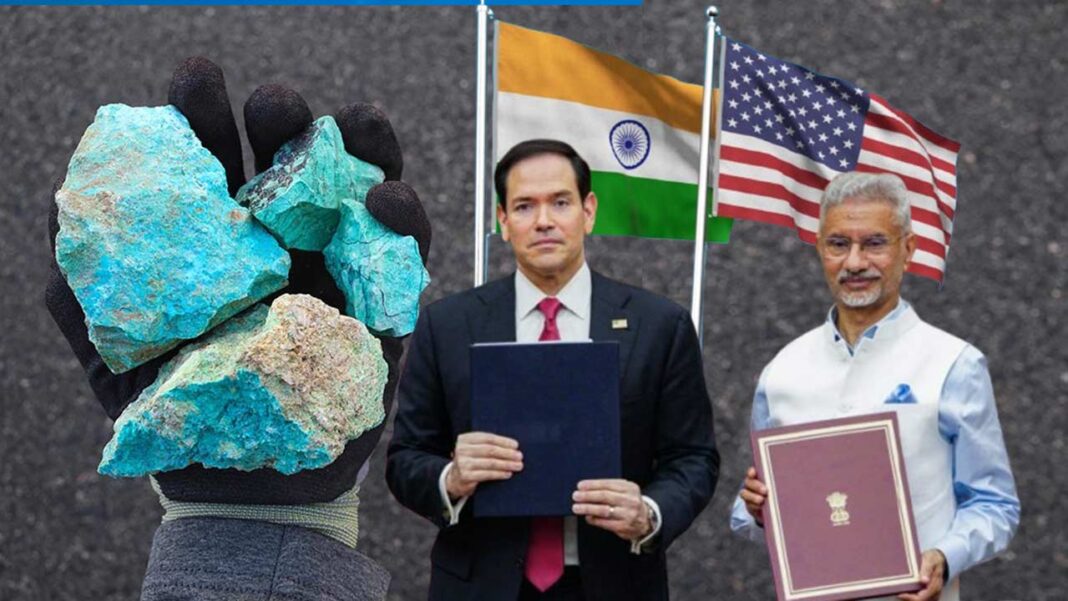

India (Commonwealth Union)_ India and the United States have signed a major agreement on critical minerals and rare earth materials, marking a significant step in their growing strategic partnership. The deal was finalized in New Delhi on Tuesday during a four-day visit by US Secretary of State Marco Rubio, with both countries presenting the agreement as an important move to reduce global dependence on China for key industrial resources. Accordingly, External Affairs Minister S. Jaishankar and Rubio signed the new framework, officially titled the “Framework on Securing of Supply in the Mining and Processing of Critical Minerals and Rare Earths.”
The agreement aims to strengthen cooperation across the entire supply chain, including mining, processing, refining, recycling, financing, and long-term investment. The partnership comes at a time when governments around the world are increasingly worried about the concentration of critical mineral supplies in China. Rare earth elements and other strategic minerals are essential for industries such as electric vehicles, semiconductors, clean energy, telecommunications, and advanced defence systems. China currently dominates much of the global processing sector, giving it significant influence over international supply chains.
Officials from both India and the United States described the agreement as more than just an economic partnership. According to a senior Indian official involved in the discussions, the framework represents a broader strategic effort to reshape global supply networks and create more reliable alternatives outside China’s control. The groundwork for the deal was laid earlier this year during the February 2025 summit between Prime Minister Narendra Modi and former US President Donald Trump in Washington. At that meeting, both leaders identified critical mineral security as a shared priority. Tuesday’s agreement now turns that political understanding into a formal structure for future cooperation, including joint ventures and coordinated export strategies.
Also read: What’s next in digital banking? Introducing the Commonwealth Digital Financiers Network
Rubio’s visit to India covered several issues beyond minerals, including defence ties, trade discussions, and regional security concerns. However, the critical minerals agreement became the most important outcome of the trip, giving both governments a tangible achievement to showcase. The agreement also fits into a wider network of initiatives launched by the two countries in recent years. India became a member of the US-led Pax Silica group earlier in 2026, and both countries are also members of the Forum on Resource Geostrategic Engagement (FORGE).
India is estimated to have considerable deposits of minerals like lithium, cobalt and titanium, but the country still faces challenges in developing strong processing capabilities. The United States is expected to provide financial backing, advanced technology and access to global markets. Analysts said the implementation of the agreement will need long-term commitment and regulatory coordination, but the signing highlights the increasing momentum in India-US relations as both countries work to create a more diversified and secure global supply chain system.