
India’s 80th Independence Day
India (Commonwealth Union)_ India marked its 80th Independence Day on August 15 with a grand national celebration that brought together history, patriotism and a strong display of the country’s growing capabilities. Prime Minister Narendra Modi led the main ceremony at the Red Fort in New Delhi, where the occasion combined traditional military honours with a clear message about India’s ambitions for the future. The celebrations were built around two themes: 150 years of Vande Mataram and “Yuva Shakti for Viksit Bharat @2047”. Together, they linked the country’s freedom struggle with its plans to become a developed nation by 2047.
Furthermore, youth, technology, self-reliance, defence production, clean energy and innovation were given special importance throughout the program. Delhi took on a festive appearance, with major landmarks lit in the colours of the tricolour. Parliament House, India Gate, North Block, Qutub Minar, the Red Fort and New Delhi Railway Station were among the prominent sites decorated for the national occasion. Tight security surrounded the celebrations, reflecting the importance of the event.
Also read: 80 Years of Freedom: India Celebrates 80th Independence Day!
Modi leads celebrations at Red Fort
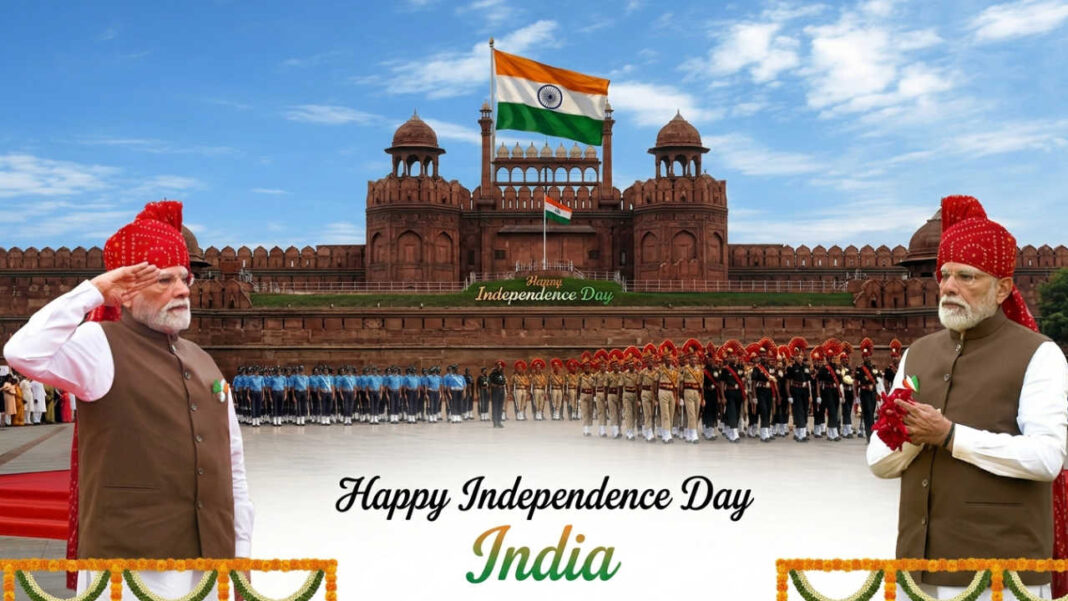
Prime Minister Narendra Modi arrived at the Red Fort early in the morning and was received by senior defence officials. He inspected the Guard of Honour before moving towards the historic ramparts, where he hoisted the national flag. Nearly 5,000 special guests attended the ceremony. They included NCC cadets, My Bharat volunteers, entrepreneurs, community representatives, women beneficiaries of government programs, and people from different states and Union Territories. Many guests wore traditional clothing, adding colour and regional diversity to the gathering.
The ceremony presented a carefully coordinated display of India’s military discipline and indigenous capability. The Prime Minister received a ceremonial Guard of Honour made up of personnel from the Army, Navy, Air Force and Delhi Police. One of the most striking features was the use of Indian-made 105mm Light Field Guns for the 21-gun salute. The moment highlighted the country’s growing emphasis on producing defence equipment at home rather than depending heavily on foreign suppliers.
Celebrating Vande Mataram
For the first time at the Red Fort celebrations, Vande Mataram became a central part of the ceremony. An Army band played the national song while guests, NCC cadets and My Bharat volunteers joined in. The young participants were arranged along Gyanpath to form the words “Vande Mataram”, creating a powerful visual statement. The presentation marked 150 years of the song’s legacy and reminded the audience of its place in India’s freedom movement. The message was also forward-looking. The participation of young people showed how the government is presenting the next generation as an important force behind India’s future growth. The celebration therefore connected the emotional legacy of independence with the energy and expectations of today’s youth.
Also read: Russia salutes India from space: Russian cosmonauts have a special message for India!
Flag hoisting ceremony
The Prime Minister then hoisted the national flag, followed by the national anthem. The anthem was synchronised with the 21-gun salute, creating one of the ceremony’s most formal and dramatic moments. The Red Fort ramparts were decorated with the tricolor and Vande Mataram, reinforcing the national character of the event. Soon after the flag was raised, two Mi-17 helicopters of the Indian Air Force carried out a ceremonial flower shower. One carried the national flag, while another displayed a flag representing Vande Mataram. The combination of military precision, music, aircraft and the national flag gave the ceremony a sense of scale that extended far beyond the Red Fort itself.
Modi’s Independence Day speech
The Prime Minister delivered a 75-minute address outlining his vision for India’s next stage of development. His speech focused heavily on economic strength, technology, national security and the goal of achieving a developed India by 2047. He announced plans to train one crore young Indians in artificial intelligence within a year and called for a nationwide search for sporting talent among children aged five to 15. India, he said, should aim to participate in at least three-fourths of Olympic events by the 2036 Games.
Nuclear energy was another major focus. Modi set an ambition of taking India’s nuclear power capacity to 100 GW by 2047 and announced plans for five new reactors. He also highlighted semiconductor manufacturing, deep-sea exploration, hydrogen technology and the expansion of gas and energy infrastructure. The speech placed particular emphasis on self-reliance. Defence production, manufacturing, pharmaceuticals and domestic technology were presented as areas where India could become a stronger global player.
Targets set for India
The Prime Minister’s broader development roadmap covered several sectors. India aims to strengthen its position in global finance and pharmaceuticals, expand semiconductor production and develop complete domestic manufacturing chains. The government also aims to increase the number of prosperous rural women through the Lakhpati Didi program and to widen access to digital education and competitive examination coaching.
Another major goal is energy security. Alongside nuclear expansion, the country is looking towards solar power, hydrogen and wider gas connectivity. Deep-sea exploration was presented as another frontier for Indian technology and economic activity. Modi described these ambitions through a seven-part framework covering production, agriculture, technology, infrastructure, defence, the green economy and soft power. The message was clear: India’s growing influence would depend not on one sector alone, but on progress across the economy and society.
Also read: India’s digital diplomacy takes off: The digital reach expands to 24 nations!
The grand parade
The visual scale of the celebrations extended to the parade and surrounding displays. Decorations highlighted India’s achievements in nuclear technology and space exploration, while installations pointed towards the national goal of becoming a developed country by 2047. Youth received special attention, with Gen Z participants, NCC members and My Bharat volunteers playing visible roles. Their presence reflected the idea that Independence Day is no longer only a ceremony looking back at 1947. It is increasingly being used to present a picture of the India that the country hopes to build. Traditional attire worn by guests from across India added another dimension to the event. Different regions, communities and backgrounds were represented at the Red Fort, turning the ceremony into a showcase of India’s cultural diversity as well as its national strength.
Special highlights of 2026
Technology was one of the defining features of this year’s celebrations. Digital India Bhashini was used to provide real-time translation of the Prime Minister’s speech into more than 22 Indian languages, making the address accessible to a wider audience. Artificial intelligence, semiconductor manufacturing and 6G development were highlighted as symbols of India’s technological ambitions. Green initiatives, including solar energy, Mission LiFE and green hydrogen, reflected the country’s growing focus on sustainability.
The celebrations also placed an unusual emphasis on indigenous defence capabilities. Accordingly, the Red Fort ceremony showcased equipment made in India, reinforcing the broader message of Atmanirbhar Bharat. Cultural performances, student participation and public programs extended the celebrations beyond the main ceremony. Young leaders and entrepreneurs were also given platforms to discuss ideas connected with agriculture, fitness, technology and startups.
Also read: The rise of Indian business empires: Ten Indian brands quietly conquering the global markets!
President Murmu’s message
In her Independence Day address, President Droupadi Murmu spoke about the importance of the tricolour, constitutional values and India’s development journey. She said the country must connect its progress towards Viksit Bharat to the ideals of the freedom movement. Her message stressed equality, opportunity and dignity for every citizen. She also pointed to the growing number of Indians from ordinary backgrounds who are achieving remarkable success in different fields. The President’s remarks complemented the Prime Minister’s development-focused message by placing the emphasis on inclusive progress. Together, the two addresses presented independence as both a historic achievement and an ongoing national responsibility.
World leaders wish India
India’s Independence Day was also marked by messages from leaders and governments around the world. Leaders from countries including the United States, Russia, Australia, France, the Maldives, Sri Lanka, Nepal, Bhutan, Cyprus, Israel and Singapore conveyed their greetings. The international messages added another layer to the celebrations. They reflected India’s expanding diplomatic relationships and its growing role in global economic, technological and strategic affairs. Indian missions abroad and partner countries also observed the occasion, ensuring that the celebrations reached well beyond the country’s borders.
A display of India’s growing power
The 80th Independence Day celebrations presented India as a country conscious of its history but increasingly focused on demonstrating its strength and potential. The military ceremony showed defence capability; the technology displays pointed to innovation; and the participation of young Indians highlighted the country’s demographic strength. From the Red Fort to landmarks across Delhi, the tricolour became a symbol of both national pride and national ambition. The scale of the event, the presence of thousands of guests, the military honours and the emphasis on indigenous technology all contributed to a carefully constructed display of India’s growing power.
The celebrations ended on a more personal note when Modi moved beyond the security cordon to meet young admirers, including NCC cadets and My Bharat volunteers. Additionally, a cleanliness campaign involving volunteers was also planned after the ceremony. In that final gesture, the message of the day came together: India’s power is not only presented through weapons, technology or economic targets, but also through its people. The 80th Independence Day therefore served as both a celebration of freedom and a national showcase of the confidence, ambition and capabilities India wants to carry into the decades ahead.