
Grand welcome in Melbourne
India (Commonwealth Union)_ Prime Minister Narendra Modi arrived in Melbourne for the second leg of his three-nation tour after completing his visit to Indonesia. He received a ceremonial welcome at the airport, where Victorian Premier Jacinta Allan and Federal Housing Minister Clare O’Neil greeted him. A guard of honour marked the formal reception before members of the Indian community welcomed him with colourful cultural performances, traditional music and enthusiastic chants. Thousands of people gathered outside the venue to greet the Prime Minister, reflecting the growing influence of the Indian community in Australia. Many members of the diaspora said they hoped the visit would further strengthen the relationship between the two countries and create new opportunities in trade, education and people-to-people exchanges.
Also read: The biggest takeaways from Modi’s Indonesia visit!
Melbourne meets Modi community event with Indian diaspora
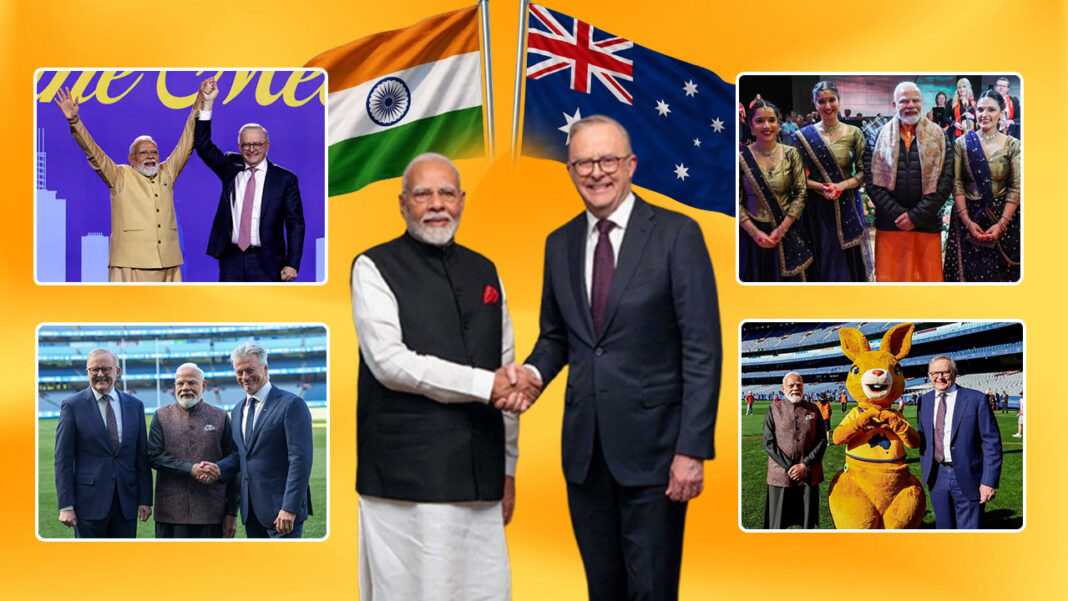
One of the biggest highlights of the visit was the “Melbourne Meets Modi” event at Marvel Stadium, where nearly 30,000 members of the Indian community gathered. Australian Prime Minister Anthony Albanese accompanied Modi to the event, underlining the importance both governments attach to their growing partnership. During his address, Modi praised the Indian diaspora for preserving its culture while making valuable contributions to Australia’s development. He said Indians living abroad continue to strengthen ties between the two countries and serve as a bridge connecting their societies. In a symbolic gesture, Modi asked the audience to switch on their mobile phone flashlights to thank Prime Minister Albanese and the Victorian government for their hospitality. The stadium lit up as thousands joined the tribute.
The Prime Minister spoke about India’s rapid transformation, highlighting progress in technology, innovation and infrastructure. He said India has become the world’s second-largest 5G market and is working on indigenous 6G technology. He also spoke about India’s expanding space programme, including plans for its own space station and preparations for the Gaganyaan human spaceflight mission. Modi reiterated India’s ambition to become one of the world’s three largest economies and said the country was moving confidently towards becoming a developed nation. He also highlighted India’s humanitarian approach, saying the country extends assistance without considering nationality or religion.
India-Australia Annual Leaders’ Summit
The visit centred on the third India-Australia Annual Leaders’ Summit, where Modi and Albanese reviewed progress in the Comprehensive Strategic Partnership and agreed to deepen cooperation across defence, trade, clean energy, critical minerals and advanced technologies. Both leaders strongly condemned terrorism, including the attacks in Pahalgam and Bondi Beach. They called for stronger international cooperation to dismantle terrorist networks, combat violent extremism and prevent radicalisation.
Defence and security emerged as key priorities. The two countries adopted a new Joint Declaration on Defence and Security Cooperation, replacing the earlier framework and signalling a major expansion of military collaboration. They also agreed to strengthen maritime security through a new roadmap that will improve information sharing and operational coordination. The leaders reaffirmed their commitment to a free, open and rules-based Indo-Pacific, stressing freedom of navigation, peaceful resolution of disputes and respect for international law. Modi also announced plans to establish a critical minerals corridor, recognising the importance of reliable supply chains for clean energy and future industries.
Also read: The horrific prison revolt: What triggered Sri Lanka’s deadliest prison riot?
Clean energy and strategic cooperation
A major outcome of the summit was the completion of administrative arrangements under the civil nuclear agreement, allowing Australian uranium exports for India’s peaceful nuclear energy program. The agreement is expected to support India’s clean energy targets while opening new opportunities for Australia’s resource sector. The two countries also launched the India-Australia Partnership on cyber, critical technologies and supply chains, aimed at strengthening cooperation in advanced technologies, cyber security and resilient supply chains.
Leaders also announced an India-Australia Defence Innovation Corridor to connect industries, startups and researchers from both countries and promote joint innovation in defence technologies. The summit highlighted the growing strategic trust between India and Australia, with both sides agreeing to expand cooperation across security, emerging technologies and economic development while reinforcing stability across the Indo-Pacific region.
India-Australia CEOs Forum
Prime Minister Narendra Modi used his Australia visit to promote India as a preferred destination for long-term investment. Addressing the India-Australia CEOs Forum and the Economic Roadmap Business event alongside Prime Minister Anthony Albanese, he invited Australian companies to expand their presence in India. Speaking to more than 200 business leaders, Modi highlighted India’s strong economic growth, policy reforms, digital transformation and expanding innovation ecosystem. He pointed to opportunities in manufacturing, infrastructure, clean energy, mining, critical minerals, semiconductors, artificial intelligence, fintech, transport, logistics, food processing and defence.
Modi said India’s scale and Australia’s expertise created a strong partnership that would benefit both countries. Modi also called for the early conclusion of the proposed Comprehensive Economic Cooperation Agreement (CECA), saying it would unlock greater trade and investment. He welcomed the growing presence of Australian universities in India and stressed the importance of cooperation in higher education, research, innovation and skill development.
Also read: From ceremonies to agreements: Defining moments of Modi’s Seychelles visit!
Key agreements signed
The two countries signed 18 major agreements covering defence, energy, technology, education, research and cultural cooperation. They are:
- Joint Declaration on Defence and Security Cooperation
- Maritime Security Collaboration Roadmap
- India-Australia Joint Statement on Energy Security
- Finalisation of Administrative Arrangement of the India-Australia Civil Nuclear Agreement
- Australia-India Partnership for Cyber, Critical Technologies and Supply Chains
- MoU between Indian Coast Guard and Australia’s Maritime Border Command
- Australian Invite for Indian Military Instructor
- MoU for Centre of Excellence in Mining and METS
- Letter of Intent to Flinders University
- Letter of Intent between NCVET and Australian Skills Quality Authority
- Repatriation of Indian Artefacts
- Operationalisation of Rooftop Solar Training Academy
- MoU under Australia-Canada-India Technology and Innovation Partnership
- MoU between GeoScience Australia and Geological Survey of India
- Traditional Knowledge Digital Library Access Agreement
- MoU between CSIR and University of Melbourne
- MoU between Satyajit Ray Film and Television Institute and Griffith Film School
- Letter of Approval to Victoria University
Sporting and political engagements
Beyond official meetings, Modi visited the Melbourne Cricket Ground with Anthony Albanese and former Australian captain Steve Waugh. The leaders paid tribute to cricket legend Shane Warne at the Shane Warne Stand before discussing stronger sporting cooperation. Australia announced its support for India’s bid to host the 2036 Olympic Games. Modi also reaffirmed India’s interest in hosting the 2030 Commonwealth Games and welcomed plans to stage a Big Bash League match in Chennai. Both leaders launched the India-Australia Sports Collaboration Roadmap to expand cooperation beyond cricket. During the visit, Modi also met Opposition Leader Angus Taylor and former Prime Minister Scott Morrison, reflecting bipartisan support in Australia for stronger ties with India.
Also read: The 2026 best island on earth revealed: Sri Lanka takes the top spot!
Protests during the visit
While the visit received an enthusiastic response from much of the Indian community, a small group of protesters gathered outside the community event venue. Human rights organisations and some members of Australia’s Muslim and Sikh communities urged the Australian government to raise issues related to human rights and democratic freedoms during bilateral discussions.
Growing partnership
India and Australia continue to strengthen cooperation across trade, security, education and technology. Australia is India’s 14th-largest trading partner, with bilateral trade in goods and services valued at $24.1 billion in 2025-2026. In 2026, Australia ranks 13th in exports, and in imports ranks 15th. The bilateral trade between India and Australia in 2026 stood at US$ 13.93 billion. The two countries share a common vision for a free, open and inclusive Indo-Pacific and are working to deepen collaboration through the proposed CECA, stronger business links and expanding people-to-people ties.
Visit concludes
After completing his engagements in Melbourne, Prime Minister Modi departed for New Zealand, the final stop of his three-nation tour. Describing it as his third visit to Australia in 12 years, he said the increasing frequency of high-level exchanges reflected the remarkable progress in bilateral relations. Thanking Prime Minister Albanese, the Victorian government and the Indian community for their warm welcome, Modi said the visit had laid a stronger foundation for future cooperation in defence, trade, clean energy, technology, education, sports and cultural exchanges, while reinforcing the strategic partnership between India and Australia for the years ahead.