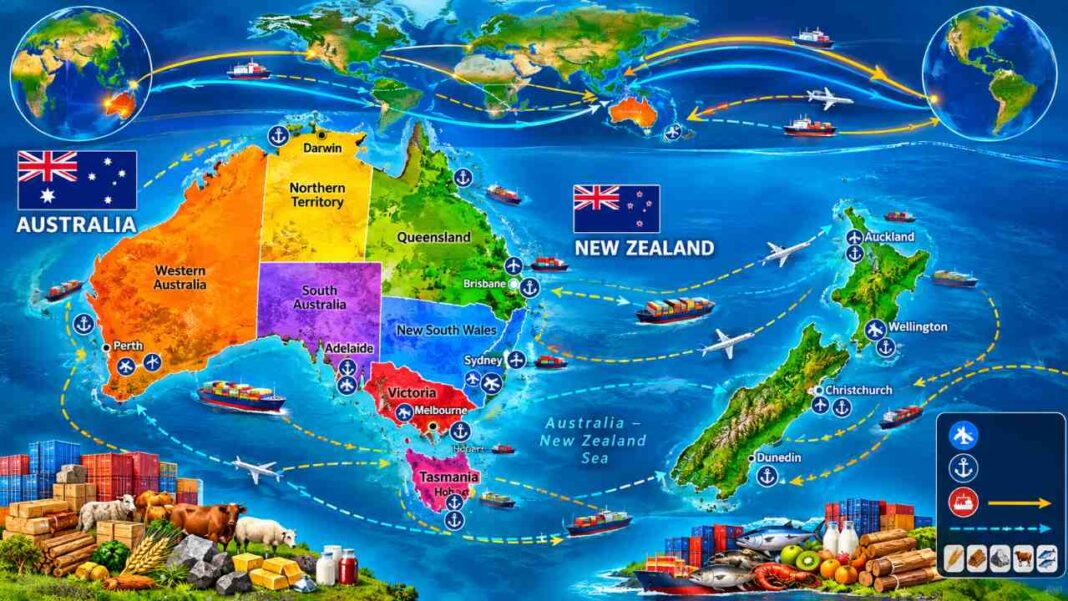

New Zealand (NZ) and Australia have moved to deepen their long-standing economic partnership, with trade ministers using their September Closer Economic Relations meeting to advance plans for a more integrated trans-Tasman market and reduce practical barriers facing businesses on both sides.
NZ Trade and Investment Minister Todd McClay hosted Australian Trade and Tourism Minister Don Farrell in Auckland on Friday, 4 September, for the annual CER Trade Ministers’ Meeting. The discussions came at a time when international businesses are confronting greater uncertainty, changing supply chains and increased pressure to improve competitiveness.
The meeting placed particular emphasis on developing a more ambitious Single Economic Market (SEM) between the two neighbouring economies. Rather than treating CER simply as an established free-trade agreement, the ministers are seeking to extend cooperation into areas such as regulation, standards, supply chains, technology and emerging industries.
One of the central developments announced after the Auckland meeting was a new programme that brings together trans-Tasman businesses and governments. The initiative is intended to help implement proposals from the Australia-New Zealand Leadership Forum aimed at lowering the cost of doing business across the Tasman.
The programme may cover regulatory coherence and common standards, while also examining supply-chain resilience, climate adaptation, defence-industry cooperation, space-related activity, innovation and technology. These areas increasingly influence investment decisions and the ability of companies to operate efficiently across national borders.
Standards cooperation takes another step
Standards alignment was another significant component of the September discussions. NZ and Australia announced a 30% increase in Joint Trans-Tasman Standards, supported by a new Standards Development and Distribution Agreement and Statement of Operating Procedures between Standards New Zealand and Standards Australia.
For businesses operating in both countries, common or closely aligned standards may reduce duplication and make it easier to introduce products and services into the neighbouring market. The initiative therefore forms part of the broader effort to make the 2 economies function more seamlessly.
The latest measures build on work undertaken at previous CER ministerial meetings. In 2025, ministers agreed to accelerate the SEM agenda, including regulatory alignment, mutual recognition and cooperation on international trade matters.
The foundations of the relationship remain substantial. The CER agreement, signed in 1983, has evolved into the primary framework supporting trans-Tasman trade between Australia and New Zealand. New Zealand’s Ministry of Foreign Affairs and Trade describes CER as its most comprehensive free-trade agreement and highlights the breadth of the economic relationship, including the movement of goods, services, investment and people.
A sizeable commercial relationship
The scale of bilateral commerce provides a strong incentive for continued integration. Ahead of the Auckland meeting, the NZ Government said 2-way trade with Australia was worth approximately NZ$35 (USD 19.95) billion in 2025, involving around 25,000 trans-Tasman businesses. Australia is also typically the first export destination for NZ companies.
For smaller companies in particular, reducing regulatory complexity may influence whether expansion into the neighbouring market is commercially viable. A business that may rely on compatible standards, clearer rules and more predictable administrative processes may face fewer costs when developing operations across the Tasman.
The ministers also discussed wider international trade coordination. Their September agenda included cooperation through the Comprehensive and Progressive Agreement for Trans-Pacific Partnership (CPTPP), the Regional Comprehensive Economic Partnership (RCEP), PACER Plus and the ASEAN-Australia-New Zealand Free Trade Area (AANZFTA).
That wider dimension is important because Canberra and Wellington are not considering CER in isolation. Both countries remain heavily exposed to international trade and therefore have an interest in maintaining predictable market access while responding to changes in global commerce.
Opportunities linked to Brisbane 2032
The Auckland meeting also produced a practical commercial initiative involving the Brisbane 2032 Olympic and Paralympic Games.
NZ announced plans for a trade mission to Brisbane aimed at helping NZ companies identify procurement opportunities associated with the major infrastructure, services and investment programme surrounding the Games.
The NZ Government estimates that the Brisbane 2032 programme represents about A$15 (USD 10.5) billion in investment and expenditure. The trade mission is intended to position NZ firms to compete for some of that economic activity rather than viewing the event solely as a sporting occasion.
The initiative may be particularly relevant to companies supplying construction-related services, professional expertise, technology, infrastructure solutions and other business services.
Tourism remains an important link
Economic cooperation also extends beyond merchandise and investment. During the September visit, Australian Trade and Tourism Minister Don Farrell held discussions with New Zealand Tourism and Hospitality Minister Louise Upston.
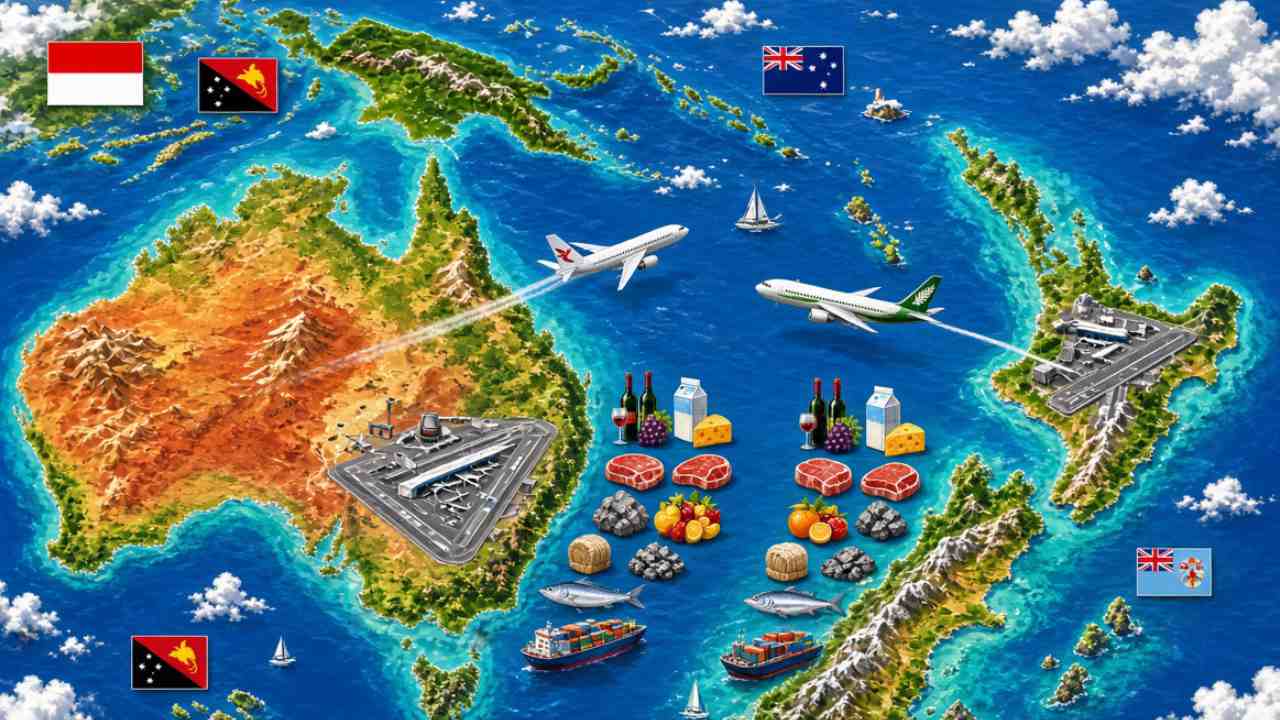
The NZ government identifies Australia as its largest international visitor market, making tourism an important component of the broader relationship. Ministers also discussed opportunities to support tourism growth and strengthen connections between businesses and travellers in both countries.
The programme also included a visit to the Bay of Islands. The initiative was focusing on Māori tourism and regional economic development. Furthermore, the initiative reflects the effort to connect national-level trade policy with opportunities in regional communities.
From free trade to economic integration
The September 2026 CER meeting illustrates how the Australia-New Zealand relationship has evolved since the original agreement came into force.
The emphasis is increasingly shifting from simply removing tariffs to addressing the practical issues that determine how easily companies may trade, invest, recruit, innovate and participate in supply chains across the Tasman.
The 2 governments’ latest initiatives therefore place regulatory alignment, common standards and business-government cooperation alongside conventional trade policy.
The next phase of CER for NZ and Australia will hinge on the effectiveness of translating these commitments into tangible changes for businesses. The September meeting established a further programme of work, while the proposed initiatives provide concrete areas in which officials and industry can pursue greater integration.
With international trade conditions continuing to change, the trans-Tasman partnership is being positioned not only as an established commercial relationship but also as a platform for cooperation in newer fields including technology, space, defence industries, supply-chain resilience and climate adaptation.
The September ministerial discussions consequently represent another stage in a decades-long process: moving CER beyond the removal of traditional trade barriers and toward a more closely connected economic environment for businesses and consumers in both countries.