
New Zealand (NZ) has taken a significant step towards deepening its economic relationship with India after Parliament approved the legislation needed to implement the bilateral Free Trade Agreement (FTA), clearing one of the final domestic hurdles before the pact can take effect.
The legislation passed the House by 93 votes to 29 on Wednesday, 16 September, with support from the governing National Party, ACT New Zealand and the opposition Labour Party. The Green Party, New Zealand First, Te Pāti Māori and 2 other MPs voted against the measure. The parliamentary record confirms that the bill moved through its remaining stages under urgency.
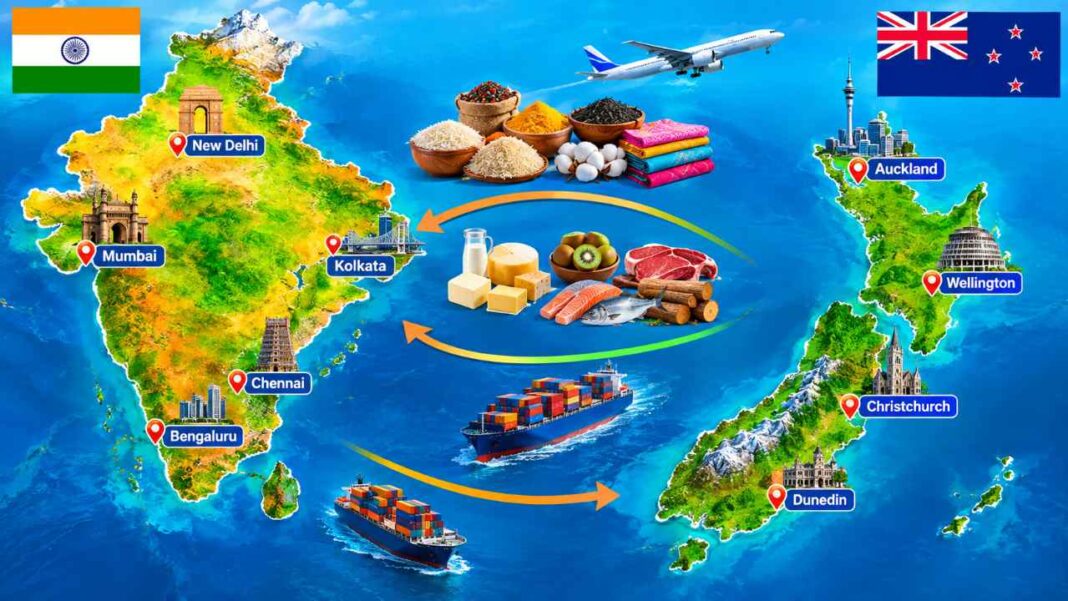
The agreement, signed in New Delhi on Monday, 27 April 2026, is designed to give NZ exporters considerably better access to the Indian market while gradually reducing barriers affecting a broad range of goods and services.
NZ Trade and Investment Minister Todd McClay said the parliamentary approval represented a decisive moment for businesses seeking to expand into one of the world’s largest economies. The government has highlighted the potential for increased exports, investment and employment as companies gain more favourable trading conditions in India.
Tariff reductions at the centre of the agreement
One of the most consequential elements of the deal is its tariff schedule. According to NZ’s Ministry of Foreign Affairs and Trade (MFAT), 95% of NZ’s current exports to India will eventually become tariff-free or receive substantial tariff reductions.
The transition begins immediately once the agreement enters into force. Around 57% of current NZ exports will receive duty-free treatment from the first day, while the proportion covered by full tariff elimination is expected to rise to 82% as the agreement is phased in.
The changes are particularly relevant to sectors such as forestry, meat, seafood, horticulture, wool, wine and selected dairy-related products.
Forestry exporters stand to receive an early benefit, with MFAT saying more than 95% of current forestry exports to India will be eligible for tariff-free entry immediately. Tariffs on almost all remaining forestry trade are scheduled to disappear over 7 years. Sheep meat and wool will also receive immediate tariff elimination.
For horticulture, the agreement establishes new quota opportunities for products including apples and kiwifruit. NZ’s government says it has secured preferential treatment for apples for the first time under an Indian free trade agreement, while kiwifruit exporters will receive duty-free access within agreed quotas together with a tariff reduction outside those quotas.
A larger market for Kiwi businesses
India’s scale is central to the economic case for the agreement. MFAT estimates that NZ’s exports to India were worth approximately NZ$2.03 (USD 1.16) billion in the year ended December 2025, despite India being among the world’s largest economies. Total two-way trade between the countries is about NZ$3.95 (USD 2.25) billion annually.
NZ officials argue that the FTA can help close that gap by making it easier for local companies to compete with suppliers from countries that already have preferential trading arrangements with India.
The agreement covers considerably more than physical goods. It includes services and contains provisions intended to improve opportunities for NZ companies operating in areas such as professional and business services. Wine exporters also receive provisions intended to ensure NZ can benefit from certain future improvements India grants to other trading partners.
The agreement also contains mechanisms addressing customs procedures and non-tariff barriers. Those provisions could become increasingly important as trade expands because lower tariffs alone do not remove every obstacle faced by exporters entering a large and complex market.
Potential employment and income effects
Prime Minister Christopher Luxon has described the agreement as a major opportunity for NZ workers and businesses, linking greater export activity with the possibility of additional employment and higher incomes.
The government’s original economic case rests partly on the importance of trade to NZ’s labour market. When companies sell more products and services overseas, demand can spread through farms, factories, transport operators, ports, professional services and other parts of the domestic economy.
However, the employment benefits should be understood as an economic expectation rather than an immediate guarantee for individual workers. The size of the eventual gains will depend on how strongly NZ firms respond to the new market access, how Indian demand develops and whether companies invest in additional production and distribution capacity.
MFAT’s economic assessment projects substantial changes in trade patterns as tariff reductions take effect. Its modelling shows the trade-weighted average tariff on NZ merchandise exports to India falling from 9.2% in 2026 to between 1.9% and 4.1% by 2036, depending on how products subject to tariff-rate quotas are treated.

Indian imports will also become cheaper
The agreement is not exclusively an export arrangement for NZ. NZ has agreed to remove its tariffs on Indian imports when the FTA enters into force.
MFAT says the agreement could benefit NZ consumers through lower prices and greater choice in areas including electrical goods, machinery, fabrics and textiles. The government’s economic assessment notes that NZ’s existing tariff levels on Indian merchandise are relatively modest, but the removal of remaining duties will nevertheless alter the competitive environment for importers and consumers.
The deal also contains provisions concerning temporary entry for certain Indian workers and business visitors. NZ’s national interest analysis refers to 5,000 Temporary Employment Entry visas, including 4,400 places associated with recognised skill shortages and 600 for specified occupations such as Indian chefs and yoga teachers. The arrangements include qualification, employment and other safeguards.
Ratification now moves towards implementation
Although Parliament has approved the implementing legislation, the agreement’s formal entry into force remains a separate step. NZ’s treaties register currently records the India FTA as signed but not yet in force.
The parliamentary legislation provides the domestic legal framework. The legislation may be needed to implement the agreement. The official bill record of Parliament shows that the measure was introduced in June, three months ago. It progressed through select committee consideration and reached its third reading in September.
The deal therefore marks not the end of the process but the beginning of a new phase in NZ-India commercial relations.
For NZ exporters, the immediate task will be converting preferential access into actual sales. Forestry enterprises, food producers, horticultural businesses, manufacturers, technology firms and service providers will need to identify Indian customers. Furthermore, navigate regulatory requirements and build distribution networks.
For India, the agreement provides improved access to NZ’s market. It also creates another channel for expanding commercial ties with a developed Pacific economy.
The broader significance may, however, emerge gradually. NZ has historically sustained strong trading relationships across Asia-Pacific markets. This trend is occurring while India has become increasingly important in global commerce. Tariffs on a wide variety of products are reduced or eliminated to achieve this goal. Additionally, the agreement includes the establishment of rules for services and other trade areas. The new FTA provides both countries with a framework for expanding economic engagement.
Whether the agreement ultimately delivers the scale of employment and income gains projected by NZ’s government will depend on business uptake and future economic conditions. What is now clear is that Parliament has given the agreement a decisive domestic green light, bringing the two countries closer to putting the landmark trade framework into operation.