Colombo Sri Lanka (Commonwealth Union)_While Sri Lanka has a considerable number of women in STEM (Science, Technology, Engineering, Mathematics), little focus has been given to empowering women to augment the country’s energy sector. Women form an integral backbone to the energy conversation, with the energy transition fuelled only by women’s participation and leadership.
This week, the United States Agency for International Development’s (USAID) Sri Lanka Energy Project and the Asian Development Bank (ADB) collaborated to launch the Sri Lankan chapter of the WePOWER Network, affiliating it with the South Asian regional network. WePOWER is a collective response to increase women in STEM and to augment women in the energy workforce. The South Asian network has a collective of over 28,000 women and girls who are actively involved to change gender norms and increase equal participation of females in energy.
Making women powerful voices in the energy transition discussion is not a choice anymore; it is an imperative. With the industry projected to initiate 14 million new jobs for clean energy growth by 2030, the International Energy Agency envisages at least USD 1.4 trillion will be invested in clean energy in the near future. India which has set net zero goals for 2070, will have to invest USD 190 billion per year in its energy economy until 2030.
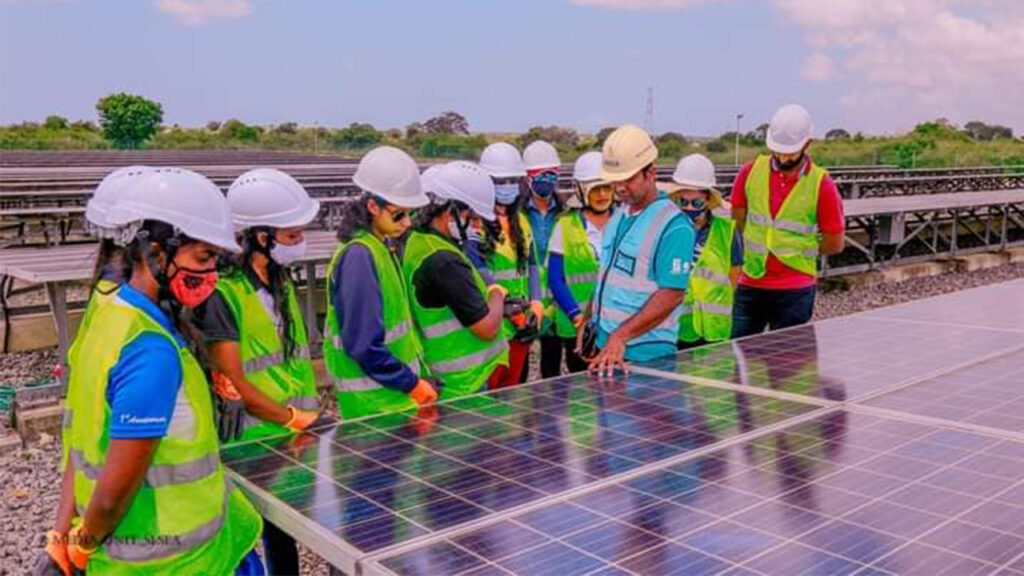
The launch of Sri Lanka’s WePOWER chapter is a powerful tool that will promote the advancement of the energy industry which is currently at a dismal 13 per cent of Sri Lanka’s women in power sector employment. In South Asia, the proportion of women engineers and technicians is as dampening – less than 6 per cent.
Encouraging workplace diversity and increased participation, it is observed that technical and professional roles will increase exponentially as the world shifts towards sustainable and environmentally friendly energy alternatives. It is also vital that Sri Lanka optimizes this crucial conduit to address challenges stemming from the economic crisis.
WePOWER’s initial plans will include training in gender equality and social inclusion and developing an action plan to monitor gender activities under its five pillars – STEM education, recruitment, development, retention, and policy and institutional change.
USAID’s input into the Sri Lanka Energy Programme will assist the country transform its power sector into a market-based, secure, reliable and sustainable industry. This is embedded in its commitment to ‘build a power sector for tomorrow’ in celebrating the Sri Lankan-American partnership that has endured for 75 years.