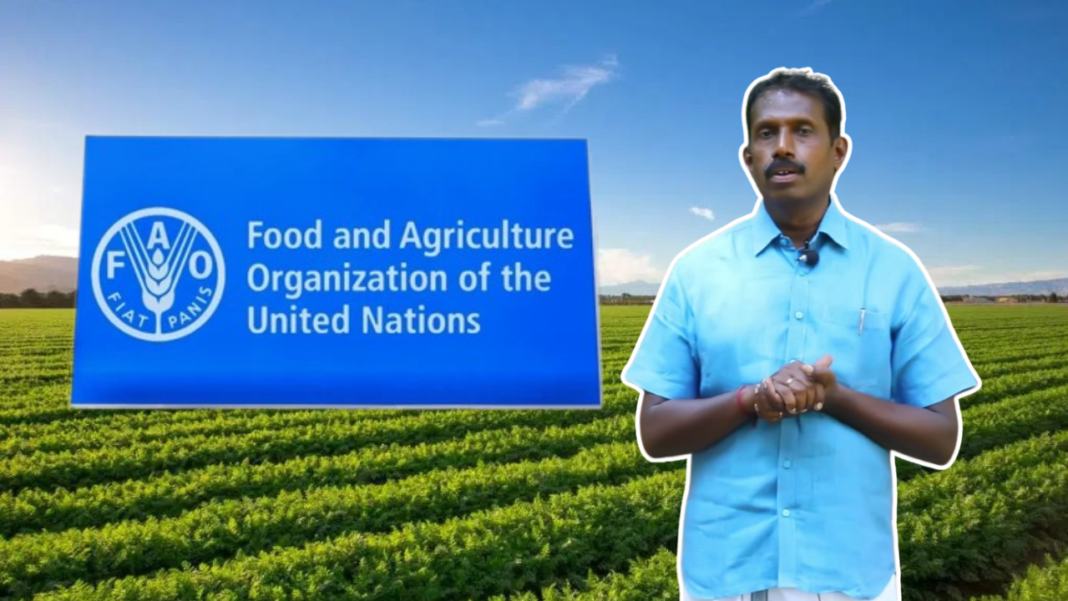

India (Commonwealth Union)_ A farmer from Tamil Nadu has earned international recognition for proving that sustainable farming can improve both income and environmental health. Valluvan, a 58-year-old farmer from Pollachi, has been honoured as a UN Food and Agriculture Organization (FAO) Soil Farmer Hero after successfully transforming his struggling coconut farm into a thriving multi-crop agricultural enterprise. For years, Valluvan faced financial difficulties. Before 2009, maintaining each coconut tree cost him nearly ₹500 annually, while the income generated from each tree was only about ₹300. The gap between expenses and earnings pushed his farm into continuous losses and forced him to rethink his approach to agriculture.
Also read: Meet the Indian entrepreneur behind Africa’s tech-driven retail revolution!
When he realized that the economics of traditional agriculture were no longer sustainable, he started to look for options that could increase productivity and generate steady income. His solution came when he came across Cauvery Calling, a massive tree-based agricultural project backed by Isha Foundation’s Save Soil movement. The initiative promoted farmers to switch to agroforestry, a technique that integrates trees with crops to boost soil health, farm productivity and the long-term health of the land. With the concept in mind, Valluvan went back to his farmland and completely overhauled his farming system. Instead of relying mainly on coconut cultivation, he introduced a diverse range of crops across his 11-hectare farm.
What was once a farm with only three crop varieties now supports more than 14 crops, including coconut, nutmeg, pepper, turmeric, elephant yam, curry leaves and seven varieties of bananas. He has also planted around 30 different tree species. The shift to diversified farming dramatically improved his financial situation. The annual income of the farmer increased from ₹30,000 to ₹2.5 lakh-₹3 lakh per acre and now he is earning income from multiple crops throughout the year and is not dependent on a single commodity. This approach has also helped protect him from market fluctuations, as losses from one crop can often be offset by earnings from others. The benefits extended beyond income.
Agroforestry significantly improved the health of his soil. When he started adopting regenerative farming practices, the soil organic carbon content on his farm was only 0.5%. Over the next seven years, that figure increased to 1.56%, a sign of stronger soil fertility, better nutrient retention and improved biological activity, which also strengthened the farm’s resilience to climate challenges. During two severe droughts, including a major water crisis in 2017 when groundwater levels dropped beyond 1,000 feet and rainfall failed for two consecutive years, Valluvan’s farm continued to survive. While many neighbouring farmers were forced to cut down coconut trees, his fields retained moisture through mulching and rainwater harvesting pits.
Today, the farm uses only one-tenth of the water it previously required. According to Valluvan, with further improvements in soil, the need for irrigation could come down even further in the years to come. His success story also echoes the larger goals of the Cauvery Calling programme, which promotes large-scale tree-based farming across the Cauvery basin. Since 2019, the programme has helped plant more than 13.4 crore trees on private farmlands in Tamil Nadu and Karnataka. In the long run, the programme aims to plant 242 crore trees, helping restore the ecological balance, improving farmer incomes and ensuring sustainable farming for the future generations.