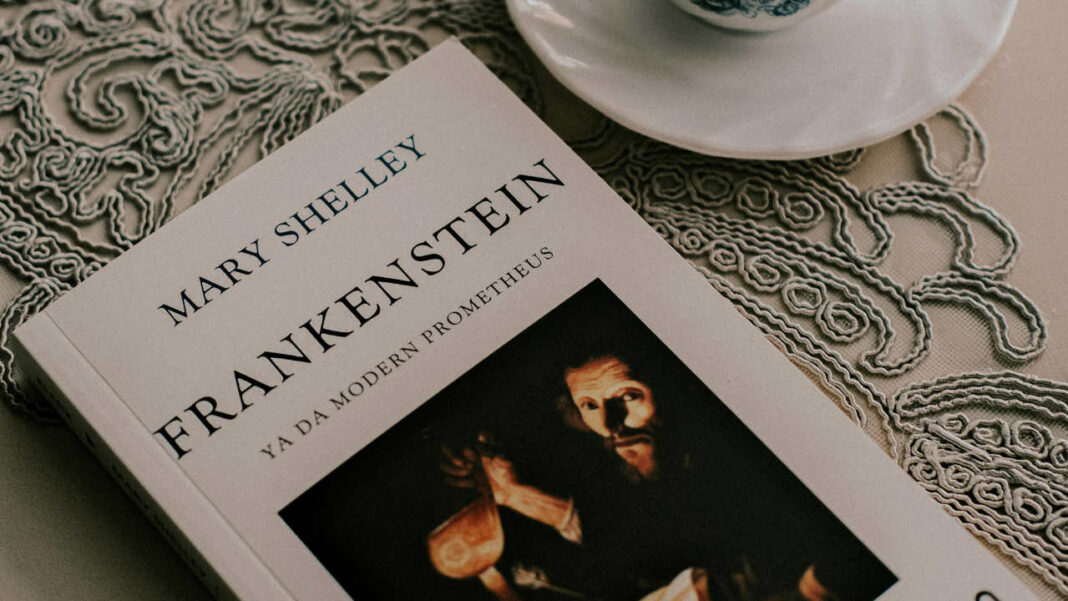


Mary Shelley‘s Frankenstein is one of the most influential works of fiction, shaping literature and our worldview. While it is remembered as a horror story, it can also serve as an examination of the moral effects of ambition, loneliness, and the horribly vague concept of responsibility.
The novel was written on the shores of Lake Geneva during a night storm in the summer of 1816 (commonly referred to as the “Year Without a Summer”) through a competition set up by Lord Byron and some of his peers. From this original challenge to one another’ evolved one of the enduring questions of mankind—the boundaries between creator and creation. Shelley indicates that her inspiration for this story was based on scientific theories of the time that proposed reanimating a lifeless body and were of particular interest to early 19th-century readers because of their fascination with galvanism and bioelectricity.
The fundamental idea of Frankenstein can be found in the numerous layers of narrative structure, which are developed through the letter of Robert Walton, an Arctic explorer whose obsessive pursuit of discovery replicates that of Victor Frankenstein. The fact that these two stories have the same structure is not an accident; this structural relationship is a literary device that highlights one central message of the novel: that lack of self-control, regardless of the intent behind the ambition, will create a force that can lead to destruction. The journeys Walton makes in the cold and the experiments conducted by Victor replicate one another—they are both attempts to rise above the limits of humanity.
Victor Frankenstein is not an evil character or villain but a tragic characteristic of the enlightenment of man. Victor’s curious nature—the desire to “penetrate into the recesses of nature” and give life to his creations—is a direct reflection of the age in which Shelley wrote; however, she uses that same optimism in a way that proves to be extremely haunting. Victor did not create a life in a way that was celebratory; instead, he created one in an extremely disturbing way—hence the definition of horror as not the monstrous appearance of a creature or madman, but rather, it is defined as the moment where the creator of that monster determines that the creature is not worthy of respect or love because of the reaction that he/she receives from the creature.
Misrepresented by many, the most compelling character in the novel is The Creature. Rather than being a mindless beast, the Creature has the ability to express himself clearly, is sensitive to the world around him, and is heavily aware of who and what he is. The Creature evolves from being an untainted bystander to a vengeful outsider; Shelley’s The Creature was a harsh critique of the way society shuns and alienates people. She makes the reader ponder who the real monster is: the one who learns cruelty from being wronged or the creator who fails to care for his creation.
Shelley’s writing combines the intensity of Gothic literature with the depth of Romantic literature. Nature is more than just a setting in this book; she uses the beauty and power of nature to articulate the psychological struggles all of the characters are experiencing. The beautiful and wild scenery in the book represents the internal conflict of its characters. In addition, the isolation both physically and existentially experienced by The Creature and Victor represents an important theme in the novel. The thoroughness of her writing style mirrors the extent to which she is influenced by the philosophical ideas and discussions of her time (Rousseau and his ideas on human goodness, as well as Milton and the fallen state of mankind).
Frankenstein’s exceptional quality comes from its ability to predict future cultural developments long before they existed. Mary Shelley posed an unsettling question about the moral implications of creating and advancing technologies: “Does the ability to create mean that we should?”
Unlike more contemporary speculative works, Shelley’s novel does not illustrate potential outcomes of technological advancements; rather, it provides a way for society to contemplate the direction it may take. For well over two hundred years after its initial publication in 1818, Frankenstein has remained an important work because it addresses a constantly recurring human conflict (the struggle between the desire to transcend limitations and the consequences that follow). It does not just have a haunting effect on its readers. It stimulates thought and debate regarding the impact of morality on scientific progress. It compels you to examine your current position as a reader to decide how you have changed as a result of reading this novel.