
A Warm Welcome in Gothenburg
India (Commonwealth Union) — Prime Minister Narendra Modi arrived in Sweden as part of the third leg of his five-nation tour across Europe and West Asia. His visit marked an important milestone in India’s growing engagement with the Nordic region and reflected the increasing importance both countries place on their partnership.
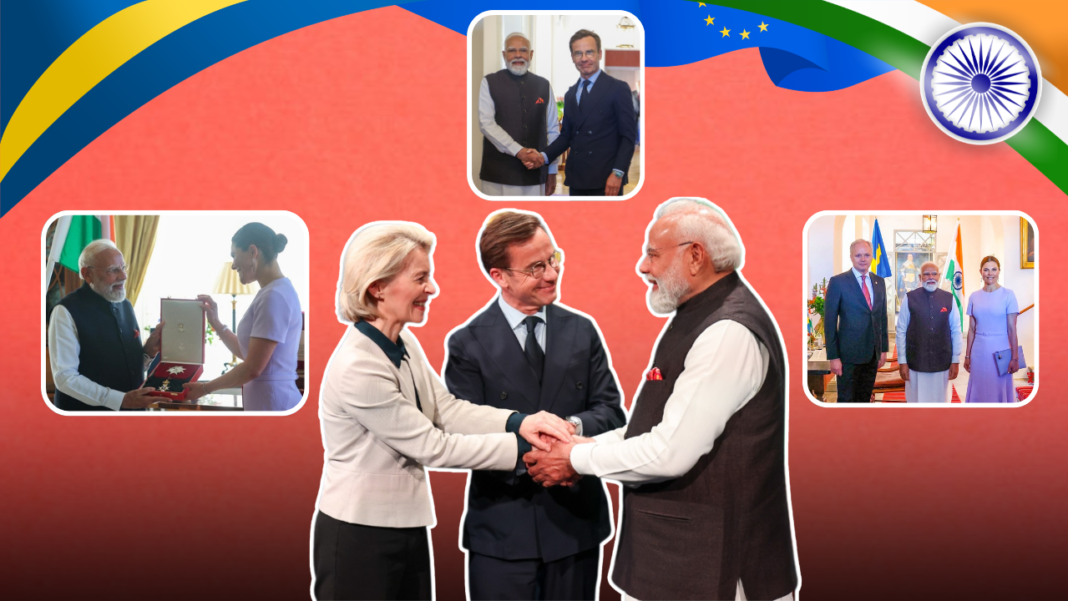
As a sign of the significance of the visit, Modi’s aircraft was escorted by Swedish Gripen fighter jets as it entered Swedish airspace. Upon his arrival in Gothenburg, Modi was warmly received by Swedish Prime Minister Ulf Kristersson, underscoring the strength of bilateral relations. The Indian leader was also treated to cultural performances that highlighted the strong people-to-people ties between the two countries. Traditional Bengali performances were held at the hotel where he stayed, bringing a touch of Indian heritage to the warm Swedish welcome.
The visit, undertaken at the invitation of Prime Minister Kristersson, aimed to expand cooperation in areas such as innovation, sustainability, advanced technology, trade, and investment.
Also read: What’s Behind the New India–Netherlands Strategic Partnership? A Look at the Key Takeaways from PM Modi’s Netherlands Visit!
Connecting with the Indian Diaspora
One of the key highlights of the visit was Modi’s interaction with the Indian diaspora in Gothenburg. Members of the Indian community turned out in large numbers to welcome the Prime Minister and celebrate the growing partnership between India and Sweden.
The event featured several cultural performances that reflected a shared appreciation for Indian traditions. Swedish opera singer Charlotta Huldt performed the iconic bhajan Vaishnava Jana To, while students from Lilla Akademien presented a Bharatanatyam dance recital. The evening was further enriched by performances celebrating Bengali culture, showcasing India’s enduring global influence in art and culture.
The event was not only a celebration of cultural ties but also a recognition of the Indian community’s contribution to strengthening relations between the two countries. Modi later remarked that Indian culture, including Bengali traditions, continues to attract admirers far beyond India’s borders.
Sweden’s Highest Honour for PM Modi
A major highlight of the visit was the conferral of Sweden’s prestigious Royal Order of the Polar Star Commander Grand Cross upon Prime Minister Modi. The honour is among Sweden’s highest state recognitions and is considered the highest distinction that can be awarded to a serving head of government.
The award marked the 31st international honour received by Modi during his tenure. Swedish authorities cited his role in strengthening India–Sweden cooperation across multiple sectors, including trade, sustainability, innovation, and technology. The honour also recognised his efforts in fostering stronger international partnerships and advancing bilateral relations.
Accepting the award, Modi described it as a recognition not of an individual but of the people of India and everyone who had contributed to bringing India and Sweden closer together. The honour symbolised the growing trust and cooperation between the two nations.
Also read: Inside Modi’s UAE Mission: What India Gained from PM Modi’s UAE Visit
Exchange of Gifts: A Tribute to Rabindranath Tagore
The visit also featured a meaningful cultural exchange centred on Nobel laureate Rabindranath Tagore.
Prime Minister Kristersson presented Modi with replicas of handwritten epigrams created by Tagore during his visits to Sweden in the 1920s. The collection included historical materials discovered in Sweden’s National Archives, along with a photograph taken during Tagore’s visit to Uppsala University in 1921.
In return, Modi gifted a selection of Tagore’s works and a handwoven bag from Santiniketan featuring motifs inspired by the poet’s vision of empowering local artisans through creativity and craftsmanship.
The exchange was particularly significant as it coincided with the centenary of Tagore’s historic association with Sweden. It underscored how cultural and intellectual links continue to complement the growing strategic relationship between the two countries.
Expanding Bilateral Cooperation
The centre piece of Modi’s visit was a series of high-level bilateral discussions with Prime Minister Kristersson and senior Swedish officials. The talks covered the full spectrum of India–Sweden relations and explored opportunities to deepen cooperation across emerging sectors.
Key areas of discussion included artificial intelligence, green technologies, defence, climate action, digital transformation, space, clean energy, startup ecosystems, resilient supply chains, and advanced manufacturing.
Crown Princess Victoria also participated in several important engagements, reflecting broad institutional support for the expanding partnership.
The two leaders acknowledged the immense untapped potential in bilateral ties, with trade reaching USD 7.75 billion in 2025. They committed to the ambitious goal of doubling trade and investment between the two countries within the next five years.
They also discussed global challenges, including the need for reforms to international institutions and greater cooperation on sustainable development and economic resilience.
Also read: Commonwealth Digital Financiers Network Makes a High-Impact India Entry: Mumbai and Bengaluru Events Draw Global Attention!
Adoption of the Joint Action Plan 2026–2030
A major outcome of the visit was the adoption of the India–Sweden Joint Action Plan 2026–2030. The framework provides a roadmap for cooperation across political, economic, technological, security, environmental, and people-to-people sectors.
The plan is intended to guide the next phase of bilateral relations and ensure continued engagement in priority areas. It reflects the shared understanding that India and Sweden can play complementary roles in addressing future challenges through innovation, technology, and sustainable growth.
Most importantly, the adoption of the plan elevated bilateral relations to the level of a strategic partnership, marking a significant milestone in ties between the two countries.
Another important aspect of Modi’s visit was his address at the European Round Table for Industry, one of Europe’s most influential business forums. The gathering included senior business executives, policymakers, European Commission President Ursula von der Leyen, Prime Minister Kristersson, and leaders of major Indian and European companies.
Modi highlighted India’s economic transformation, manufacturing growth, and ongoing reforms aimed at attracting global investment. He emphasised that India offers substantial opportunities for companies seeking expansion, particularly in technology and sustainability-driven sectors.
The roundtable served as an important platform for direct engagement between India and Europe’s corporate leadership, strengthening investor confidence and identifying new avenues for collaboration.
Also read: India and the US Unite Over China Concerns: A Landmark Critical Minerals Pact Signed!
Meeting with Global Industry Leaders
During his time in Gothenburg, Modi also met several leading business executives. Among them was Robert Maersk Uggla, Chairman of Maersk, one of the world’s largest shipping and logistics companies.
Their discussions focused on boosting investment in India’s port infrastructure, logistics networks, and supply chain systems. Modi also encouraged Swedish and European companies to expand their presence in India, highlighting opportunities in manufacturing, digital infrastructure, telecommunications, artificial intelligence, green energy, and advanced technologies.
A recurring theme throughout these discussions was that India–Sweden relations have evolved beyond a traditional buyer-seller relationship and are increasingly centred on innovation, co-development, and technology partnerships.
A Five-Sector Vision for Future Growth
At the European Round Table for Industry, Modi outlined a clear framework for future industrial collaboration between India and Europe. He identified five sectors that could serve as pillars of future cooperation:
- Telecommunications and digital infrastructure
- Artificial intelligence and semiconductors
- Green transition and clean energy
- Infrastructure and mobility
- Healthcare and life sciences
The Prime Minister urged companies to make long-term commitments in these sectors, positioning India as a key destination for investment, research, and manufacturing in the coming decade.
This vision forms part of India’s broader ambition to become a global hub for innovation and industrial growth while deepening ties with trusted international partners.
Key Outcomes of Modi’s Sweden Visit
- India–Sweden Relations Elevated to a Strategic Partnership
The most significant outcome of the visit was the elevation of bilateral relations to a strategic partnership, providing a stronger framework for future cooperation.
- Target to Double Bilateral Trade and Investment
The two countries agreed to work towards doubling bilateral trade and investment within five years, demonstrating confidence in the long-term economic potential of the relationship.
- Launch of the India–Sweden Joint Innovation Partnership 2.0
A new Joint Innovation Partnership 2.0 was launched to strengthen collaboration in advanced fields such as artificial intelligence, quantum technologies, 6G communications, life sciences, space research, sustainable mining, and critical minerals.
- India–Sweden Technology and Artificial Intelligence Corridor
Both sides agreed to establish the India–Sweden Technology and Artificial Intelligence Corridor to promote technological cooperation, startup collaboration, and advanced research.
- Cooperation in Critical Minerals
The two countries agreed to establish an SME and Startup Platform aimed at promoting innovation-led growth, entrepreneurship, and job creation.
- Connectivity and Cultural Initiatives
In the cultural sphere, the launch of the Tagore–Sweden Lecture Series was announced, further strengthening intellectual, educational, air connectivity, and people-to-people links between the two countries.
Concluding a Productive Visit
As the visit concluded, Prime Minister Modi thanked Prime Minister Kristersson and the people of Sweden for their warm hospitality. He described the visit as highly productive and expressed confidence that the agreements and initiatives announced during the trip would provide fresh momentum to bilateral relations.
The visit demonstrated how India and Sweden are expanding their engagement beyond traditional diplomacy into areas that will shape the future, including technology, innovation, sustainability, trade, and global governance.
It reaffirmed the shared commitment of both countries to building a stronger, more innovative, and forward-looking partnership. The visit not only reinforced the foundations of a strategic partnership but also launched a series of ambitious initiatives that promise to open a new chapter in India–Sweden relations.