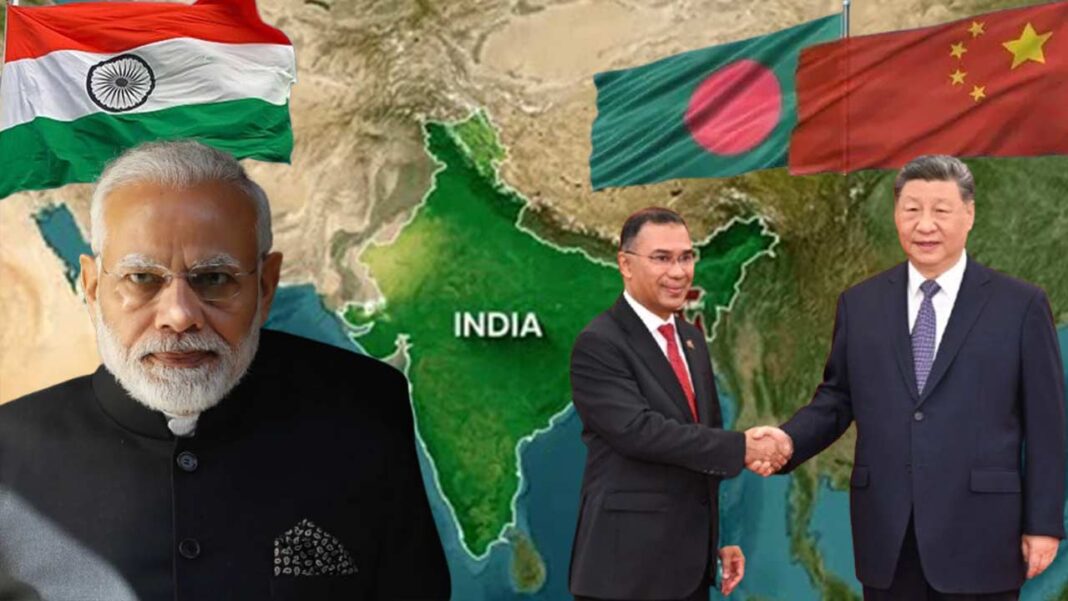

India (Commonwealth Union)_ China’s plan to construct a China-Myanmar-Bangladesh Economic Corridor has posed a fresh strategic challenge for India and might alter the balance of power in South Asia and the Indo-Pacific. The concept was discussed during talks between Bangladesh Prime Minister Tarique Rahman and Chinese President Xi Jinping in Beijing, where the two leaders looked at ways to strengthen economic cooperation, improve connectivity, and increase trade between their countries. Accordingly, the proposed corridor is intended to improve transport links, increase cross-border trade, and support Bangladesh’s economic growth through improved infrastructure. During the meeting, China also expressed interest in further modernizing Bangladesh’s two major seaports, Chittagong and Mongla. Beijing wants to help develop Chittagong into a regional commercial hub while upgrading Mongla to improve its services and efficiency. If these plans move forward, Bangladesh could strengthen its position as an important trade gateway in the Bay of Bengal.
Also read: India unlocks nuclear hydrogen: How India turned nuclear heat into the fuel of tomorrow?
For China, the corridor would create a direct route linking Yunnan province with Myanmar and Bangladesh before reaching the Bay of Bengal. Such a network would expand Beijing’s economic presence while improving access to key maritime trade routes. For India, however, the proposal carries far greater strategic significance because the corridor would be located close to its northeastern region, an area New Delhi considers highly sensitive. The project is widely seen as another extension of China’s Belt and Road Initiative (BRI), which has already funded major infrastructure projects across Asia, Africa and Europe. Many analysts also compare the proposal with the China-Pakistan Economic Corridor (CPEC), which gives China access to the Arabian Sea through Pakistan. India has consistently opposed CPEC because it passes through Pakistan-occupied Kashmir, a territory India claims as its own.
Also read: Bangladesh takes a big conservation step: Becomes latest member of Global Big Cat Alliance!
China has steadily increased its investments across the Bay of Bengal in recent years. In Bangladesh, it has financed ports, power stations and transport projects. In Myanmar, Beijing is developing the China-Myanmar Economic Corridor, centred on the strategically important Kyaukpyu deep-sea port and special economic zone. Extending this network into Bangladesh would significantly strengthen China’s influence in a region where India has traditionally been the dominant power. One of India’s biggest concerns is the possible impact on its northeastern states. The proposed route would pass close to the Siliguri Corridor, often called the “Chicken’s Neck,” a narrow stretch of land that connects mainland India with its northeastern region. Because this corridor is India’s only land link to eight northeastern states, any increase in Chinese influence around the area is likely to raise security concerns in New Delhi.
Also read: PM Modi’s Italy mission decoded: What Modi achieved in Italy?
India has spent years investing in its own regional connectivity projects to strengthen ties with neighbouring countries. These include the India-Myanmar-Thailand Trilateral Highway, the Kaladan Multimodal Transit Transport Project, the Bangladesh-Bhutan-India-Nepal (BBIN) initiative and transport cooperation under BIMSTEC. Together, these projects are designed to improve trade, boost regional integration and reduce the Northeast’s dependence on the Siliguri Corridor. Hence, a Chinese-backed economic corridor spanning Bangladesh and Myanmar could directly threaten these Indian initiatives. Depending on the scope and financial backing of the corridor, it could also draw more regional participation and move economic activity to Chinese-backed infrastructure.
The proposal also underscores Bangladesh’s cautious diplomatic approach. Dhaka has expanded economic relations with China while keeping close diplomatic relations with India. Rather than selecting one partner over the other, Bangladesh seems determined to win investment and development opportunities from both countries. However, the proposal highlights an important reality for India. Regional influence today is not just a function of military strength or diplomacy, but also of the ability to deliver infrastructure, trade opportunities and economic growth. China has invested heavily in connectivity projects across Asia, giving it growing influence in neighbouring countries.
Although the China-Myanmar-Bangladesh Economic Corridor remains only a proposal, it signals Beijing’s continued effort to expand its presence across South Asia and the Indian Ocean. Even after India stayed out of the Belt and Road Initiative and the earlier Bangladesh-China-India-Myanmar (BCIM) corridor failed to progress, China continues to look for new ways to strengthen its regional reach. How India responds in the coming years could shape not only the future of its northeastern region but also the wider strategic balance in the Bay of Bengal, the Indian Ocean and the Indo-Pacific.