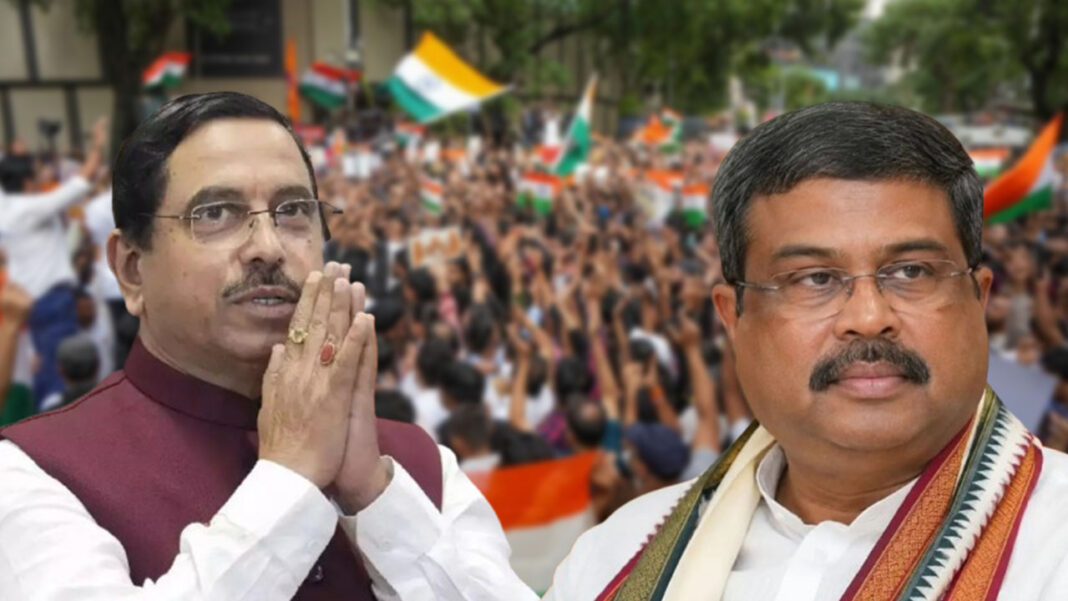

India (Commonwealth Union)_ India appointed its new education minister after Dharmendra Pradhan stepped down from the post amid weeks of nationwide protests over the alleged NEET-UG 2026 paper leak and examination irregularities. Accordingly, senior BJP leader Pralhad Joshi has been given additional charge of the Ministry of Education, marking a significant change in the Union Cabinet at a time when the government is facing growing pressure over the country’s examination system. Pradhan announced his resignation through a detailed letter addressed to Prime Minister Narendra Modi, saying the decision was made in the interest of students and the nation. He explained that he did not want the ongoing protests to be misused by anti-national forces or allow the issue to become more complicated through prolonged legal disputes. Calling the situation deeply painful, he said the matter was never about his personal position or prestige but about protecting the future of students.
Also read: What is driving India’s export boom? Top 10 commodities revealed!
In his resignation letter, Pradhan reflected on his four decades of public life, saying he had dedicated himself to students, teachers, and educational reforms throughout his political career. He thanked Prime Minister Modi for his trust and support and said he would continue serving the country in whatever role he was assigned. He also highlighted the government’s response to the NEET controversy, noting that the investigation had been handed over to the Central Bureau of Investigation, the examination was cancelled, and a fresh test was successfully conducted on June 21. Pradhan further said the government had adopted a coordinated approach involving the Centre, state governments, and district administrations to ensure the re-examination was conducted smoothly.
Looking ahead, he announced that the NEET examination would be held in Computer-Based Test (CBT) mode from next year to improve transparency and reduce the possibility of malpractice. Despite the controversy, he maintained that many deserving students, especially those from underprivileged backgrounds, had performed well in the examination. Soon after Pradhan’s resignation was accepted, the president’s office confirmed the appointment of Pralhad Joshi as the new education minister. Joshi will continue to handle his existing responsibilities as Union Minister for Consumer Affairs, Food and Public Distribution, and New and Renewable Energy while taking charge of the Education Ministry.
Joshi’s appointment brings one of the BJP’s most experienced parliamentarians into the education sector. The 63-year-old leader has represented Karnataka’s Dharwad constituency in the Lok Sabha continuously since 2004, winning five consecutive elections. He was associated with the Rashtriya Swayamsevak Sangh (RSS) before entering Parliament and then built his political career within the BJP organisation. Over the years, Joshi has held several important positions in the party and the government. He was the BJP Karnataka State President from 2012 to 2016 when he led the party’s expansion and election strategy in the state. At the center, he has managed key ministries, including Coal, Mines, and Parliamentary Affairs, before taking charge of Consumer Affairs, Food and Public Distribution, and New and Renewable Energy.
Also read: Modi’s Australia visit is a major boost for India-Australia relations: The strategic moves revealed!
Joshi’s long administrative experience and parliamentary background are expected to play an important role as the Education Ministry works to restore public confidence following the NEET controversy. The ministry is responsible for implementing major education policies, overseeing school and higher education, and carrying forward reforms under the National Education Policy. Speaking after taking charge, Joshi thanked Prime Minister Modi for placing his trust in him. He praised the work done by his predecessor, saying Dharmendra Pradhan had implemented several important initiatives, including the National Education Policy, and helped strengthen India’s education system. Joshi said he would continue working under the Prime Minister’s guidance and perform his responsibilities with dedication.
Even before becoming education minister, Joshi had publicly assured students that the government was committed to protecting their interests and taking strict action against examination irregularities. He had backed peaceful protests but also asked students to be alert to any attempts by anti-social elements to misuse the movement. With Joshi at the helm of the Education Ministry, the government enters a new phase in its quest to restore trust in the country’s examination system. His vast experience in governance and Parliament will be keenly observed as India seeks to bolster educational reforms and ensure greater transparency in competitive examinations.