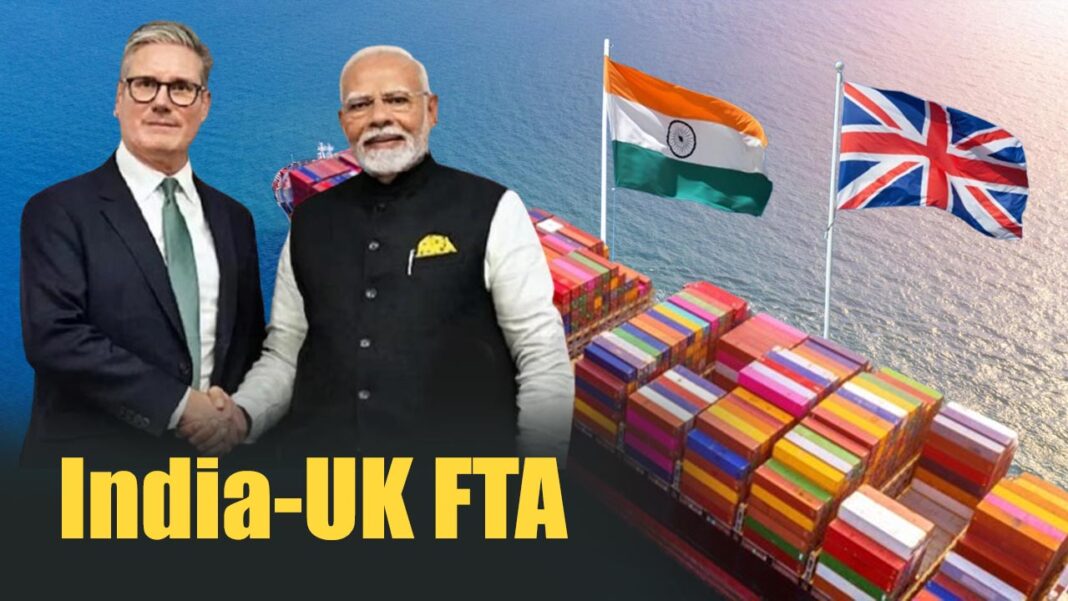

India (Commonwealth Union)_ The India-UK Free Trade Agreement (FTA), officially known as the Comprehensive Economic and Trade Agreement (CETA), has finally come into force, marking a major shift in trade relations between the two Commonwealth nations. The agreement removes tariffs on thousands of products and provides businesses on both sides with greater access to each other’s markets. The pact aims to increase bilateral trade from the current $55-60 billion level to $100 billion by 2030. It provides Indian exporters with duty-free access to most British tariff lines, benefiting key sectors such as textiles, leather, footwear, marine products, gems and jewellery, engineering goods and processed foods.
For the UK, the agreement creates wider access to India’s growing consumer market through phased tariff reductions, particularly in sectors such as automobiles, alcoholic beverages, financial services, education and professional services. The agreement covers 30 chapters, including goods trade, digital commerce, government procurement, services, investment, small businesses, innovation, labour and environmental cooperation. It is designed to reduce costs, simplify trade procedures and create a more predictable environment for companies operating in both countries.
Also read: Modi’s Australia visit is a major boost for India-Australia relations: The strategic moves revealed!
The launch of India-UK FTA
The India-UK CETA officially came into effect on 15 July 2026 after three years of negotiations. The agreement is expected to strengthen trade flows between two major Commonwealth economies and provide new opportunities for exporters, manufacturers, professionals and investors. Accordingly, India’s Prime Minister Narendra Modi described the implementation of the agreement as a significant milestone that would support farmers, entrepreneurs and micro, small and medium enterprises (MSMEs) by improving market access.
The first export consignments under the agreement were flagged off from Gujarat’s Sanand, marking the beginning of preferential trade under the new framework. The launch represented the practical start of lower tariffs and easier access for Indian products entering the UK market. The agreement is expected to increase bilateral trade by around £25.5 billion annually in the long term. It is also projected to add approximately £5.1 billion to India’s GDP and £4.8 billion to the UK’s GDP every year.
FTA history
The India-UK CETA was officially signed on 24 July 2025 in London after extensive negotiations between both countries. It is among India’s most comprehensive trade agreements and represents one of the UK’s most important bilateral trade deals after leaving the European Union. The deal comes amid global trade uncertainty as countries seek to forge stronger economic ties and more secure supply chains. The pact means India gains tariff elimination on roughly 99% of its export categories, almost the entire value of Indian goods heading to the UK. The deal provides comprehensive market access across multiple sectors while allowing both countries to protect sensitive industries.
Also read: The biggest takeaways from Modi’s Indonesia visit!
Why is it important?
The agreement is important because it reduces trade barriers between two economies with strong commercial links. Lower tariffs will make Indian products more competitive in the UK market while giving British companies better access to Indian consumers. The deal also opens up opportunities in information technology, finance, education, telecommunications and professional services, boosting services trade.
Additionally, of major importance is the Double Contribution Convention which allows eligible Indian professionals temporarily working in the UK to be exempt from paying National Insurance contributions for a period of up to five years. The measure is expected to benefit around 75,000 Indian workers and around 900 employers. The deal provides simpler customs procedures, better digital trade rules and clearer regulations for businesses, especially MSMEs, facilitating cross-border trade that is easier and cheaper.
The new tariff plans
The biggest impact of the agreement comes from tariff reductions. The UK has immediately removed tariffs on 96.8% of its tariff lines, covering 97.7% of imports from India by value. Indian exporters will eventually receive duty-free access for nearly 99% of their exports to the UK. India has removed tariffs immediately on 64.1% of tariff lines for British products and will gradually eliminate duties on another 21% of products. Overall, about 90% of UK tariff lines will receive tariff benefits, with nearly 85% of products becoming duty-free over time. Indian sectors benefiting from immediate tariff removal include textiles, leather products, footwear, marine exports, gems and jewellery, engineering goods, chemicals and processed foods. For UK exporters, tariff reductions will benefit products such as cosmetics, chocolates, soft drinks, premium food products, whisky and advanced manufacturing goods.
Also read: The horrific prison revolt: What triggered Sri Lanka’s deadliest prison riot?
Benefits for India
Indian exporters are expected to gain significantly from the removal of duties that previously ranged between 4% and 20% in the UK market. Duty-free access will benefit the textile and apparel sector, enabling Indian manufacturers to compete more effectively with suppliers from other countries. Import duties will also be removed for leather goods, footwear and accessories, making them more competitive. The marine sector is expected to see strong growth as seafood products such as shrimp and fish gain improved access to British consumers. India’s gems and jewellery industry will also benefit as lower tariffs improve export opportunities for diamonds, jewellery and precious stone products.
The engineering sector is another major beneficiary. The UK is already one of India’s top markets for engineering exports, with exports worth $4.7 billion in 2025-26. With greater market access for electrical machinery, auto components and steel products, engineering exports to the UK are projected to reach more than $7.5 billion by 2029-30. Indian firms will also have access to the UK government procurement market, worth around £90 billion every year, creating opportunities in infrastructure, technology and professional services.
Benefits for the UK
The agreement provides British companies with greater access to India’s expanding economy. One of the key benefits is improved access for automobile exports. Under the agreement, up to 37,000 fully built passenger vehicles annually will receive preferential tariff treatment through a quota system. Tariffs on large internal combustion engine vehicles will gradually fall to 10% by the fifth year. Premium electric vehicles, hybrids and hydrogen-powered vehicles will receive tariff benefits from the sixth year. British exporters also gain significant access to the Indian market. Consumers in India are expected to benefit from lower prices on several British products, including cosmetics, chocolates, soft drinks, processed food products and lamb.
Additionally, high-end medical devices, electrical equipment, optical products and specialised manufacturing goods will also become more competitive because of lower import duties. British exporters of whisky, cosmetics, processed foods and luxury products will also benefit from reduced tariffs, allowing them to compete more effectively in India. The agreement introduces improved access to India’s government procurement market, allowing UK suppliers to bid for central government contracts valued at approximately £38 billion annually. The financial services chapter is another major gain for the UK. It provides long-term market access opportunities worth around £13.6 billion for British financial companies.
Also read: From ceremonies to agreements: Defining moments of Modi’s Seychelles visit!
Mutual benefits
The India-UK FTA creates benefits across goods, services and investment sectors. Businesses in both countries will gain from lower tariffs, simpler customs procedures and stronger digital trade rules. The deal gives access to services in 137 sub-sectors including IT, finance, education, telecommunications and business services and also increases movement opportunities for professionals, allowing skilled workers from both countries to help companies, share expertise and grow business operations. Consumers are expected to benefit from greater product choice and lower prices as a result of the agreement. Indian consumers will gain access to more affordable British goods, while UK consumers will benefit from competitive Indian exports, including food products, textiles and jewellery.
Sensitive sectors remain unaffected
While opening several industries, India has maintained protection for sensitive sectors. Accordingly, dairy products, poultry, eggs, sugar, cereals, millets, edible oils, oilseeds, apples and several agricultural products remain outside tariff concessions. India has also protected smaller vehicles, affordable electric vehicles and certain categories of smartphones and gold products from immediate tariff reductions. Premium British automobiles will receive phased concessions, allowing India’s domestic manufacturers time to strengthen their competitiveness.
Faster trade and lower costs
The FTA is designed to reduce both tariffs and non-tariff barriers. Both governments have agreed to release shipments as quickly as possible, aiming to process goods within 48 hours, while prioritizing perishable products. These measures are expected to lower logistics costs, improve supply chain efficiency and make trade more predictable for exporters and importers. Businesses in both countries will benefit from simplified customs procedures, easier documentation and faster movement of goods across borders.
Future of India-UK bilateral trade
The India-UK FTA is likely to be a major driver for future economic cooperation between the two Commonwealth members. Almost all Indian exports will have duty-free access to the UK, and most British products will be tariff-benefited in India, laying a stronger foundation for trade expansion. Indian exporters in textiles, engineering, marine products, leather, food processing and jewellery are expected to gain new opportunities, while British companies will benefit from access to India’s large consumer market. The expected impact of the deal to increase bilateral trade by £25.5 billion underscores the deal’s significance for the economy. By lowering tariffs, improving market access and simplifying trade rules, the FTA offers a firmer foundation for businesses, exporters and investors in both countries and also takes India and the UK closer to their shared goal of attaining $100 billion in bilateral trade by 2030.