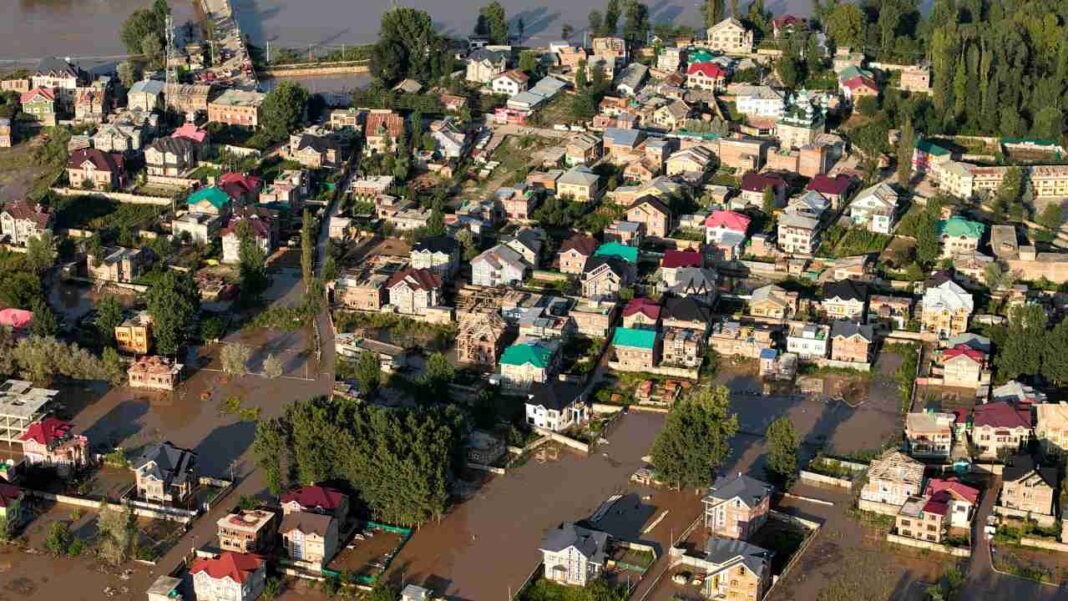

A new study warns that coastal flooding will threaten many more people in the UK over the coming decades. By the year 2100, at least half a million extra people could be at risk. That is a jump of about 25% compared with today.
The research comes from the Met Office and the University of Bristol. It is the first study to work out, in detail, how many people across the UK could be affected by rising seas in the future.
Even if countries stick to their current climate pledges, the numbers keep climbing. An estimated 1.4 million additional people in the UK are anticipated to be at risk of coastal flooding by 2200. By 2300, that number grows to 1.7 million. The findings appear in the journal Nature Communications.
Matt Palmer led the study. He works as a climate scientist at the University of Bristol’s Cabot Institute for the Environment and also holds a role at the Met Office. Palmer explains that oceans and ice sheets react very slowly to a warming planet. Because of these factors, sea levels will keep rising for hundreds of years, regardless of what we do now. He calls the phenomenon the “sleeping giant” of climate change.
He says the study shows just how big the challenge of adapting will be. But he also stresses that cutting emissions now can still help avoid the worst outcomes. Global cooperation, like the commitments made under the Paris Agreement, matters here. While it won’t completely halt sea-level rise, it can mitigate its impact.
Around UK coastlines, sea levels are expected to rise by 0.4 to 0.6 metres by 2100. That alone would push coastal flood risk zones up by 13%. Looking further ahead, to 2300, the rise could triple, reaching between 1.2 and 1.8 metres. At that point, flood-prone areas would grow by more than half, a 56% increase.
To reach these numbers, the team combined UK-specific sea-level forecasts from the IPCC with a detailed flood model built by Fathom, a Bristol-based flood modelling company. Together, these tools let researchers test many different sea-level scenarios and estimate how many people would be affected in each one.
Dr James Savage from Fathom, who worked on the study, points to low-lying regions as the most vulnerable. The Wash and the Humber Estuary came up as major hotspots in nearly every scenario the team tested. The study also looked at a more extreme, and more uncertain, possibility. This scenario factors in the risk of ice sheets collapsing faster than expected. Under this outcome, UK sea levels could rise by more than 15 metres by 2300.
That kind of rise would be devastating. Critical infrastructure, including the M25 motorway and London’s financial district, would be at serious risk. Wide stretches of west and north London could sit under a metre of water during a major flood event.
Because of this uncertainty, the researchers say ice sheets need close, ongoing monitoring. Catching early warning signs would give governments more time to prepare for faster, more severe sea-level rise.
Jeffrey Neal, a hydrology professor at Bristol and chief scientific advisor at Fathom, spoke candidly. He warned that the worst-case outcomes could eventually force large numbers of people to relocate away from the coast entirely.
But he also offered a note of hope. Neal stated that these extreme scenarios are not predetermined. Strong, coordinated global action to cut emissions, in line with the Paris Agreement, could still steer the world away from the worst possible future. The message from the study is clear. Some sea-level rise is already locked in. However, the extent of the worsening is still largely dependent on our actions.