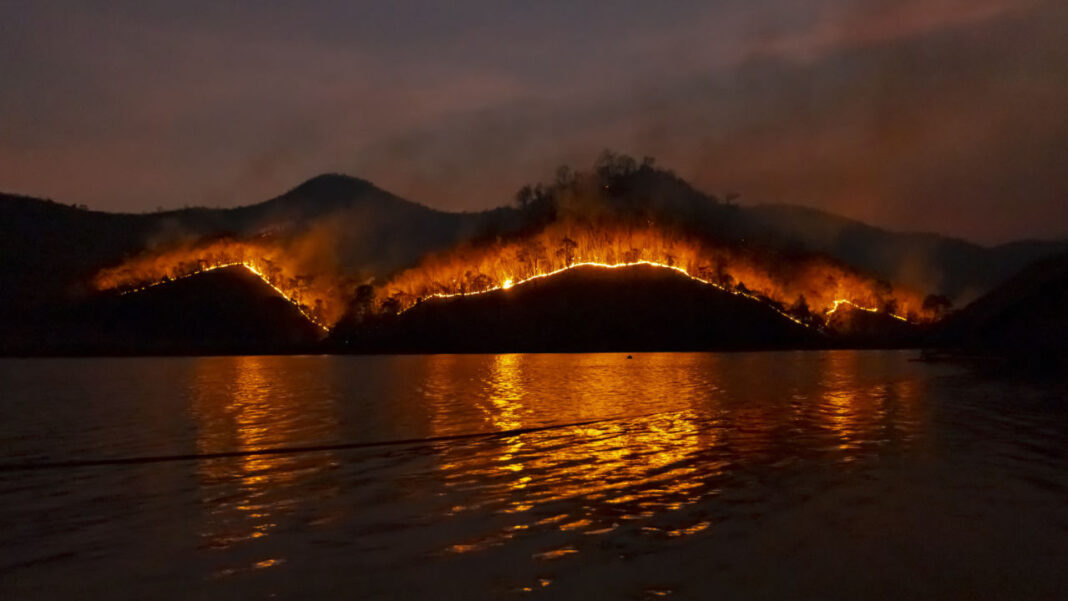

Environment (Commonwealth Union) – Wildfires are well known to cause environmental hazards well across there local boundaries. Singapore has been frequently impacted by wildfires from Indonesia and Malaysia.
Recently the flames were hundreds of miles away, wildfires in Canada have become a recurring disruption for New York State.
The effects have included air quality warnings and increased hospital visits linked to asthma-related problems.
Now, researchers at the University at Buffalo (UB) have uncovered another impact: a decline in sightings of dozens of bird species across the Empire State.
A study published earlier this month in Biodiversity and Conservation, a journal from Springer Nature, revealed that 40 bird species were less frequently detected in New York as concentrations of fine particulate matter (PM2.5) rose during recent breeding periods. The research examined multiple breeding seasons, including 2023, which coincided with Canada’s most severe wildfire season on record.
“Our results show a link between wildfire smoke and the probability of observing particular bird species,” explains corresponding author Festus Adegbola, who is a PhD candidate in the Department of Geography, within the UB College of Arts and Sciences. “Wildfire smoke is often underexplored when monitoring biodiversity. Failing to account for air quality may bias models of species distributions and abundance.”
Researchers began by examining PM2.5 concentrations — a major indicator of wildfire-related air pollution — during New York’s breeding seasons from 2021 to 2023. The most severe pollution levels were recorded in 2023, when smoke from Canada’s record-breaking wildfires spread across New York and significantly affected air quality during June and July. On several occasions, PM2.5 levels surpassed the limits recommended by the World Health Organization, rising to as much as eight times the advised threshold.
The scientists then contrasted the air quality data with almost 99,000 birdwatching records submitted to Cornell University’s eBird platform. Operated by the Cornell Lab of Ornithology, the citizen science initiative enables bird enthusiasts to document the species they encounter, forming one of the largest global databases of bird sightings.
Taking into account that eBird observations are given by birdwatchers with various levels of expertise, Scientists at the University at Buffalo made use of detailed data screening methods and advanced statistical approaches to enhance the precise nature and reliability of their results.
Overall, the study examined 84 bird species using nearly 99,000 eBird checklists gathered from locations throughout New York during the three most recent breeding seasons.
About half of the bird species examined became harder to detect as PM2.5 concentrations increased. The affected species included numerous migratory woodland songbirds, including warblers, thrushes and vireos.
Adegbola indicated that smoky conditions may have altered bird behavior — causing them to sing and move less, or spend more time hidden within thick forest canopies — which could have made them more difficult to spot.
In contrast, 15 species showed a higher likelihood of being observed as PM2.5 levels climbed, while 29 species experienced no notable change in detection rates. Many of these birds were aerial insect hunters or species linked to wetland habitats.
However, the researchers caution that this does not mean wildfire smoke had a positive effect on those species.
The study co-author Adam Wilson, PhD, an associate professor of geography and adviser to Adegbola indicated that many of these species tend to live in more open habitats compared with forest-dwelling songbirds. As a result, their higher detection rates during smoky periods may have been influenced more by changes in where birdwatchers looked for birds rather than by the birds’ own behavioral responses.
The researchers emphasize that a drop in bird observations during periods of heavy smoke does not automatically indicate a decline in bird numbers. Instead, the birds may have become more difficult to spot. Recognizing this difference is essential for accurate biodiversity assessments, helping scientists avoid confusing short-term changes in visibility with actual population losses.