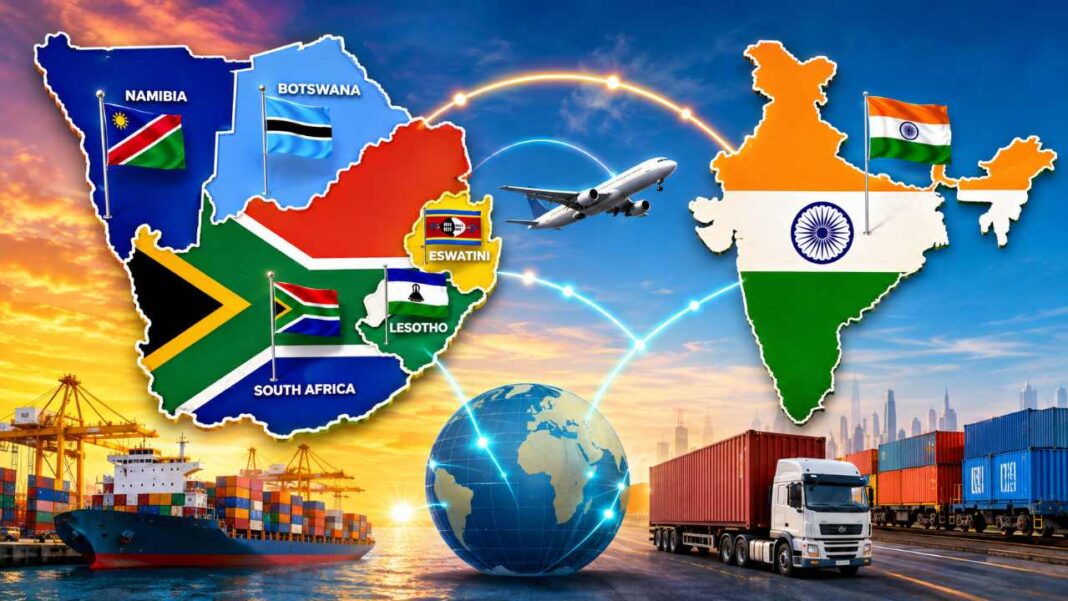

India & the 5-member Southern African Customs Union (SACU) signed Terms of Reference (ToR) on Wednesday, 12 August ’26, to commence talks on a Preferential Trade Agreement (PTA). This is as New Delhi seeks to lower tariffs on exports, including cars and pharmaceuticals, besides industry machinery.
This move revives talks between India and the SACU, which comprises South Africa, Botswana, Namibia, and Lesotho besides Eswatini. It comes after 5 previous rounds of unsuccessful negotiations over the 8-year period spanning ’02 & ’10 that ended without a deal.
The pact may become India’s first major trade agreement with an African regional bloc. It gives Indian enterprises preferential access to a market of about 65 million people. This is while helping SACU members expand exports to the world’s fastest-growing major economy.
The ToR set the scope and objectives as well as procedures for the negotiations. Unlike a comprehensive free trade agreement (FTA), a preferential trade pact typically cuts duties on an agreed-upon list of products. It is less likely to cover services, investment or intellectual property.
The talks come as South Africa considers increasing duties on automobiles from India & China to 50% from the current 25%. This threatens a key Indian export.
Executive director at Namibia’s Ministry of International Relations & Trade, Ndiitak Nghipondoka Robiati, said that the terms may guide negotiators towards a balanced, mutually beneficial & development-orientated agreement. This was said after signing the agreement with an additional secretary at India’s trade ministry, Yashvir Singh.
India’s Trade Minister, Piyush Goyal, said he was confident that SACU countries & India may benefit immensely from a fair, equitable & balanced agreement. He added that he hoped to finalise it in the coming months.
Trade officials, along with industry representatives, asserted that India is expected to seek duty concessions for automobiles, as well as for auto parts, pharmaceuticals, machinery, electrical equipment, chemicals, and textiles.

Automobiles & auto parts were India’s 2nd-largest export category to SACU. This was after petroleum products moved with shipments worth USD 1.7 billion during the fiscal year ended March ’26.
India’s exports to SACU totalled USD 7.5 billion in ’25/’26. During this period, imports from SACU amounted to USD 9.2 billion. South Africa accounted for most of the trade. The trade balance was with Indian exports of USD 7 billion, besides imports of USD 8.5 billion.
New Delhi’s also seeking more reliable access to SACU supplies of critical minerals. This includes platinum-group metals, manganese & copper. These are important for manufacturing batteries besides clean energy technologies.
A broader push to diversify trade and strengthen supply-chain resilience between the two regions is also driving the renewed negotiations. The proposed arrangement may therefore provide benefits beyond tariff reductions. Also, creating greater certainty for enterprises planning investment and manufacturing as well as distribution operations across India, besides Southern Africa.
The talks nevertheless face potentially sensitive negotiations over market access, tariff concessions & the treatment of protected industries. South Africa’s consideration of higher automobile import duties on vehicles from India, besides China, highlights the commercial pressures that could complicate progress. Even so, officials on both sides have expressed confidence that the new framework can deliver a balanced and development-orientated agreement.
With negotiations expected to begin by September ‘26 & officials aiming to conclude them within a year, the revived India-SACU process now has a defined timetable. If successfully completed, the preferential trade agreement may become an important platform for expanding South-South commerce, attracting investment and connecting Indian businesses more deeply with the wider African market.
With the ToR now signed, both sides can focus on reducing tariffs, improving market access and expanding investment across automobiles, pharmaceuticals, machinery and critical minerals. If negotiators can overcome the obstacles that stalled earlier rounds, the proposed Preferential Trade Agreement could create a more predictable trading environment, strengthen supply chains and deliver broader benefits to businesses across the five SACU economies and India.