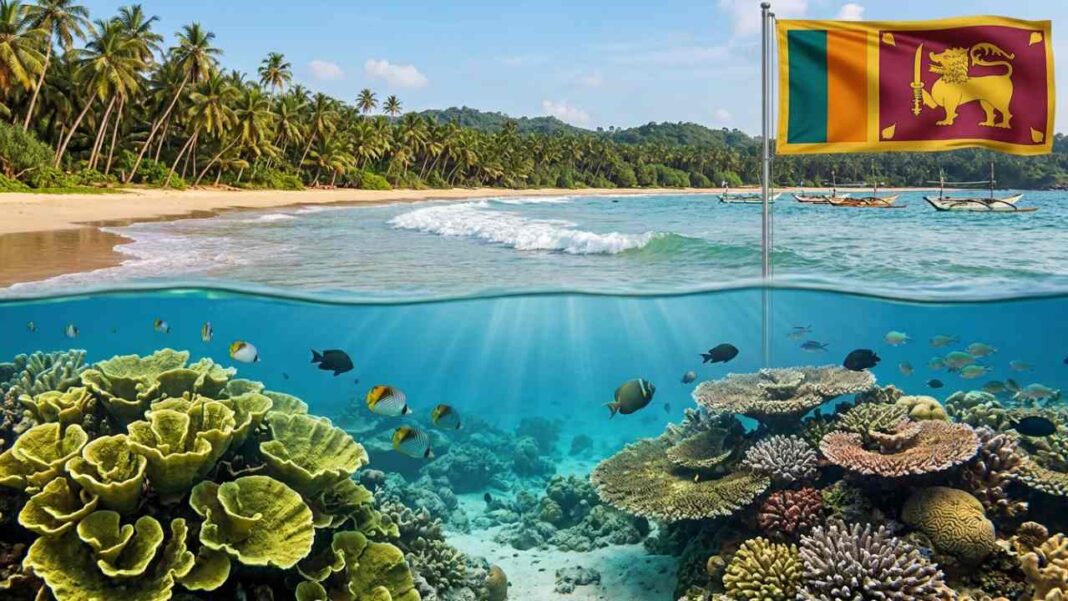

Sri Lanka (Commonwealth Union)_ Coral reefs in Sri Lanka are more than just colorful underwater attractions. They are important natural systems supporting marine life, fisheries, tourism and coastal communities. They also help protect shorelines by weakening the force of waves before they reach land. Accordingly, with 245 coral species identified recently along the eastern coast, the country has a valuable marine ecosystem that is increasingly under pressure from climate change and human activity. Hence, efforts to protect this natural resource are being strengthened with the construction of a Coral Conservation Center and Laboratory in Nilaveli, Trincomalee. The facility is expected to improve the country’s ability to conserve threatened coral species, support restoration work and expand research into marine ecosystems.
Also read: Why is China betting big on BRICS? Chinese President Xi’s India visit sends a global signal!
Deputy Environment Minister Anton Jayakody inspected the facility this week as construction continued under a national programme aimed at protecting Sri Lanka’s coastal and marine environment. The centre will give particular attention to rare species such as Black Coral and Red Coral. Conservation and artificial propagation programmes for these corals have already begun, and officials say the early results have been encouraging. The laboratory is being designed to reproduce the temperatures and other environmental conditions corals need to survive and grow. Corals raised in controlled conditions can later be moved to suitable areas of the seabed to help restore damaged reefs. Construction is expected to be completed by the end of September.
Also read: Bangladesh gets new president: BNP veteran Mirza Fakhrul sworn in as 23rd president of Bangladesh!
The facility is also planned to develop into a Coral Museum and Research Centre. It could provide opportunities for university students, researchers and members of the public to learn more about coral ecosystems. Research carried out there could also help improve restoration methods and provide a better understanding of how Sri Lanka’s reefs respond to environmental changes. The need for such work is becoming increasingly urgent. Rising sea temperatures are threatening coral reefs around the world, causing coral bleaching. Bleaching is when corals lose the tiny algae that live in their tissues and provide most of their energy. When bleaching is prolonged or severe, corals can die. However, climate change is not the only concern. Pollution, overfishing, destructive fishing practices, sedimentation, coastal construction and physical damage can also weaken reefs and reduce their ability to recover from environmental shocks.
Restoration programmes can help damaged reefs recover, but they cannot solve the wider problem alone. Scientists have repeatedly stressed the importance of reducing local pressures while addressing the larger challenge of global warming. Also important are the protection of water quality, the responsible management of coastal development and the prevention of destructive activities. For Sri Lanka, the health of coral reefs has ramifications beyond marine biodiversity. Coastal fisheries rely on healthy reef habitats while destinations like Trincomalee, Nilaveli and Pigeon Island profit from their natural beauty. Communities linked to the sea for their livelihoods can also be affected by the decline of marine environments.
The new conservation center will not stop ocean warming or coral bleaching. But it could give Sri Lankan scientists and conservation officials another important tool to protect vulnerable species, restore damaged reefs and study a changing marine environment. Plans for similar initiatives elsewhere in the country could add to these efforts. For an island nation closely associated with the ocean, protecting coral reefs is not just a matter of preserving underwater beauty. It is about protecting food security, livelihoods, tourism and the resilience of Sri Lanka’s coastline for the future.