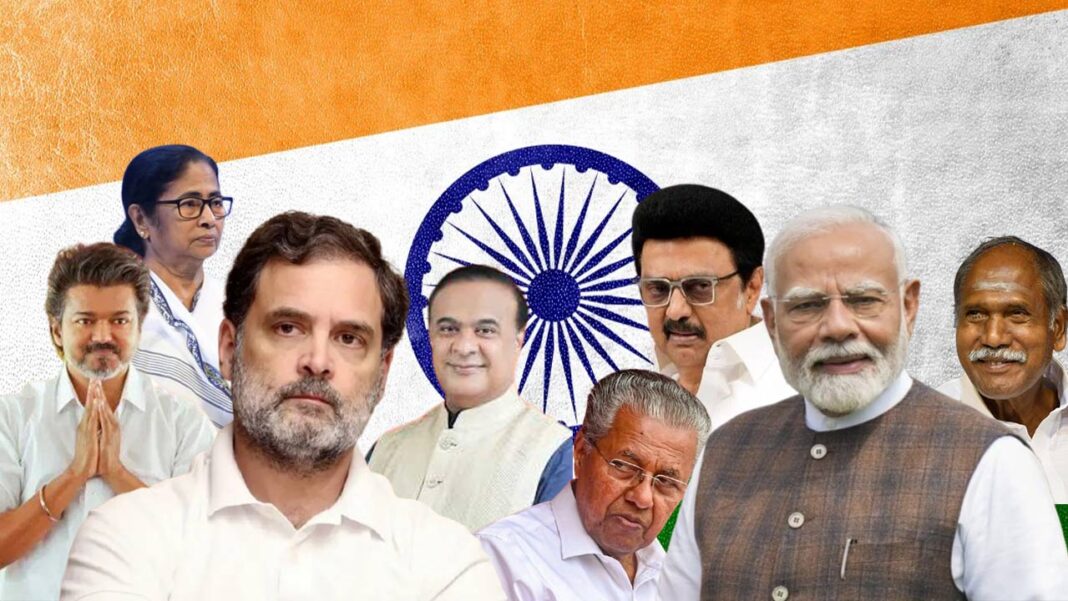

India (Commonwealth Union)_ India’s latest round of state assembly elections has made sweeping political changes across several key regions, with shocking results that could shape the country’s political direction in the years ahead. Accordingly, more than 154 million voters participated in polls held across Assam, West Bengal, Tamil Nadu, Kerala, and the union territory of Puducherry. The scale alone makes it one of the largest democratic exercises outside a national election.
At the center of the outcome is a stronger position for Prime Minister Narendra Modi and his party, the Bharatiya Janata Party (BJP). The overall results suggest a growing national tide of support for the BJP, with opposition parties continuing to lose ground in some places where they were once strong. But the elections also show that Indian politics remains diverse and unpredictable and that regional factors still matter. Here is a closer look at what happened in each state and who emerged victorious.
Also read: New power shift in Tamil Nadu as Vijay’s TVK redraws the political map with highest seats!
West Bengal – A historic win for the BJP
West Bengal delivered one of the most dramatic results of this election cycle. For decades, the state has resisted national party dominance, maintaining a strong regional political identity. After years under Congress rule, followed by over three decades of Left Front governance, the state had been led by Mamata Banerjee and her Trinamool Congress for the past 15 years. However, this time, the long-standing pattern was broken. The BJP won with an overwhelming majority of 206 out of 294 seats. This is an incredible rise for the party which had only a few seats in the state a decade ago. The result effectively ends Banerjee’s long reign and signals a big change in the mood of the electorate.
Additionally, there was a huge voter turnout of more than 92 percent, showing strong public participation. The result is not only a victory for the BJP, but a huge erosion of one of the country’s most prominent regional leaders. West Bengal, once seen as a stronghold against the BJP’s expansion, has now firmly been brought under its political fold. The result also raises broader questions about electoral processes, as concerns were reported over revisions to voter rolls. Still, the scale of the BJP’s victory leaves little doubt about the magnitude of change in the state.
Also read: West Bengal Election: Modi’s BJP Claims Landmark Victory in West Bengal!
Assam – BJP retains the power
In Assam, the outcome was far less surprising but equally significant. The BJP and its allies remained in a comfortable majority and strengthened their position in the northeastern region. As such, Chief Minister Himanta Biswa Sarma will continue for another term after the ruling alliance performed well. The BJP alone secured 82 seats in the assembly, and the alliance crossed the 100-seat mark. The election witnessed a voter turnout of over 85 percent, indicating continued popular support for the incumbent government. For the first time in Assam, the incumbent alliance crossed the 100-seat mark, reflecting the magnitude of the victory. The result also confirmed that the BJP has established itself in the northeast, a region where it had little presence in the past. Rather than a wave of change, Assam’s election reflects stability and continued voter confidence in the current leadership.
Tamil Nadu – A political disruption
Tamil Nadu delivered the most unexpected outcome of all. The clear winner was a relatively new political party, Tamilaga Vettri Kazhagam, led by actor-turned-politician Joseph Vijay Chandrasekhar, which won 108 of the 234 seats, a remarkable feat for a movement that is only two years old. This result is historic for another reason. For the first time since 1967, Tamil Nadu will be governed by a party that is not rooted in the Dravidian political tradition. For decades, Dravidian parties have been the dominant force in the state’s politics, shaping its social and cultural identity.
Both major Dravidian parties lost around 13 percent each in their vote share. The BJP won only a single seat, reflecting its lack of clout in the state. Vijay’s win is mainly attributed to his strong personal appeal and popularity among voters. His campaign strategy was largely image-driven, with messaging focused on trust in his leadership rather than individual candidates. Tamil Nadu’s result shows that even deeply entrenched political systems can be disrupted when a new force captures the public’s imagination.
Also read: Stardom meets the ballot: Top stars step into the polling booth!
Kerala – The end of left rule
Kerala’s election marks the end of a significant chapter in India’s political history. The Left Democratic Front (LDF), led by Pinarayi Vijayan, has lost power in the state. The Congress-led United Democratic Front (UDF) secured a clear majority, winning 102 out of 140 seats, while the Left was reduced to just 35. Voter turnout was close to 80 percent, reflecting steady participation. This result is particularly notable because it leaves India without a single Left-ruled state government for the first time in decades. Kerala is the last major bastion of Left politics in the country, and its history includes the world’s first democratically elected communist government. The change signals a wider decline of Left influence in Indian politics and strengthens the Congress party’s position in the opposition space.
Puducherry – BJP continues
In Puducherry, a smaller but strategically important union territory, the BJP-led alliance retained power. While the scale of the election here is much smaller compared to the states, the result contributes to the overall national picture. It shows that the BJP continues to maintain its presence not just in large states but also in smaller regions where coalition politics plays a key role.
A shifting political journey
The overall results of these five regions show a fast-changing political scenario. The BJP has massively expanded its footprint, particularly with its breakthrough in West Bengal and sustained strength in Assam and Puducherry. These victories solidify its national position and enhance its clout in the run-up to future elections. Meanwhile, opposition parties are increasingly struggling to keep up. The outcome is more a matter of continuity than change and helps the party’s overall electoral stability. Some of the major regional leaders, who were once big counterweights to the BJP, have been weakened or lost their grip, including Mamata Banerjee’s loss in West Bengal and the decline of Dravidian parties in Tamil Nadu.
But the elections also show that Indian politics remains complex. The rise of a new force in Tamil Nadu shows that voters are still open to alternatives, especially when they feel estranged from mainstream parties. The Kerala result provides some hope for the Congress, but the opposition remains divided and directionless. These elections reveal two simultaneous trends: the BJP continues to gain strength at the national level, but regional politics remains highly fluid. The alliances that once appeared to be strong are now struggling to hold together and, in some cases, to lead. The interplay of these two forces will be important in shaping India’s political future in the years to come.