
Science & Technology (Commonwealth Union) – Microscopy played a revolutionary role in the world of science by moving from the world of the invisible to the visible. The work of Antony van Leeuwenhoek from the Netherlands who was not particularly from what is generally considered a scientific background was crucial in the world of microscopy in the 1600s.
The publication of Robert Hooke’s book Micrographia published in 1665 was said to be key in opening the world of the invisible to the public.
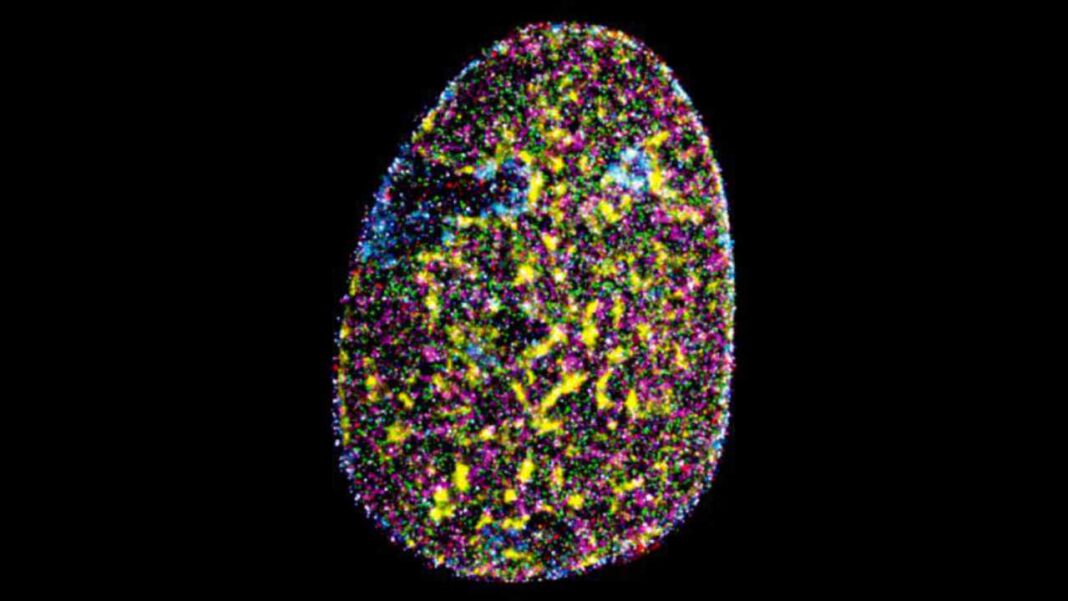
Scientists at the Indian Institute of Science (IISc) have deployed a cutting-edge microscopy method to simultaneously observe multiple biomolecules within the nucleus of a cancer cell at extremely high resolution. Among the targets imaged were key elements of the cell’s transcription machinery as well as proteins that help maintain nuclear structure—offering one of the earliest comprehensive maps of how the nucleus is organised.
The human body contains trillions of cells, each functioning as a highly complex network of proteins, nucleic acids, and other essential molecules that sustain cellular health. According to Mahipal Ganji, Assistant Professor in the Department of Biochemistry and corresponding author of the study published in Nature Communications, developing new tools to visualise numerous biomolecules within single cells is essential for advancing biological research. Traditional imaging approaches, however, typically allow scientists to observe only two or three biomolecules at a time.
To overcome this limitation, the team used a technique known as DNA-Points Accumulation for Imaging in Nanoscale Topography (DNA-PAINT). This method enables ultra-detailed imaging far beyond the capabilities of conventional microscopes. It works by using short, fluorescent DNA strands that temporarily bind to specific molecular targets, emitting brief flashes of light when illuminated by a laser.
By assigning distinct DNA tags to different cellular components, researchers can track and reconstruct highly precise images of minute structures. Despite its promise, previous applications of this method were restricted to tracking just a few molecular targets at once. As noted by Micky Anand, a PhD student and co-first author of the study, conventional techniques are limited in scope, and expanding this capacity would unlock much deeper insights into the organisation and function of cells.
In this study, the IISc researchers introduced several key enhancements to DNA-PAINT. They developed tagging systems capable of attaching to 12 different targets at once—five of which showed faster and more durable binding, enabling crisper images with resolution down to 3–5 nanometres. Because these tags bind more strongly, the technique requires less laser energy to visualise biomolecules, which in turn minimises damage to both the DNA tags and the cells.
The team also dramatically accelerated the imaging process. Earlier versions of DNA-PAINT could take hours to capture just a single biomolecule, but with the improved method, researchers were able to image nine distinct targets in under four hours.
Additionally, the technique made it possible to track how cells reorganise proteins and other biomolecules when a key process such as transcription is disrupted.
“Understanding how protein distributions change in diseased cells could open up new ways to detect illness before symptoms appear,” explained Abhinav Banerjee, who is a BC PhD alumnus, now a postdoctoral researcher at the Janelia Research Campus (HHMI) as well as the co-first author of the study. “By mapping the precise locations of diverse biomolecules at the nanometer scale, we can begin to uncover how they interact with one another and how these relationships are altered in disease.”
As proteins are a key component of every cell understanding its distribution will be an essential component in life science. Changes are alterations in proteins can play a key role immunology in detecting new conditions in cells.