
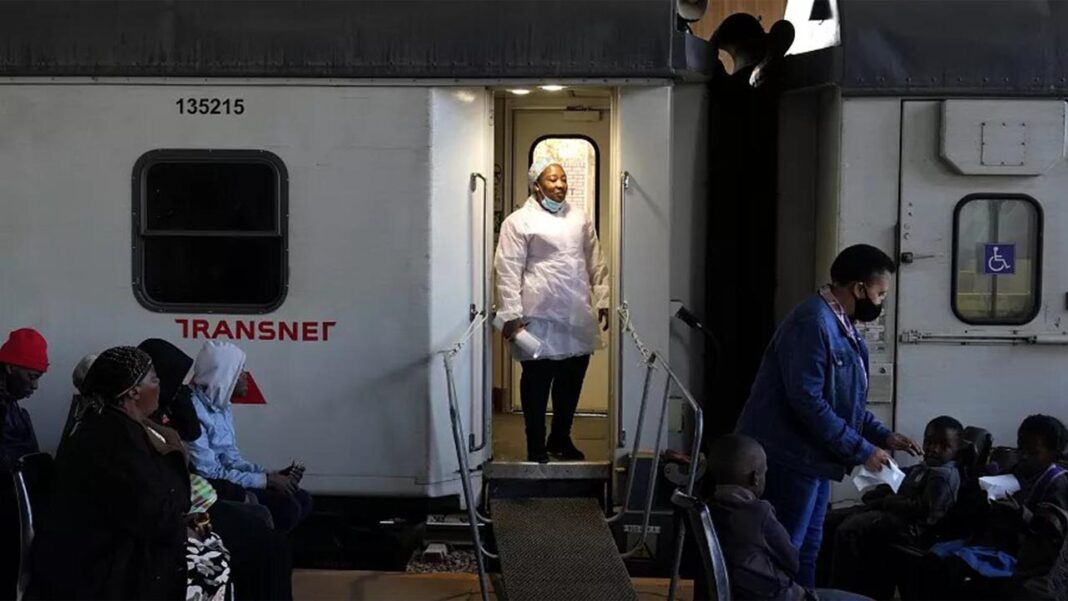

Africa (Commonwealth Union) _ For the past three decades, the Phelophepa train has traveled across South Africa, delivering free medical care to both young and old residents in remote communities. The health train has grown significantly since its inception, expanding from a modest three-carriage operation to two comprehensive 16-carriage trains.
The Phelophepa train is a lifeline for those who struggle to access healthcare due to overcrowded or distant local clinics. In Tembisa, a township east of Johannesburg, patients are lining up to receive care. Thabang, one of the patients, shared, “I’ve been suffering a lot from my eyesight. I heard about this train coming to assist people. They take around 150 people per day, and some of us even sleep here because we live far away.”
The care provided by the Phelophepa train is a stark contrast to South Africa’s overburdened public health care system, upon which approximately 84% of the population relies. The country’s healthcare system reflects the deep inequalities within the nation, where only 16% of South Africans are covered by health insurance, a luxury out of reach for many in a country grappling with over 32% unemployment.
Alongside healthcare professionals, the Phelophepa train carries managers, translators, and security staff, all coordinated by the Transnet Foundation, the social responsibility arm of Transnet, South Africa’s state-owned railway company.
When the Phelophepa train first launched in 1994, many Black South Africans were still living in rural villages with limited access to health facilities. Initially operating as an eye clinic, the train soon expanded its services as it became evident that the need was far greater.
Today, the two trains serve the rapidly growing populations of South Africa’s capital, Pretoria, and nearby Johannesburg, the nation’s economic center. Each train can spend up to two weeks in locations like Tembisa, addressing the immediate healthcare needs of the community.
However, while the Phelophepa train provides vital services, it is far from a comprehensive solution to South Africa’s healthcare challenges. Public health expert Alex van den Heever noted that since the first democratic government took power in 1994, there have been significant increases in healthcare budgets and the employment of nurses and doctors in the public sector. Nonetheless, much work remains to be done to improve healthcare access and equity in South Africa.


